ETFs vs Managed Funds Australia 2026: Which Delivers Better Returns?
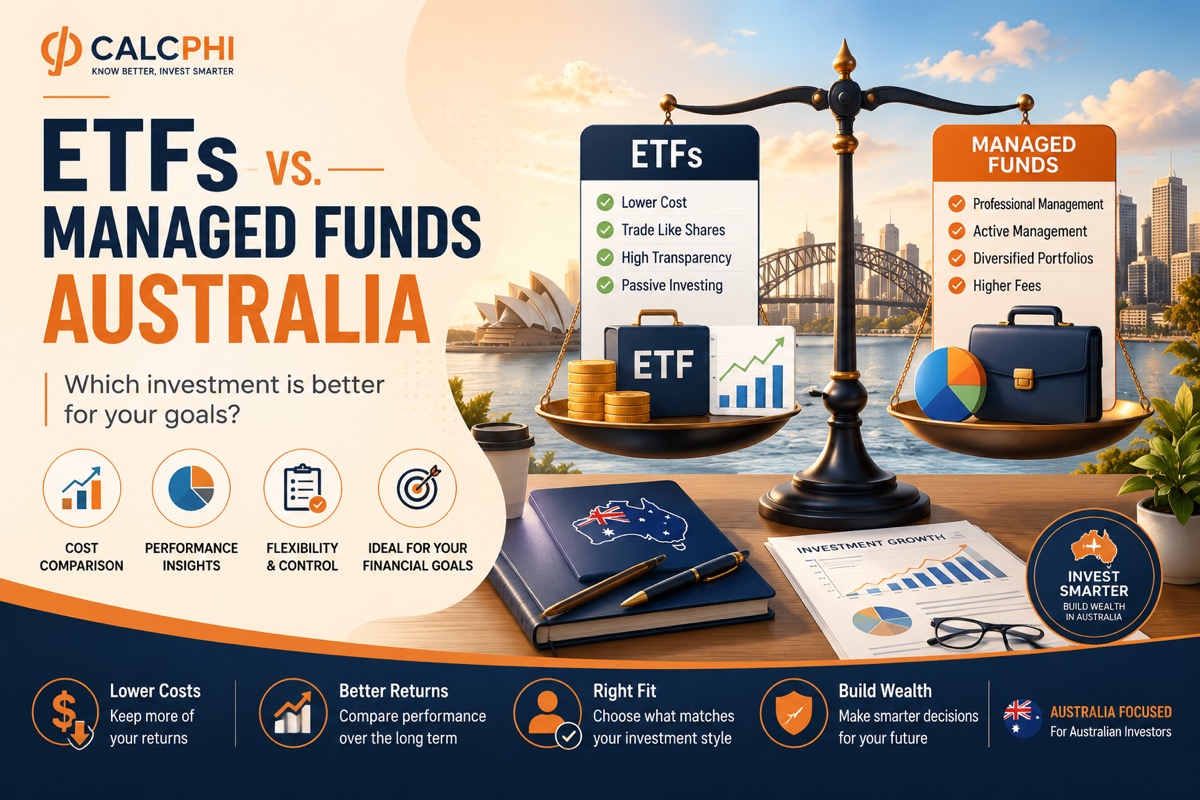
Both ETFs (Exchange-Traded Funds) and managed funds pool investor money into a diversified basket of assets — but they differ significantly in how they are structured, how much they cost, and how they perform. The average ETF management expense ratio (MER) in Australia sits at around 0.47–0.54% per year, with some index ETFs charging as little as 0.03–0.07%. Actively managed funds typically charge 0.80% to 1.5% or more. Compounded over 20 years, that fee gap costs the average investor over AUD $72,000 on a $100,000 starting investment — even before accounting for the fact that fewer than one in five active managers beat their benchmark after fees.
What Is an ETF and How Does It Work?
An ETF is a type of managed fund that trades on a stock exchange — in Australia, typically the ASX (Australian Securities Exchange) or Cboe Australia. You buy and sell ETF units through a broker or trading platform, the same way you would buy shares in BHP or Commonwealth Bank. Prices change throughout the trading day in real time.
Most ETFs are passively managed, meaning they simply track an index — for example, the S&P/ASX 200, the MSCI World Index, or the NASDAQ-100 — without any human fund manager picking stocks. Because there is no active management team to pay for, the fees are typically very low. Popular Australian ETFs include VAS (Vanguard Australian Shares Index ETF, 0.07% fee), VGS (Vanguard MSCI Index International Shares ETF, 0.18% fee), and VDHG (Vanguard Diversified High Growth ETF, 0.27% fee). These are widely used as core portfolio holdings because they provide instant diversification at minimal cost.
What Is a Managed Fund and How Does It Work?
A managed fund pools your money with other investors and hands it to a professional fund manager who makes decisions about what to buy and sell. Unlike ETFs, most traditional managed funds are not listed on the ASX — you invest through the fund manager directly, through a financial adviser, or via an investment platform.
Pricing works differently too. The unit price for a managed fund is typically calculated once a day after the market closes, so you cannot see real-time prices during the day. There is also usually a minimum investment amount, which can range from AUD $1,000 to $25,000 depending on whether you are accessing retail or wholesale units.
Managed fund MERs range from around 0.15% for low-cost index versions (such as Vanguard's unlisted Australian Shares Index fund) all the way to 1.5% or more for actively managed equity funds. The higher the fee, the harder the fund manager has to work just to break even against a passive benchmark.
The Fee Gap: Why It Matters More Than You Think
The fee difference between ETFs and managed funds might seem small in dollar terms today, but compounded over 10 to 20 years, it becomes the single biggest driver of the gap in your final balance. Consider two investors who each put AUD $100,000 into Australian equities and earn the same gross return of 8% per year for 20 years:
- Investor A uses an ETF with a 0.10% fee — ends up with approximately AUD $454,000
- Investor B uses an actively managed fund with a 1.20% fee — ends up with approximately AUD $382,000
That is a difference of over AUD $72,000 — purely from fees, on the same underlying return. The fund manager would need to consistently outperform the market by more than 1.1% every single year just to match the ETF result. Historically, very few active managers have achieved this over long periods.
Do Active Managed Funds Actually Beat the Market?
Research consistently shows that fewer than one in five Australian equity fund managers benchmarked to the S&P/ASX 200 Accumulation Index manage to beat their benchmark after fees over a 3 to 5 year period. In some years, fewer than one in ten outperform.
The reason is straightforward. Markets are reasonably efficient, meaning that share prices already reflect most publicly available information. For a manager to beat the market, they need to be consistently right in ways that other professional investors are consistently wrong. Over short periods, luck can make this appear possible. Over 10 or 20 years, it becomes extraordinarily rare.
There are exceptions. Some niche active strategies — such as small-cap Australian equities, certain global credit mandates, and alternative assets — have shown genuine persistent alpha (return above the benchmark). But these often come with much higher fees and minimum investment thresholds that put them out of reach for most retail investors.
ETF Returns in Australia: What the 2026 Data Shows
As of the first quarter of 2026, the average ETF return across the ASX over one year has been approximately 14.74% per annum, and over three years, approximately 13.37% per annum. These are net of fees, meaning the fund manager's costs have already been deducted.
The top-performing ETFs over five years have delivered annualised returns above 27% — largely driven by technology and precious metals exposure — though past performance does not guarantee future results. For most long-term investors, a broad index ETF targeting 7–10% average annual returns over a decade is a more realistic planning assumption than chasing the best performer of last year.
Tax Treatment: ETFs vs Managed Funds in Australia
Both ETFs and managed funds are subject to Australian income tax on distributions (dividends, interest, and net capital gains) and Capital Gains Tax (CGT) when you sell your units. But there are some practical differences worth understanding.
With a managed fund, the fund manager may realise capital gains throughout the year when they sell underlying holdings to rebalance the portfolio. These gains are passed on to all investors in the fund — even if you did not sell any of your units yourself. This can create an unexpected tax bill in a high-turnover active fund. With most passive ETFs, trading within the fund is minimal, so internal capital gain distributions tend to be lower.
Both structures benefit from the 50% CGT discount if you hold your units for more than 12 months before selling. If you sell at a gain after 12 months, only half of that gain is added to your taxable income for the year.
For investors using Australian shares ETFs or managed funds, franking credits are another important consideration. Many Australian companies pay fully or partially franked dividends, and these credits flow through to investors in both ETFs and managed funds to offset your tax liability.
If you are holding ETFs or managed funds inside superannuation, gains and income are taxed at a flat 15% in the accumulation phase — one of the most tax-efficient investment structures available to Australians.
Accessibility and Flexibility: A Practical Comparison
Minimum investment is one area where ETFs win clearly for new investors. Because ETFs trade like shares on the ASX, you can start with as little as the cost of one unit — often between AUD $50 and AUD $200 for a major index ETF. Managed funds, particularly wholesale or institutional class units, often require AUD $1,000 to $25,000 upfront.
Transaction costs are another nuance. ETFs require you to pay brokerage each time you buy — typically AUD $0 to $10 per trade depending on your broker. If you are making small regular contributions (say, AUD $200 per fortnight), that brokerage can erode your cost advantage over a managed fund that allows automatic contributions with no transaction fee.
Transparency and real-time pricing favour ETFs. You can check your investment's value at any moment during ASX trading hours, the same way you would check a share price. Managed funds typically reprice once a day, after market close.
Which One Is Right for You?
For a long-term buy-and-hold investor — someone building wealth for retirement over 20 or 30 years — the fee advantage of index ETFs almost always wins. The compounding effect of lower costs, combined with broad diversification, is very difficult for active managers to overcome consistently.
For investors who want access to niche asset classes (such as private credit, unlisted infrastructure, or specialist global equity strategies), managed funds may offer exposure that is not yet available in an ASX-listed ETF format.
For SMSF trustees, both structures work well, but ETFs are particularly convenient because they are held and priced like shares, simplifying record-keeping and compliance.
The honest answer is that most Australian investors are best served by a core of low-cost index ETFs, potentially supplemented by a small position in actively managed funds if there is a specific strategy or asset class you cannot access cheaply through an ETF.
Quick Comparison: ETF vs Managed Fund
| Feature | ETF | Managed Fund |
|---|---|---|
| Traded on ASX | Yes | Usually no |
| Average fee (MER) | 0.04%–0.54% | 0.15%–1.5%+ |
| Real-time pricing | Yes | Once daily |
| Minimum investment | ~$50–$200 | $1,000–$25,000 |
| Brokerage per trade | $0–$10 | Usually none |
| Capital gain distributions | Generally lower | Can be higher |
| Access to niche strategies | Growing | Broader range |
| SMSF compatible | Yes | Yes |

Frequently Asked Questions
-
Are ETFs better than managed funds in Australia?
For most long-term investors, ETFs offer a better outcome due to significantly lower fees and consistent market-tracking performance. Research consistently shows that fewer than one in five actively managed Australian equity funds beat their benchmark after fees over three to five years. The fee saving compounded over decades can result in tens of thousands of dollars more in your final balance.
-
What is the average return on ETFs in Australia in 2026?
Based on ASX data to early 2026, the average ETF in Australia has returned approximately 14.74% over the past 12 months and 13.37% per annum over the past three years, net of fees. These returns are influenced heavily by global equity markets and are not guaranteed to continue at this rate. Long-term planning assumptions of 7–10% per annum for diversified equity ETFs are more conservative and generally more appropriate.
-
Do managed funds outperform ETFs in Australia?
Over short periods, some active managed funds do outperform their benchmark. But over longer horizons of five to ten years, the majority of actively managed Australian equity funds underperform equivalent index ETFs after fees. The exceptions tend to be specialist or niche strategies in less efficient markets, such as small-cap equities or emerging market bonds.
-
How are ETFs taxed in Australia?
ETFs are taxed as managed investments in Australia. Distributions (including dividends and capital gain components) are taxed in the year they are received, at your marginal income tax rate. If you sell ETF units after holding them for more than 12 months, you are eligible for the 50% CGT discount — meaning only half the capital gain is added to your taxable income. Franking credits from Australian equity ETFs can also offset your tax liability.
-
Can I hold ETFs inside my super or SMSF?
Yes. ETFs can be held inside self-managed super funds (SMSFs) and many retail and industry super funds also offer ETF-based investment options. Inside superannuation, investment earnings and gains are taxed at a flat 15% in accumulation phase, making it one of the most tax-efficient ways to hold long-term investments.
-
What is the cheapest ETF available in Australia?
As of early 2026, the cheapest ETFs on the ASX by management expense ratio include the Vanguard US Total Market Shares Index ETF (VTS) and the Macquarie Core Australian Equity Active ETF (MQAE), both at 0.03% per annum. For broad Australian market exposure, the BetaShares Australia 200 ETF (A200) charges 0.07% per annum, and the Vanguard Australian Shares Index ETF (VAS) charges 0.10% per annum.
Use our Australia calculators:
Investment Returns Calculator → Compound Interest Calculator → Franking Credits Calculator → Super Balance Calculator →