Dollar Cost Averaging vs Lump Sum Investing: What the Data Says for Australian Investors
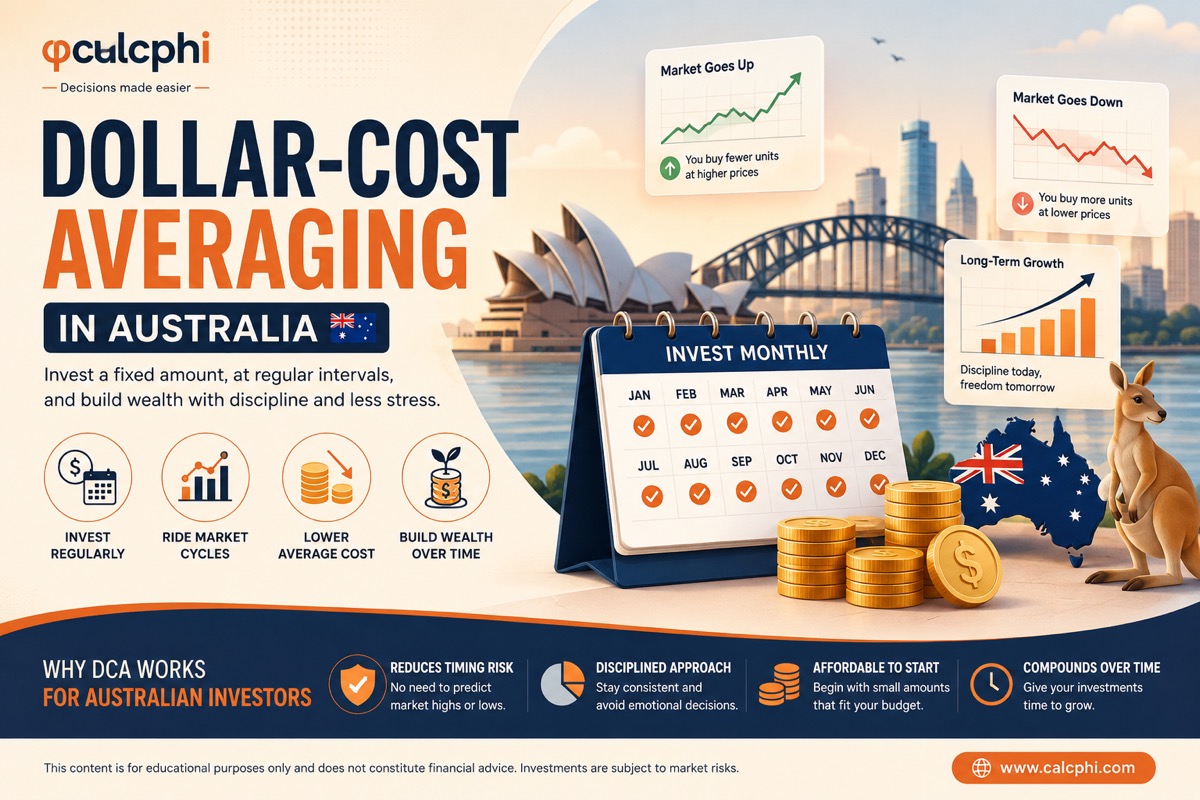
Dollar cost averaging (DCA) is the practice of investing a fixed amount at regular intervals — weekly, fortnightly, or monthly — regardless of current market prices. Lump sum investing means deploying all available capital at once. Vanguard's research found lump sum outperforms DCA approximately two-thirds of the time globally and around 60% of the time in the Australian market specifically, because markets tend to rise and cash sitting on the sideline earns less than invested capital. But for most Australians investing from a regular salary, the choice is largely academic — your superannuation contributions are already DCA by default.
What Is Dollar Cost Averaging?
Dollar cost averaging works by spreading purchases across time. Because you invest a fixed dollar amount — not a fixed number of units — you automatically buy more units when prices are low and fewer units when prices are high. Over time, this produces an average purchase price that is lower than the simple average of prices over that period.
A practical example: if VAS trades at $100 in January, $80 in February, and $90 in March, and you invest $300 per month, you purchase 3.0 units, then 3.75 units, then 3.33 units — a total of 10.08 units at an average cost of $29.76 per month. The simple average price was $90. Your DCA average cost was $89.28. The mathematics always works in this direction when prices fluctuate.
For most Australians, DCA is not a strategic choice — it is how investing naturally works when you invest from a salary. Every super contribution, every automated brokerage transfer, every salary sacrifice is DCA. The lump sum decision only arises when you have an inheritance, a redundancy payout, a property sale, or a large bonus to deploy.
What Is Lump Sum Investing?
Lump sum investing means committing your full available capital to the market on a single date. The logic is straightforward: if markets tend to rise over time, the sooner your capital is working, the better. Every day in cash is a day not compounding in the market.
The risk is equally straightforward: if markets fall significantly after your investment date, you have committed everything at the high. The fear of this outcome — even when statistically unlikely — is what drives most people to consider DCA as an alternative.
What the Data Actually Shows
Vanguard's widely cited study examined rolling 12-month investment periods across US, UK, and Australian markets and found lump sum investing outperformed DCA approximately two-thirds of the time globally. In the Australian market specifically, the figure was around 60% — slightly lower, reflecting the ASX's higher volatility compared to the US market.
Northwestern Mutual's research extended this analysis further and found lump sum outperformed DCA in 75% to 80% of historical periods studied, with an average outperformance margin of approximately 2.3% per year. The direction of the finding is consistent across all major studies: in a market that trends upward, deploying capital immediately captures more of that upward trend.
The key qualifier: lump sum only wins when you stay invested. An investor who puts in a lump sum and then sells during the next downturn does far worse than a DCA investor who kept buying through the decline. The statistical advantage of lump sum assumes the same investor discipline in both scenarios.
Australian Market Context
The ASX has returned approximately 9–10% per year including dividends over the long run, which is why lump sum tends to win — there is a meaningful opportunity cost to holding cash. But the ASX is also volatile enough that the 40% of cases where DCA wins are not trivial scenarios.
The GFC saw the ASX fall 37% from peak to trough. The COVID crash in early 2020 saw a 36% drawdown in roughly five weeks. An investor who deployed a lump sum immediately before either of those events would have experienced severe short-term paper losses — even though markets recovered and long-run lump sum investors came out ahead if they held.
The Australian market's concentration in financials and resources also creates sector-specific volatility that differs from more diversified global indices. A global ETF like VGS would have shown different DCA vs lump sum outcomes than an Australia-only index like VAS over the same periods.
Practical AUD Example: $60,000 to Invest
Assume you have $60,000 and the market returns 8% over the coming year.
| Strategy | Approach | End Value (8% year) | Difference |
|---|---|---|---|
| Strategy A — Lump Sum | Invest full $60,000 on day one | $64,800 | — |
| Strategy B — DCA | $5,000 per month over 12 months | ~$62,400 | −$2,400 |
In a rising market, Strategy A finishes ahead by approximately $2,400. The DCA investor's capital spent an average of six months in cash rather than invested, missing out on roughly half the year's returns on the undeployed portion. In a falling market — say the index drops 15% over the year — the DCA investor finishes ahead because they bought at progressively lower prices as the market fell.
The real decision is not which strategy performs better on average. It is which strategy you will actually execute without abandoning when the market moves against you.
Tax Considerations for Australian Investors
DCA creates one specific tax complexity worth understanding: each purchase creates a separate CGT parcel with its own acquisition date and cost base. To access the 50% CGT discount that applies to assets held for at least 12 months, each parcel must individually clear the 12-month threshold.
This means a DCA investor who started buying monthly in January 2025 and sells in February 2026 will have January parcels qualifying for the 50% discount but February 2025 parcels that have not yet cleared 12 months. Lump sum investors have a single acquisition date, making CGT record-keeping simpler.
Franking credits add another layer. If you are DCA-ing into Australian shares and the company pays a franked dividend, the timing of your purchases relative to ex-dividend dates affects the credits you receive. This is unlikely to change your overall strategy but worth noting if you are optimising tax outcomes.
Superannuation: DCA by Default
Your superannuation is already the largest DCA investment most Australians hold. The Superannuation Guarantee rate is currently 11.5% of ordinary time earnings, and contributions are made at every pay cycle and invested by your fund — automatically buying more units in falling markets and fewer when markets are elevated.
Over a 40-year working life, these regular contributions compound into the majority of most Australians' retirement wealth. The DCA mechanism of super is one reason it is such an effective wealth-building structure — the automation removes the temptation to time the market, and the regular cadence captures the benefit of buying through every cycle.
If you are considering whether to DCA or lump sum invest outside super, it helps to recognise that your super is already doing the DCA heavy lifting. The question for your non-super investments may be less about DCA discipline and more about whether to deploy a windfall gradually or immediately.
When DCA Makes More Sense
- You are investing from regular income. If you invest $500 per fortnight from your salary, that is DCA — there is no alternative.
- You would otherwise delay investing out of fear. If DCA is the psychological tool that gets you invested, the suboptimal strategy you execute beats the optimal strategy you never implement.
- Markets appear significantly overvalued. While timing the market is unreliable, investors with strong valuation concerns sometimes use DCA as a structured way to deploy capital over 3–6 months rather than waiting indefinitely for a pullback that may not come.
- The investment is large relative to your total wealth. Deploying a windfall equal to five years of savings in one day creates enormous psychological exposure. DCA over a few months reduces regret risk even if it is technically suboptimal.
When Lump Sum Makes More Sense
- You have a genuine lump sum available. If the money is sitting in a savings account earning 4.5% while the market returns 9–10% on average, each month of delay has a real expected cost.
- You have a long investment horizon. Over 10+ years, the initial entry point matters much less than being invested consistently. Short-term volatility is noise relative to decades of compounding.
- You can hold through downturns without panic selling. Lump sum's statistical advantage disappears if you sell in the next correction. Only choose lump sum if you have demonstrated — not just assumed — you can hold through a 30%+ drawdown.
- The asset is less volatile. Deploying a lump sum into bonds, property, or a diversified multi-asset fund carries less timing risk than concentrating in a single sector or small-cap shares.
The Hybrid Approach
For investors who want to capture most of lump sum's statistical advantage while managing the psychological risk, a hybrid approach is practical: invest 60–70% of available capital immediately as a lump sum, then DCA the remaining 30–40% over 3 to 6 months.
This structure means your majority capital is working from day one, capturing most of the expected upside. The deferred portion reduces the emotional weight of an all-in decision and provides a systematic buying schedule if markets pull back during the DCA period.
Park the DCA portion in a high-interest savings account or term deposit while deploying it — at current rates around 4.5–5%, your waiting capital is still earning meaningfully rather than sitting idle.
Term Deposits While DCA-ing
If you choose to DCA a lump sum over several months, the uninvested portion should be earning a return. Term deposits are a useful holding vehicle: they are capital-guaranteed, currently paying 4.5–5% per annum for 3 to 6-month terms, and the fixed term adds a small friction that prevents impulsive early deployment or withdrawal.
Structure your term deposits to mature in alignment with your planned DCA schedule. If you plan to invest $10,000 per month for six months, consider six term deposits — each for $10,000 — maturing one month apart. This keeps your capital working while ensuring it is available when each DCA purchase is due.
Frequently Asked Questions
-
Is dollar cost averaging better than lump sum investing in Australia?
No, on average. Vanguard's research found lump sum investing outperforms DCA about 60% of the time in the Australian market — and up to two-thirds of the time across global markets — because the ASX tends to rise over time and cash sitting on the sideline earns less than invested capital. However, DCA is the right approach for regular salary investors and those who would otherwise delay investing out of fear.
-
How much does lump sum typically outperform DCA by?
Vanguard found the median outperformance of lump sum over a 12-month DCA period was around 1.3% to 2.3% of final portfolio value, depending on the market. Northwestern Mutual's research puts it higher — lump sum winning by an average of 2.3% per year, with outperformance in 75–80% of historical periods studied.
-
When does dollar cost averaging outperform lump sum?
DCA outperforms when markets fall significantly after your investment date — like the GFC (ASX −37%) or the COVID crash (ASX −36%). If you DCA through a major downturn, you buy units at lower prices and build a lower average cost base. The problem is that markets typically recover, so lump sum investors who hold through the crash often end up ahead over a 3–5 year horizon anyway.
-
Is superannuation an example of dollar cost averaging?
Yes. Your employer's Superannuation Guarantee contributions (currently 11.5% of your salary) are deducted at every pay cycle and invested by your super fund — this is DCA by definition. For most Australians, super is already their largest DCA investment, automatically buying more units in falling markets and fewer units when markets are high.
-
What is the hybrid approach to lump sum vs DCA?
A common compromise is to invest 60–70% of your available capital as a lump sum immediately, then DCA the remaining 30–40% over 3 to 6 months. This captures most of the statistical upside of lump sum investing while reducing the psychological risk of a large single investment at a market peak. Park the DCA portion in a high-interest savings account or term deposit while deploying it.
-
Does timing affect CGT when dollar cost averaging?
Yes. Each DCA purchase creates a separate CGT parcel with its own acquisition date and cost base. To access the 50% CGT discount, each parcel must be held for at least 12 months before sale. This means a DCA investor selling after 12 months from their first purchase may still have later parcels that do not yet qualify for the discount. Track each parcel separately using your brokerage records.
Use our Australia calculators:
Investment Returns Calculator → Compound Interest Calculator → Capital Gains Tax Calculator → Super Balance Calculator → Term Deposit Calculator →