The Power of Compound Interest: How Australians Build Wealth Over Time
There is a moment — usually somewhere around year fifteen of a long-term investment — when something remarkable happens. The returns you earn in a single year start to exceed the amount you actually put in that year. Your money begins making more money than you do. That is compound interest at work, and it is the closest thing to a financial superpower that ordinary Australians have access to.
This guide breaks down exactly how compound interest works, where it shows up in the Australian financial landscape, what it genuinely costs you to start late, and how to make sure tax and fees do not quietly eat the gains that compounding delivers.
What Compound Interest Actually Means (In Plain English)
Most people have heard the term. Fewer understand why it is so different from simple interest in practice.
Simple interest is calculated only on the money you originally put in — your principal. If you deposit A$20,000 at 5% simple interest, you earn A$1,000 every single year without exception, because the base never changes.
Compound interest is calculated on your principal plus every dollar of interest you have already earned. In year one, you still earn A$1,000 on your A$20,000. But in year two, the 5% applies to A$21,000, giving you A$1,050. In year three, it applies to A$22,050, giving A$1,103. The number grows each year because the base it is calculated on keeps expanding.
Over ten years, A$20,000 at 5% simple interest becomes A$30,000. With compound interest, it becomes A$32,578. That A$2,578 difference might not sound dramatic over a decade — but stretch the timeline to thirty years and simple interest gives you A$50,000 while compound interest gives you A$86,439. Same principal. Same rate. The only variable is whether your returns are allowed to reinvest and generate their own returns.
The compounding frequency also matters. Interest calculated monthly grows faster than interest calculated annually at the same stated rate, because each month's interest starts earning its own returns sooner. A 5% rate compounded monthly is equivalent to an effective annual rate of 5.116% — a gap that widens significantly over decades.
How Compounding Shows Up Across Australian Financial Products
Compound interest is not just a savings account concept. It is the underlying engine in almost every major wealth-building vehicle Australians use.
High-Interest Savings Accounts and Term Deposits
As of May 2026, Australian high-interest savings accounts are offering approximately 4.8–5.1% per annum, while 12-month term deposits are sitting in the 4.3–4.8% range from major banks and credit unions. These products compound interest monthly or annually depending on the provider. The compounding frequency is worth checking before you choose — monthly compounding on the same advertised rate will produce a meaningfully higher balance over a two- or three-year term.
Want to see exactly how a term deposit or savings account stacks up over your chosen timeframe? Use CalcPhi's free Compound Interest Calculator to enter any rate, contribution amount, and compounding frequency and get your exact projected balance in seconds.
Superannuation: Australia's Most Powerful Compounding Vehicle
Superannuation is arguably the most significant compound interest vehicle most Australians will ever use — and many people dramatically underestimate it because they do not see the balance growing in real time.
The mechanics are simple: your employer contributes 11.5% of your ordinary time earnings into your super fund (the Superannuation Guarantee rate for FY 2025-26). That money is invested — typically in a diversified mix of Australian shares, international shares, property, and fixed income — and the returns are reinvested inside the fund. Returns generate further returns, compounding year after year, all within a concessionally taxed environment where investment earnings are taxed at just 15% rather than your marginal income tax rate.
Use CalcPhi's Super Balance Calculator to project your superannuation balance at retirement based on your current balance, salary, and expected fund return. You can also model the impact of salary sacrifice to see how boosting your super contributions now changes your balance in twenty or thirty years.
Australian Shares and ETFs
The ASX has delivered a long-run total return of approximately 9–10% per annum when dividends are reinvested — and reinvesting dividends is where compounding truly kicks in for share investors. A dividend reinvestment plan (DRIP) automatically uses your dividend payments to purchase additional shares, which then generate their own dividends, which purchase more shares. This is mechanical compounding happening every quarter.
Broad-market ETFs tracking the ASX 200 or global indices have made this kind of compounding accessible to any Australian with a few hundred dollars and a brokerage account. You do not need a managed fund or a financial adviser to access compounding returns — a low-cost index ETF and a long time horizon are sufficient.
The Real Cost of Waiting: A Decade Can Cost You Hundreds of Thousands
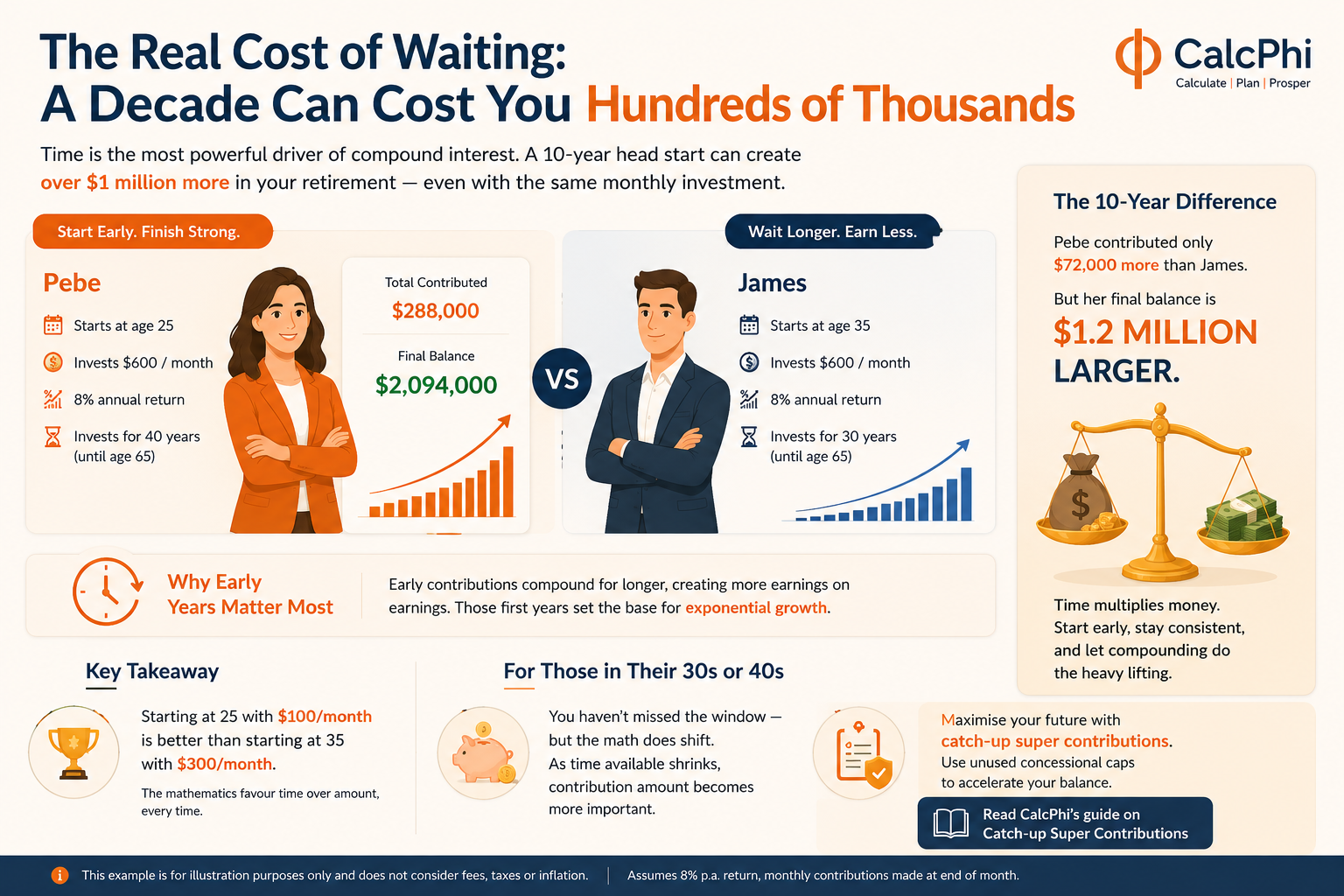
The most counterintuitive insight in compound interest is that time contributes more to your final balance than the amount you invest. Consider two Australians — Priya and James.
Priya starts investing A$600 per month at age 25, at an 8% annual return. She invests for 40 years until age 65. Total contributed: A$288,000. Final balance: approximately A$2,094,000.
James waits until 35 to start investing the same A$600 per month at the same 8% return, also until age 65. He invests for 30 years. Total contributed: A$216,000. Final balance: approximately A$894,000.
Priya contributed only A$72,000 more than James. But her final balance is A$1.2 million larger — because her money had a decade more time to compound on itself. Those early years of compounding, before the balance gets large, are paradoxically the most valuable because they set the base on which everything else grows.
This is why financial advisers consistently say that starting at 25 with A$100 per month is better than starting at 35 with A$300 per month. The mathematics favour time over amount, every time.
If you are in your 30s or 40s reading this and feeling like you have missed the window — you have not. But the maths do shift. The contribution amount becomes more important as the time available shrinks, which is why catch-up superannuation contributions and maximising concessional caps matter significantly for Australians over 40. Read CalcPhi's guide on catch-up super contributions to understand how to use unused concessional caps to accelerate your balance.
The Inflation Problem: Real Returns Matter More Than Nominal Returns
Here is the thing about seeing your balance grow from A$50,000 to A$86,000 over fifteen years: that looks great until you account for inflation. If inflation has averaged 3% per year during that period, the purchasing power of your A$86,000 is equivalent to about A$55,000 in today's dollars. Your real return — the growth after inflation — is far smaller than the headline number suggests.
This is why financial planners refer to real returns rather than nominal returns. A savings account earning 4.8% when inflation is running at 3.5% is delivering a real return of only about 1.3%. You are growing your nominal balance, but your actual wealth — the goods and services your money can buy — is barely moving.
The practical implication is that cash savings accounts, while valuable for emergency funds and short-term goals, are poor vehicles for long-term wealth building in an inflationary environment. Investments with higher expected real returns — diversified share portfolios, property, or superannuation in a growth option — are what genuinely build purchasing power over decades.
Use CalcPhi's Investment Returns Calculator to model your investment growth with an inflation adjustment. Enter your expected return rate and an inflation assumption, and the calculator will show you both your nominal final balance and what it is worth in today's dollars.
How Tax Affects Your Compounding Returns
Tax is the single biggest drag on compounding returns outside superannuation. In a standard taxable brokerage account, every dividend you receive is taxed at your marginal rate in the year it is paid — even if you reinvest it. Every time you sell a position and realise a capital gain, tax is due. This slows compounding because a portion of each return is diverted to the ATO before it can reinvest and compound further.
For most Australian investors, the most tax-efficient approach to long-term compounding involves three things:
- Hold investments for longer than twelve months wherever possible to access the 50% capital gains tax (CGT) discount, which halves the taxable portion of any gain.
- Use superannuation as the primary long-term compounding vehicle, because investment earnings inside super are taxed at 15% during the accumulation phase rather than your marginal rate — for someone on the 32.5% or 37% tax bracket, this is a substantial difference in how much of each year's return stays in the fund to compound.
- Understand franking credits, which are particularly relevant for ASX share investors. Australian companies pay corporate tax before distributing dividends, and the franking credits attached to those dividends represent a tax credit you can claim — effectively reducing the tax you pay on that dividend income.
The CalcPhi Capital Gains Tax Calculator can help you estimate the CGT impact when you eventually sell an investment, and the Franking Credits Calculator shows the grossed-up value of franked dividends so you understand the true pre-tax yield of ASX shares.
A Decade-by-Decade Action Plan for Australian Investors
Compound interest is not a strategy — it is an outcome. The strategy is building a financial life that lets compounding work uninterrupted for as long as possible.
In your 20s, the priority is simply to start. The amount matters far less than the habit and the timeline. Contributing A$200 a month into a diversified ETF or maximising your employer super and making voluntary contributions of even A$50 a fortnight sets the compounding clock ticking. Avoid lifestyle debt — credit card balances at 20% interest compound against you just as powerfully as investments compound for you.
In your 30s, the focus shifts to increasing contributions as income grows. Every pay rise is an opportunity to redirect the increase to investments before lifestyle inflation absorbs it. This decade is where salary sacrifice into superannuation begins to make serious mathematical sense, because the tax saved on contributions can itself be reinvested.
In your 40s, the emphasis moves to fee minimisation and tax efficiency. A seemingly small difference in fund fees — say, 0.5% versus 1.2% per annum — translates into tens of thousands of dollars over a twenty-year horizon, because high fees slow compounding just as surely as low returns do. Review your super fund's investment fees, compare options using CalcPhi's Super Fund Comparison tool, and ensure your asset allocation still matches your risk tolerance and time horizon.
In your 50s, compounding continues to work — do not be tempted to de-risk too aggressively too early. A 55-year-old with a retirement target of 67 still has twelve years of compounding ahead. Keeping a meaningful allocation to growth assets preserves the compounding engine longer.
Fees Are Compounding Against You — Every Year
It is worth being direct about investment fees, because they are poorly understood by most Australian investors. Fees do not just reduce this year's return. They reduce the base on which next year's return is calculated. That means fees compound against you in exactly the same way that returns compound for you.
On a A$200,000 super balance, the difference between 0.5% and 1.5% annual fees might feel like A$2,000 per year — manageable. But over twenty years, that 1% fee difference costs approximately A$88,000 in lost compounding on a 7% growth assumption. The fee amount stays the same in percentage terms but the dollar impact grows dramatically as the balance scales.
This is why the shift from actively managed high-fee super funds to low-cost industry funds or index-tracking options has been one of the most significant improvements available to ordinary Australians trying to build retirement wealth.
Model your own compound interest growth with CalcPhi's free Australian calculators:
Compound Interest Calculator → Super Balance Calculator → Investment Returns Calculator → Capital Gains Tax Calculator →Frequently Asked Questions
How does compound interest work in an Australian savings account?
When you deposit money into a high-interest savings account, your bank calculates interest — typically daily, based on the account balance — and credits it monthly. In the following month, interest is calculated on your original deposit plus the interest already credited. This cycle repeats every month, so your balance grows faster over time than it would with simple interest. As of May 2026, Australian HISA rates sit between 4.8% and 5.1% per annum from major providers.
Is superannuation affected by compound interest?
Yes — superannuation is one of the most powerful compounding environments available to Australians. Investment returns inside your super fund are reinvested automatically, and those returns earn further returns each year. Because earnings inside super are taxed at just 15% during the accumulation phase (compared to your marginal tax rate on outside investments), more of each year's return stays in the fund to compound. Over a forty-year working life, this tax advantage combined with compounding produces materially larger balances than equivalent investments held outside super.
What is a realistic compound interest rate to assume for long-term planning in Australia?
For a high-interest savings account, the realistic rate as of 2026 is approximately 4.8–5.1%. For a balanced diversified super fund, the long-run historical average is approximately 7–8% per annum after fees. For an Australian shares portfolio tracking the ASX 200 with dividends reinvested, the long-run historical return is approximately 9–10% per annum, though this comes with considerably more year-to-year volatility. When planning for long-term goals, most financial planners use 6–8% as a conservative-to-moderate assumption for diversified portfolios.
Does starting 10 years later really make that much difference to my final super balance?
Yes — often more than most people expect. Because compound interest is exponential rather than linear, the returns generated in the final ten years of a forty-year investment period are dramatically larger than the returns in the first ten years. Starting a decade later means missing those final, highest-value compounding years, which typically account for 40–50% of the total terminal balance. A decade of delay at a typical salary and contribution rate can result in a final super balance that is 40–60% smaller.
How can I reduce the tax drag on my compounding investments outside of super?
The three most effective strategies for Australian investors are: holding investments for over twelve months to access the 50% CGT discount on realised gains, investing in Australian shares with franking credits to offset dividend tax, and using voluntary concessional contributions to super (up to the annual cap) to redirect investment growth into the 15% tax environment rather than having it taxed at your marginal rate. For specific advice relevant to your situation, a qualified financial adviser or tax professional can help you optimise your structure.
Can I use a calculator to see how compound interest grows my savings?
Absolutely. CalcPhi's Compound Interest Calculator for Australia lets you enter any starting amount, regular contributions, interest rate, compounding frequency, and time period to get an exact projected balance — along with a year-by-year breakdown showing how the balance grows over time. It is free, requires no sign-up, and runs entirely in your browser.
Disclaimer: The information in this article is for educational and general informational purposes only. All figures are estimates and examples — actual investment returns, superannuation balances, and interest rates will vary depending on market conditions, fund performance, fees, and individual circumstances. Nothing in this article constitutes financial, tax, or investment advice. Past performance of any asset class does not guarantee future results. Please seek personalised guidance from a qualified financial adviser or tax professional before making any financial decisions.
