Emergency Fund Australia: How Much to Save and Where to Keep It (2026 Guide)
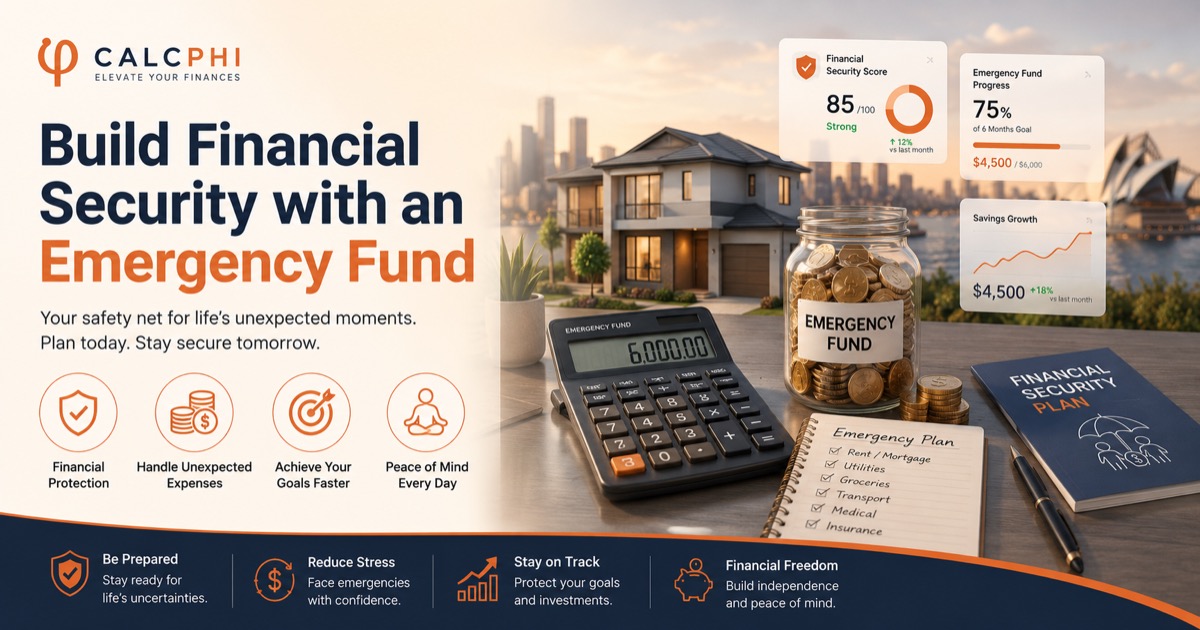
An emergency fund is a dedicated cash reserve covering three to six months of essential living expenses — held separately from investments, and accessible within one to two business days without penalty. It is not designed to grow wealth or beat inflation. It is financial insurance: a buffer that stops a bad week from becoming a financial catastrophe. A 2024 ASIC survey found roughly one in three Australians could not cover an unexpected $3,000 expense without going into debt. This guide covers how to size, place, and build your emergency fund as an Australian in 2026.
What Counts as an Emergency?
Genuine emergencies are unexpected, unavoidable, and time-sensitive. They include redundancy or sudden job loss, a large medical or dental bill not covered by Medicare or private health, urgent car repairs essential for work, emergency home repairs such as a broken hot water system or storm damage, or a family crisis requiring interstate travel.
What does not count as an emergency: annual car registration (predictable — budget for it separately), holidays, a new phone, or planned home renovations. One of the most common mistakes Australians make is treating their emergency fund as a general-purpose savings account. Keeping it separate, with a clear mental boundary around its purpose, is what makes it work when it is actually needed.
How Much Emergency Fund Do You Need in Australia?
The key is to base your target on essential expenses only — not your total take-home pay, and not your total spending. Essential expenses are the costs you cannot cut in a crisis: rent or mortgage repayments, groceries, utilities, insurance premiums, minimum debt repayments, childcare, and transport to work. Discretionary spending — dining out, streaming subscriptions, clothing — would be the first things cut during a genuine financial emergency.
Three months
Appropriate for dual-income households with stable salaried employment, no dependants, and low fixed obligations. Two incomes provide a natural buffer — if one person loses their job, the other can carry expenses while the situation resolves.
Four to five months
Right for single-income households with a stable employer, couples with dependants (children add expense volatility through medical costs and childcare), or anyone with a mortgage rather than rent (mortgage repayments are harder to pause quickly).
Six months
The right target for single-income earners with dependants, anyone in a specialised field where job searches take longer, people with significant health conditions, or those with older vehicles and homes requiring more frequent unplanned repairs.
Six to twelve months
Applies to self-employed Australians, freelancers, and contractors. This group has no access to redundancy pay, no sick leave, no annual leave entitlements, and income that can stop abruptly. The higher end of this range is genuinely necessary for contractors whose income is project-based or seasonal.
To calculate your personal target, add up your essential monthly expenses and multiply by your recommended buffer. If your essentials total $4,500 per month and you are a single-income renter with one child, your target is $4,500 × 6 = $27,000.
| Situation | Recommended Buffer | Reason |
|---|---|---|
| Dual income, stable employment, no dependants | 3 months | Low income disruption risk; partner can cover |
| Single income, stable employment | 4–5 months | No backup income if employment disrupted |
| Dual income with dependants | 4–5 months | Childcare and medical costs add expense volatility |
| Single income with dependants | 6 months | Maximum vulnerability; longer job search horizon |
| Self-employed / freelance / contractor | 6–12 months | No redundancy or leave entitlements; income can stop abruptly |
| Variable income (commission, seasonal) | 6 months | Covers income troughs without disruption |
Where to Keep Your Emergency Fund in Australia
Your emergency fund has three non-negotiable requirements: it must be safe (no risk of losing the capital), accessible (available within one to two business days without penalty), and earning a reasonable return (not sitting idle in a zero-interest everyday account).
High-Interest Savings Accounts (HISA)
In 2026, high-interest savings accounts from Australian banks and digital lenders are the most practical home for most emergency funds. Providers including Ubank, ING, Macquarie, and HSBC are offering ongoing rates between 4.5% and 5.5% p.a. with no lock-in period.
Key features to look for: no monthly fees, no minimum balance requirement, full access to your funds within one to two business days, and coverage under the Australian Government's Financial Claims Scheme (FCS). The FCS guarantees deposits up to $250,000 per account holder per Authorised Deposit-taking Institution — meaning your emergency fund is government-protected at any Australian bank, building society, or credit union.
Keep your emergency fund in a separate account from your everyday spending. A small amount of friction — the need to transfer funds rather than tap instantly — prevents erosion for non-emergencies.
Mortgage Offset Account
If you own a home with a variable-rate mortgage, your offset account is often the best place for your emergency fund. Every dollar in an offset account reduces the loan balance on which interest is calculated — meaning the effective return on your funds equals your mortgage interest rate.
With standard variable rates currently sitting around 6.0–6.4% p.a. in Australia, parking $20,000 in an offset account effectively earns you 6.0–6.4% — risk-free, tax-free (since it reduces a cost rather than generating taxable income), and instantly accessible. That beats any HISA on an after-tax basis at every income level. The funds remain fully liquid and can be withdrawn at any time.
What to Avoid
Term deposits fail the accessibility test. Breaking a term deposit early typically incurs an interest rate reduction of 1–2% and may involve a processing delay. This disqualifies them as a primary emergency fund vehicle — though a small secondary portion of a larger buffer could be placed here if you have more than six months saved.
Shares and ETFs fail the stability test. Equity markets can fall 20–40% during recessions — and recessions are precisely when job losses and income disruptions occur. An emergency fund that is worth $40,000 today but only $26,000 when the market crashes defeats the entire purpose. Never sell investments at a loss to cover living expenses.
Superannuation is not accessible. Super cannot be withdrawn until preservation age (60 for most Australians) except under very limited early release conditions. Never factor super into your emergency fund planning.
Emergency Fund vs Paying Off Debt
If you hold high-interest consumer debt — credit cards at 18–22% p.a. or personal loans at 12–16% — the mathematical priority is to pay that debt down aggressively before building a large emergency fund. Interest at 20% per annum destroys wealth faster than almost any savings strategy can recover.
The practical solution is a two-phase approach. First, build a minimal emergency buffer of $2,000–$3,000 — enough to absorb a single unexpected expense without reaching for a credit card. Then attack high-interest debt with maximum intensity. Once that debt is cleared, redirect the repayment amount straight into the emergency fund until you reach your full target.
This approach prevents the most common failure mode: you pay down $5,000 of credit card debt, a car repair costs $1,800, and the debt goes straight back on the card because you had no buffer. The minimal starting buffer breaks this cycle.
How Long Does It Take to Build an Emergency Fund?
The timeline depends on how much you can consistently set aside each month. If your emergency fund target is $20,000 and you save $500 per month earning 4.5% interest in a HISA, you will reach your target in approximately 37 months. At $1,000 per month, around 19 months. At $1,500 per month, closer to 13 months.
| Monthly savings | Time to $20,000 target (at 4.5% p.a.) |
|---|---|
| $300/month | ~60 months (5 years) |
| $500/month | ~37 months (3 years) |
| $1,000/month | ~19 months |
| $1,500/month | ~13 months |
| $3,000/month | ~7 months |
The fastest way to accelerate is a short-term spending audit. Track every dollar for 30 days and identify discretionary expenses you value less than financial security. Most Australians find $300–$700 per month they can redirect without significantly affecting their quality of life — subscriptions, food delivery, impulse purchases, and irregular discretionary spending add up faster than expected.
If you receive a tax refund, bonus, or any windfall, direct a significant portion toward the emergency fund before lifestyle inflation absorbs it. A $3,000 ATO tax refund invested directly cuts months off your build timeline.
Maintaining and Reviewing Your Emergency Fund
An emergency fund is not something you build once and forget. Review your emergency fund target whenever you have a significant life change: moving from renting to owning a home, having a child, changing jobs or moving to contract work, or taking on significant new debt obligations.
If you use your emergency fund — which is exactly what it is there for — prioritise rebuilding it before resuming other financial goals. Treat it like a bill: the monthly contribution to restore the fund comes before discretionary spending is resumed.
Over time, as your income grows and your finances stabilise, a well-maintained emergency fund becomes easier to keep and easier to build back up. It is one of the highest-return financial habits available to Australians — not because of interest earned, but because of financial disasters avoided.

Frequently Asked Questions
-
How much emergency fund is enough for Australians in 2026?
Three to six months of essential living expenses is the standard recommendation, but the right amount depends on your income security and household structure. Single-income earners, people with dependants, and self-employed Australians should aim for six months or more. A dual-income couple with stable employment can often manage well with three months. Calculate your target by adding up your essential monthly expenses — rent or mortgage, groceries, utilities, insurance, and minimum debt repayments — and multiplying by your recommended number of months.
-
Where should I keep my emergency fund in Australia?
A high-interest savings account (HISA) offering 4.5–5.5% p.a. is the most practical option for most Australians. Look for accounts with no lock-in period, no fees, and coverage under the Australian Government's Financial Claims Scheme (deposits protected up to $250,000 per ADI). If you have a home loan, a mortgage offset account is often an even better option — the effective return equals your mortgage interest rate (currently around 6.0–6.4%) and the earnings are tax-free in the sense that they reduce a cost rather than creating taxable income.
-
Should I build an emergency fund or pay off debt first?
If you have high-interest consumer debt (credit cards, personal loans), prioritise paying that off — but first establish a small buffer of $2,000–$3,000 to avoid new debt from small emergencies. Once high-interest debt is cleared, redirect those repayment amounts toward building a full three-to-six-month emergency fund. Low-interest debt like a standard variable mortgage does not need to be fully eliminated before building your emergency fund.
-
Is the interest on my emergency fund taxable?
Yes. Interest earned in a HISA is assessable income under Australian tax law and taxed at your marginal rate. If you earn $900 in interest on a $20,000 emergency fund at 4.5%, and your marginal rate is 32.5%, you will pay approximately $293 in tax on that income — reducing your effective return to about 3%. Using a mortgage offset account avoids this, since it reduces a cost rather than generating new taxable income.
-
Can I use my superannuation as an emergency fund?
No. Superannuation is preserved until preservation age (age 60 for most Australians) and cannot be accessed for general financial emergencies. Early release of super is only available under strict conditions: severe financial hardship, compassionate grounds, terminal illness, or temporary incapacity. Do not include super in your emergency fund planning.
-
How often should I review my emergency fund?
Review it at every major life change — a new job, a child, a new mortgage, a move to self-employment, or taking on significant new financial obligations. Also review it annually as part of a general financial check-up to make sure your target still reflects your current essential expenses. If you use any of your emergency fund, treat rebuilding it as a priority before resuming other financial goals.
Use our Australia calculators:
Savings Goal Calculator → Offset Account Calculator → Budget Calculator → Compound Interest Calculator →