Building vs Buying a House in Australia: Which Costs Less in 2026?
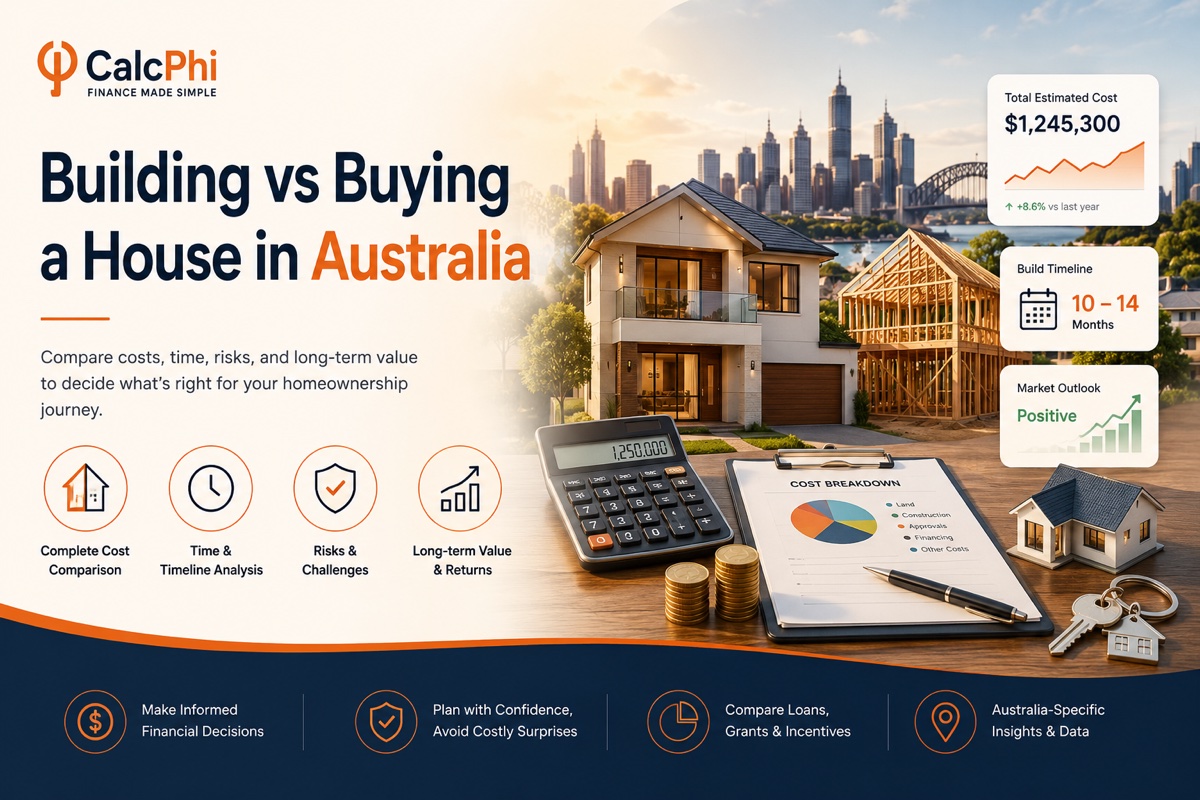
The question of whether to build or buy a home is one of the most consequential financial decisions an Australian household will ever make. Get it right, and you could save $80,000 to $150,000 compared to the alternative. Get it wrong — by underestimating construction overruns or overpaying for an established home in a cooling suburb — and the consequences follow you for the length of a 30-year mortgage.
In 2026, the answer is more nuanced than ever. Construction costs have stabilised after a brutal 2021–2024 period, but they remain roughly 47% above pre-pandemic levels. At the same time, established property prices in most capital cities have continued to climb, widening the gap between what it costs to build a home and what it costs to buy one in the same area. This guide breaks down the real numbers — upfront costs, hidden costs, grant entitlements, stamp duty differences, and long-term considerations.
What Does It Cost to Build a House in Australia in 2026?
The national average cost to build a standard four-bedroom home in Australia in 2026 is approximately $443,000 excluding land, based on a 230m² volume build. For standard single-storey residential construction, expect to pay between $1,800 and $2,800 per m². Double-storey homes run higher, from around $2,100 to $3,500 per m². Premium or custom builds can reach $5,000 per m² or beyond.
| State | Approximate Build Cost | Notes |
|---|---|---|
| NSW | ~$550,000 | Highest nationally; trade wages and compliance costs |
| VIC | ~$490,000 | – |
| QLD | ~$460,000 | – |
| WA | ~$450,000 | – |
| SA | ~$403,000 | Among the most affordable |
These figures cover the building contract — the structure, standard inclusions, and finishes. They do not include land, site preparation, landscaping, fencing, driveways, or utility connections, which can add a further $20,000 to $80,000 depending on the block. A realistic contingency of 10 to 15% on top of the base contract price is standard practice in the industry.
What Does It Cost to Buy an Established Home in 2026?
The median house price across Australia's capital cities in 2026 sits between $800,000 and $1.6 million depending on the city. Sydney remains the most expensive capital at around $1.4 million median. Brisbane and Melbourne follow at $950,000 to $1.1 million. Perth and Adelaide now sit in the $750,000 to $900,000 range after significant price growth since 2022.
Buying established means you pay stamp duty on the full purchase price — not just the land component. In NSW, stamp duty on a $1,000,000 home is approximately $40,090. In VIC, around $55,000. In QLD, approximately $30,750. These are substantial upfront costs that build zero equity.
On top of stamp duty, buying established typically involves conveyancing fees ($1,500–$2,500), building and pest inspection ($400–$700), mortgage application and legal fees ($500–$2,000), and Lenders Mortgage Insurance if your deposit is under 20% (up to $35,000).
The True Cost Comparison: Building vs Buying Side by Side
The table below compares the full cost of building versus buying a comparable four-bedroom home in an outer suburban Sydney corridor in 2026, where house-and-land packages are actively available.
| Cost Item | Build (House & Land Package) | Buy Established |
|---|---|---|
| Land purchase price | $420,000 | — |
| Build contract price | $380,000 | — |
| Established property price | — | $950,000 |
| Stamp duty (build: land only) | ~$14,000 | ~$38,000 |
| Construction contingency (10%) | $38,000 | — |
| Landscaping, fencing, driveway | $30,000 | — |
| Conveyancing and inspections | $3,000 | $3,000 |
| Total approximate cost | ~$885,000 | ~$991,000 |
The building path saves approximately $106,000 in this example. The two biggest contributors are stamp duty (payable only on the land when building) and the fact that outer suburban land prices are materially below established property prices for the same level of finish and space.
However, this table does not capture two significant additional costs of building: rent paid during construction and construction loan interest during the build period. A 12 to 18 month build on a $380,000 contract, drawing progressively at ~6.5%, adds roughly $15,000–$20,000 in interest. If you are simultaneously paying $2,500/month in rent, that is a further $30,000–$45,000 in holding costs. Factor those in, and the saving from building narrows but typically still holds.
First Home Buyer Grants: Building Gets the Better Deal
If you are a first home buyer, building a new home is almost universally better supported by government grants and concessions than buying established.
| State | FHOG Amount | Applies To Established? | Key Threshold |
|---|---|---|---|
| NSW | $10,000 | No | New homes under $750,000 |
| QLD | $30,000 | No | New homes signed before 30 June 2025 |
| VIC | $10,000 metro / $20,000 regional | No | New builds only |
| WA | $10,000 | No | New homes, no stamp duty under $450K |
| SA | $15,000 | No | New builds, concessions for eligible buyers |
The cumulative impact of these grants and stamp duty differences can represent a $25,000 to $50,000 advantage for building compared to buying established — on top of any inherent price difference between the two options.
The Real Risks of Building: What the Numbers Don't Show
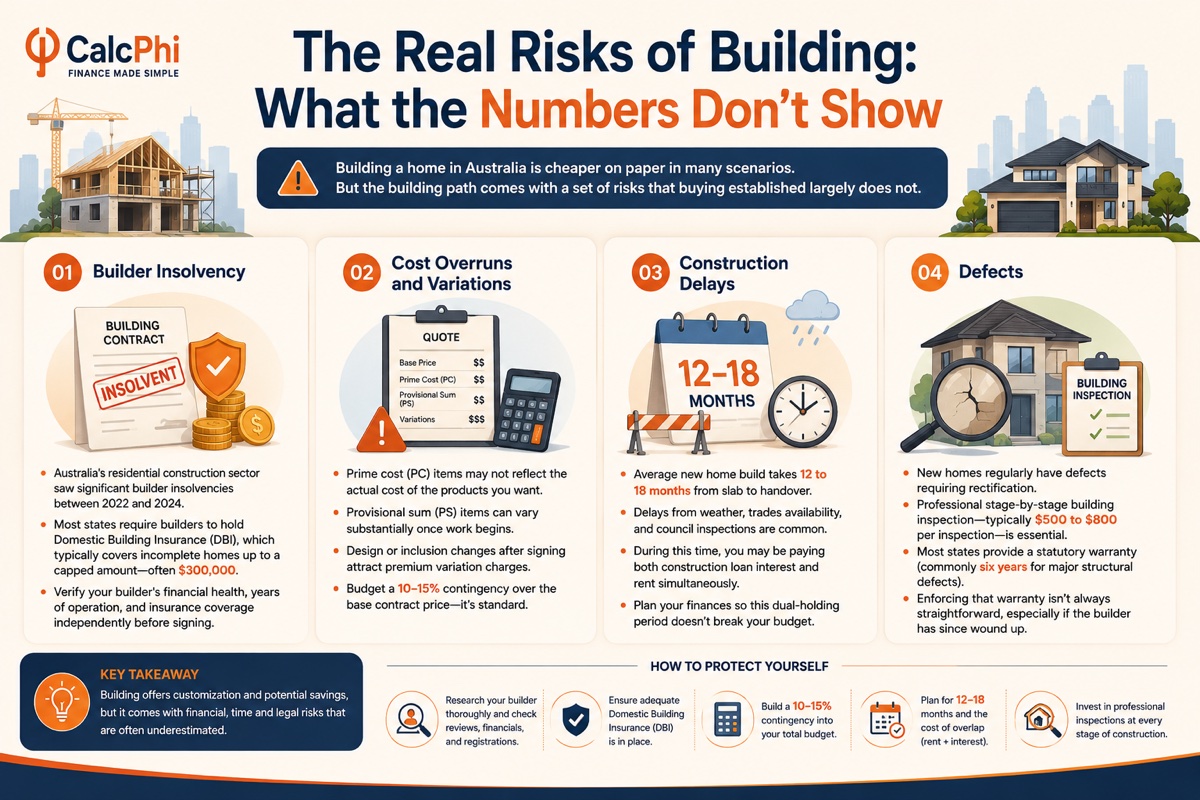
Building a home in Australia is cheaper on paper in many scenarios. But the building path comes with a set of risks that buying established largely does not.
Builder Insolvency
Australia's residential construction sector experienced significant builder insolvencies between 2022 and 2024. Volume builders entered fixed-price contracts during the COVID boom, then faced material cost increases and trade shortages that made those contracts unviable. Most states require builders to hold Domestic Building Insurance (DBI), which typically covers incomplete homes up to a capped amount — often $300,000 — which may be insufficient to complete a partially built home. Before signing any building contract, verify your builder's financial health, years of operation, and insurance coverage independently.
Cost Overruns and Variations
A fixed-price building contract is not a guarantee against cost blowouts. Prime cost (PC) items — such as appliances, tapware, or tiles — are listed at allowance amounts that may not reflect the actual cost of the products you want. Provisional sum items — such as site earthworks or soil treatment — can vary substantially once work begins. And if you request any changes to the design or inclusions after signing, variations are typically charged at a premium. Budgeting a 10 to 15% contingency over the base contract price is not overcautious — it is standard.
Construction Delays
The average new home build in Australia runs for 12 to 18 months from slab to handover. Delays for weather, trades availability, and council inspections are common. During this time, if you are renting, you carry both the construction loan interest and rent simultaneously. Plan your finances so this dual-holding period does not break your budget.
Defects
New homes regularly have defects requiring rectification. A professional stage-by-stage building inspection — typically $500 to $800 per inspection — is not optional; it is essential. Most states provide a statutory warranty period (commonly six years for major structural defects) during which the builder is required to fix defects at no cost. But enforcing that warranty is not always straightforward, particularly if the builder has since wound up.
When Buying Established Is the Better Choice
Building wins on price in growth corridors, but buying established wins in several specific scenarios.
If the property is in an established inner or middle-ring suburb with proximity to employment, transport, and amenity — that location premium tends to compound in value over time more reliably than fringe-estate land. Established properties also offer the opportunity to add value through renovation, which building does not. A structurally sound home in a blue-chip suburb needing cosmetic work can deliver strong equity growth that new estates rarely match.
Buying established is also the right call when you need to move in quickly — settlement is typically six to twelve weeks, versus twelve to eighteen months for a build. If your circumstances require certainty of timing (lease ending, job relocation, growing family), established property is significantly less risky. For investors, established properties in high-rental-demand locations often generate stronger rental yields from day one, compared to new estates where rental markets are still maturing.
Which Path Is Right for You?
Choose building if: you are a first home buyer wanting to maximise grants and minimise stamp duty; you are flexible on timing and can absorb the construction period financially; you want a new home with modern energy efficiency, layout, and warranties; you are buying in a growth corridor where land prices create meaningful savings; and you can absorb a 10 to 15% cost overrun without financial stress.
Choose buying established if: you need to move in within three months; you want a specific suburb with proven capital growth history; you prefer certainty — a fixed, inspectable, agreed purchase price; you have identified a property with renovation upside in a desirable location; or you are investing and need immediate rental income.

Frequently Asked Questions
Is it cheaper to build or buy a house in Australia in 2026?
In most outer suburban and regional growth corridors, building is cheaper than buying an equivalent established home — typically by $80,000 to $150,000 in total cost, once stamp duty savings and grant entitlements are factored in. However, building involves additional costs including rent during construction, construction loan interest, landscaping, and contingency for variations. In established inner-city or middle-ring suburbs, buying is often more competitive because land in those areas commands a premium that construction savings cannot offset.
What is a construction loan and how does it work?
A construction loan is a specialised home loan that releases funds progressively — in stages tied to construction milestones such as slab, frame, lock-up, fit-out, and completion. During the build, you pay interest only on the amount drawn down. Once construction is complete, the loan converts to a standard principal-and-interest home loan. Construction loans typically carry slightly higher interest rates than standard home loans and require more documentation, including a signed building contract and council-approved plans.
Do I pay stamp duty on both the land and the building contract when building?
In most Australian states, stamp duty when building a new home applies only to the land purchase price — not to the building contract. This is one of the most significant financial advantages of building over buying established, where stamp duty applies to the full property value. Rules vary by state and by how the transaction is structured, so always confirm the exact rules with your conveyancer before proceeding.
How much contingency should I budget when building a new home?
Industry professionals consistently recommend a contingency of 10 to 15% over the base building contract price. This covers prime cost and provisional sum variations, any design changes you request, unexpected site conditions (such as reactive soil, rock, or slope), and cost increases between contract signing and the relevant construction stage. A $380,000 building contract should carry a contingency of $38,000 to $57,000 in your budget — even on a fixed-price contract.
What grants are available for first home buyers building in 2026?
Grant amounts vary by state: Queensland offers $30,000 for new builds, NSW and WA offer $10,000, Victoria offers $10,000 metropolitan / $20,000 regional, and SA offers $15,000. In addition, most states provide stamp duty concessions or exemptions for first home buyers below certain property value thresholds. These grants and concessions apply only to new homes in most states and are not available when buying established.
Can I use my superannuation to buy or build a home?
The First Home Super Saver Scheme (FHSSS) allows first home buyers to withdraw voluntary super contributions — up to $50,000 — to use as a home deposit, whether building or buying. The scheme effectively taxes those savings at a lower rate than personal income, making it a tax-efficient way to build a deposit. However, your compulsory employer contributions cannot be accessed under this scheme. It is worth modelling the impact of a withdrawal on your long-term retirement balance before proceeding.
Disclaimer: The figures and examples in this article are for educational and estimation purposes only. Costs, grants, and tax rules are subject to change and vary by state and individual circumstance. Nothing in this article constitutes financial, legal, or tax advice. Before making any property purchase or construction decision, consult a qualified financial adviser holding an Australian Financial Services (AFS) licence and a licensed conveyancer in your state.

Written & verified by Emma Hartley
Certified Financial Planner & Mortgage Specialist
Emma is a CFP based in Brisbane with 9 years of experience in mortgage advice, first home buyer strategy, and retirement planning for Australian households navigating property markets and the age pension system.