Home Loan Pre-Approval Australia 2026: How It Works, What You Need, and Why It Matters
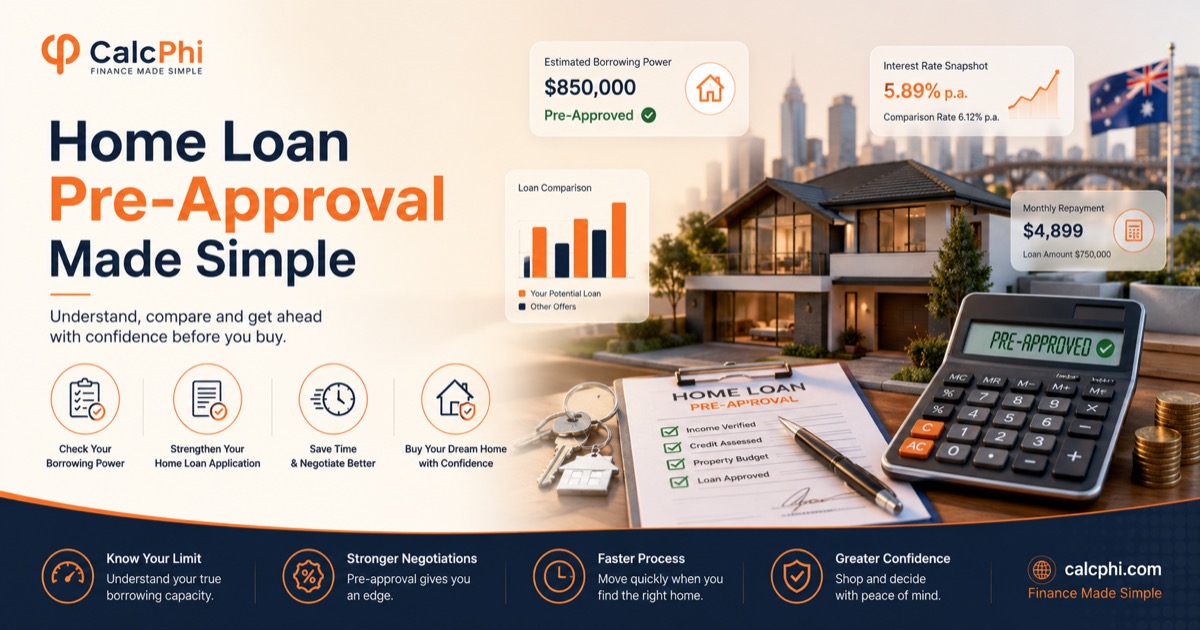
If you are planning to buy a property in Australia, getting home loan pre-approval before you start house hunting is one of the smartest moves you can make. It tells you exactly how much you can borrow, sharpens your offer-making confidence, and signals to vendors and real estate agents that you are a serious buyer — not someone who still needs to "sort out the finance." This guide explains exactly what pre-approval is, how it differs from formal approval, what documents you need to prepare, how lenders calculate how much they will lend you, and what can cause a pre-approval to be withdrawn.
What Is Home Loan Pre-Approval?
Home loan pre-approval — sometimes called conditional approval or approval in principle — is a lender's preliminary assessment that you are eligible to borrow up to a specified amount. It is based on a review of your income, expenses, debts, credit history, and savings. Crucially, it is not a guaranteed loan offer. The lender still needs to assess the specific property you intend to buy, including ordering an independent valuation, before issuing formal (unconditional) approval.
Think of pre-approval as a well-informed green light to go house shopping. You know your budget ceiling, and you can make offers or bid at auction with genuine confidence — rather than guessing what you might be able to borrow. Pre-approval typically lasts 90 days, though some lenders will extend this to six months.
Pre-Approval vs Formal Approval: What Is the Difference?
Pre-approval (conditional) is granted before you find a property. It is subject to conditions — the most important being that the property must pass a lender valuation and meet the lender's security criteria. Your financial circumstances must also remain unchanged. Pre-approval can be issued relatively quickly, often within 24 to 48 hours for straightforward salaried applicants.
Formal approval (unconditional) is issued after you have found a specific property, the lender has completed a full assessment of both you and the property, and the valuation has been accepted. This is the point at which you can legally exchange contracts or sign a purchase agreement with confidence that your finance is secured.
Never treat pre-approval as a guarantee. It can be withdrawn if your income or employment changes, you take on new debt, your credit score drops, or the property valuation comes in below your purchase price.
Why Getting Pre-Approved Matters in 2026
Australia's property market remains highly competitive, particularly in Sydney, Melbourne, and Brisbane. Vendors and real estate agents routinely prioritise buyers who can demonstrate pre-approval, because it reduces the risk of a sale falling through due to financing issues.
At auctions specifically, bidding without pre-approval is a significant risk. If you win and then cannot secure finance, you may forfeit the 10% deposit. Having pre-approval means you can bid up to your limit with confidence, knowing your lender has already assessed your borrowing capacity.
For first home buyers, pre-approval also clarifies eligibility for government grants and schemes — such as the First Home Guarantee, which allows eligible buyers to purchase with as little as a 5% deposit without paying Lenders Mortgage Insurance. Before applying for pre-approval, check whether you qualify using CalcPhi's First Home Buyer Calculator, which estimates deposit requirements, stamp duty, and grant eligibility by state.
Documents You Need for Home Loan Pre-Approval
Lenders across Australia — whether the big four banks, regional lenders, or non-bank lenders — require similar sets of documentation. Getting these prepared before you apply will significantly speed up the process.
Identity documents
You need a primary photo ID (passport or driver's licence) plus a secondary document such as a Medicare card or birth certificate. Most lenders require 100 points of ID.
Proof of income for PAYG employees
Your two most recent payslips, your last two years of tax returns with ATO Notices of Assessment (NOA), and a current employment contract if you have recently started a new job. Lenders want to confirm your income is stable and ongoing — casual or contract workers may need to show a longer employment history.
Proof of income for self-employed borrowers
The documentation requirements are more demanding. You will generally need two years of personal tax returns with ATO NOAs, two years of business tax returns and financial statements, and accountant-prepared financials for the most recent financial year. Some lenders will also request BAS statements to confirm GST turnover. Self-employed applicants typically need at least two years of trading history before a lender will accept their income as stable enough for standard mortgage assessment.
Asset and savings documentation
Bank statements for the last three to six months showing your genuine savings. A superannuation statement may also be required. If you own other property, recent valuations or council rates notices help.
Liability and debt documentation
Statements for any existing loans — car loans, personal loans, home loans — showing the current balance and monthly repayment. Credit card statements showing both the limit and the outstanding balance. Your HECS-HELP debt statement, because lenders factor this into your repayment obligations even though it is paid through the tax system.
How Lenders Calculate Your Borrowing Capacity
Understanding how your borrowing capacity is determined will help you set realistic expectations before applying. Australian lenders follow a framework set partly by APRA (the Australian Prudential Regulation Authority) and the individual credit policies of each institution.
The serviceability buffer
APRA mandates that lenders assess your ability to service the loan at 3% above the current interest rate. If your proposed loan rate is 6.2% per annum, the lender tests whether you could afford repayments at 9.2%. This buffer exists to protect borrowers from rate rises. Before you apply, use CalcPhi's Borrowing Power Calculator to estimate your maximum borrowing capacity based on income, expenses, and existing debts with the 3% APRA buffer applied.
The Household Expenditure Measure (HEM)
Even if your actual living expenses are lower than a standard benchmark, lenders apply the HEM — a standardised measure of living costs based on your household size and location — as a floor figure. This means declaring very low expenses does not necessarily increase your assessed borrowing capacity.
Existing debts and credit card limits
Every dollar of credit card limit reduces your assessed borrowing capacity, even if you pay the balance in full every month. A $20,000 credit card limit effectively represents a potential $20,000 in liability. If you have credit cards with high limits you do not use, consider reducing the limits before applying for pre-approval.
To see what your monthly repayments would look like at different loan amounts and interest rates, use CalcPhi's Mortgage Calculator. You can adjust the loan amount, term, and interest rate to find the monthly repayment figure that fits your budget.
Understanding Hard vs Soft Credit Enquiries
Every time you formally apply for pre-approval, the lender conducts a credit enquiry that appears on your credit file. A single enquiry has a minor and temporary impact on your credit score. The problem arises when you apply to multiple lenders in a short period — each enquiry shows up separately, which can signal financial stress and meaningfully reduce your score.
If you want to compare offers from multiple lenders, using a mortgage broker is the smarter approach. A broker can assess your situation and identify the most suitable lenders from their panel before submitting a single application to the lender you select. This generates only one credit enquiry rather than several.

What Can Cause Pre-Approval to Be Declined or Withdrawn?
Pre-approval can be refused at the application stage or withdrawn after being granted. The most common reasons include a low or insufficient credit score — typically caused by missed repayments, defaults, or too many credit applications — an unstable employment history (particularly for casual, contract, or newly self-employed applicants), existing debts that reduce serviceability, and a deposit that does not meet the lender's minimum requirement.
After pre-approval is granted, it can be withdrawn if you take on new debt, change or lose your job, or if the property valuation comes in below the purchase price. This last point is particularly important at auction, where you are contractually committed to the purchase before a formal valuation is completed. Always have a financial buffer in case the valuation falls short. Want to understand how much Lenders Mortgage Insurance might cost if your deposit is below 20%? Use CalcPhi's LMI Calculator to estimate the cost at different loan-to-value ratios.
Broker vs Direct Bank Application: Which Is Better?
Going directly to your own bank has the advantage of familiarity and potentially faster processing if you already have a relationship with them. However, you are limited to that institution's products, rates, and credit appetite.
A mortgage broker accredited with multiple lenders can compare dozens of loan products across banks, credit unions, and non-bank lenders to find the one most suitable for your situation. Brokers are paid by the lender in the form of an upfront and trail commission — not by you — and they are legally required to act in your best interest under the National Consumer Credit Protection Act. For first home buyers, borrowers with complex income situations, or anyone who has been declined by one lender, a broker can be particularly valuable.
Step-by-Step: How to Apply for Pre-Approval
Start by checking your credit score — services like Equifax or Experian provide free credit reports, and reviewing yours before applying means there are no surprises for the lender. Address any errors on your credit file before submitting an application.
Next, gather all your documents as outlined earlier in this guide. The more complete your submission, the faster the lender can assess it. Then decide whether to apply directly or via a broker. If you apply directly, most major lenders — CommBank, ANZ, Westpac, NAB — offer online pre-approval applications that can produce a conditional decision within 24 to 48 hours for clean-cut cases. Complex applications are referred to a credit assessor and typically take three to five business days.
Once you have pre-approval in hand, keep your finances stable — no new credit applications, no large purchases on credit, and no job changes if you can help it. Keep checking that your pre-approval has not expired, especially if your property search extends beyond 90 days.
Frequently Asked Questions
-
Does home loan pre-approval guarantee I will get the loan?
No. Pre-approval is a conditional assessment based on your finances at the time of application. The lender still needs to assess the specific property you intend to buy — including an independent valuation — before issuing formal (unconditional) approval. If the valuation comes in below your purchase price, the lender will only lend against the lower valuation figure. Your personal financial circumstances must also remain unchanged between pre-approval and settlement.
-
How long does home loan pre-approval last in Australia?
Most lenders issue pre-approval for 90 days, though some will extend to six months. If your pre-approval expires before you find a property, you can apply to renew it, but the lender will reassess your financial position at that point. Any changes to your income, debts, or credit score between the original approval and renewal may affect the outcome.
-
Does applying for pre-approval affect my credit score?
Yes, but only modestly for a single application. Each formal credit application generates a hard enquiry on your credit file. One enquiry has a minor, temporary effect. Multiple enquiries in a short period — from applying to several lenders simultaneously — can have a more meaningful negative impact, as it may signal financial distress to lenders. Using a mortgage broker allows you to compare multiple lenders with just one enquiry on your file.
-
Can I get pre-approval if I am self-employed?
Yes, but the documentation requirements are more extensive. Lenders generally want two years of personal and business tax returns, ATO Notices of Assessment, accountant-prepared financials, and sometimes BAS statements. Self-employed applicants with less than two years of trading history may find standard pre-approval difficult and may need to consider lo-doc products, which require a higher deposit and typically carry higher rates.
-
What is the difference between pre-approval and pre-qualification?
Pre-qualification is an informal estimate of borrowing capacity — often done online in minutes using basic income and expense details — that carries no weight with vendors or agents. Pre-approval involves a formal assessment of your actual financial documents and credit history. Always seek formal pre-approval before making offers on property, not just a pre-qualification estimate.
-
Should I get pre-approval before going to auction?
Absolutely. Buying at auction is unconditional — there is no cooling-off period and no finance clause. If you win and cannot secure formal approval, you risk forfeiting your deposit. Pre-approval gives you a verified borrowing limit so you can bid with confidence and set a clear ceiling. Still factor in the possibility that the property valuation might come in below your winning bid.
Use our Australia calculators:
Mortgage Calculator → Borrowing Power Calculator → LMI Calculator → First Home Buyer Calculator →Disclaimer: The information in this article is for educational and general guidance purposes only. It does not constitute financial or mortgage advice. Every borrower's situation is different, and eligibility for home loan pre-approval depends on individual financial circumstances, lender policies, and APRA guidelines that may change over time. Before applying for a home loan, consult a licensed mortgage broker or financial adviser who holds an Australian Credit Licence or Australian Financial Services Licence.
