How to Refinance Your Mortgage in Australia and Save Thousands
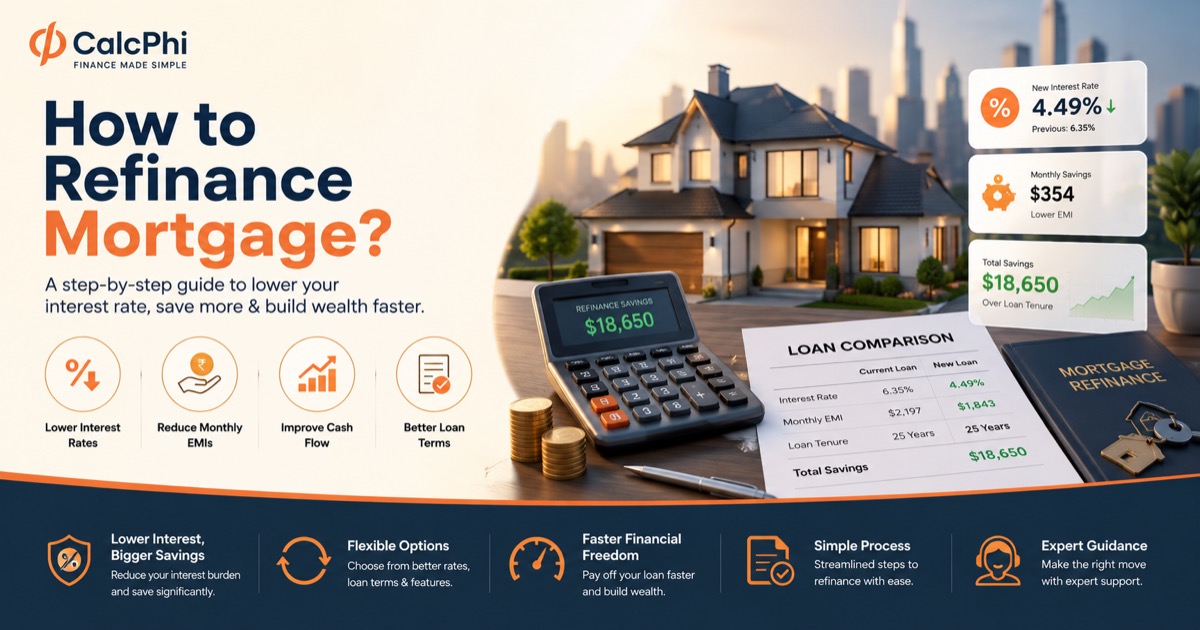
Australian borrowers who have not reviewed their mortgage in the past two years are almost certainly paying a "loyalty tax" — the gap between what new customers get and what existing customers are charged. The average gap between best-available variable rates and major bank standard variable rates in mid-2026 sits at 0.40–0.65%. On a $650,000 loan, that is $2,600–$4,225 per year in excess interest. Refinancing takes 4–6 weeks and costs around $600–$1,000 in fees. The maths on whether to do it is usually straightforward.
When Does Refinancing Make Sense?
The decision to refinance comes down to a simple break-even calculation: how long does it take for the savings from the lower rate to recoup the costs of switching? If that break-even is within two to three years and you plan to hold the loan for longer than that, refinancing almost always makes financial sense.
The clearest trigger is a rate gap. If you can find a rate more than 0.40–0.50% lower than what you currently pay, it is worth running the numbers. Below 0.40%, the savings may not justify the time and paperwork involved, though it depends on your loan size.
Other valid reasons to refinance include: changing your loan structure (e.g., switching from interest-only to P&I), accessing equity for investment or renovations, consolidating debts into your mortgage at a lower rate, adding or removing a borrower from the loan, or switching from a fixed rate that is about to expire to a better variable or fixed deal.
When refinancing does not make sense: if you are within a fixed term (break costs may exceed savings), if your property value has fallen significantly and your LVR is now above 80% (you may need to pay LMI on the new loan), or if your financial circumstances have changed in ways that may make it hard to qualify for a new loan.
The Step-by-Step Refinancing Process
Step 1: Assess Your Current Loan and Rate
Get your current interest rate in writing (it will be on your home loan statement or accessible via internet banking). Note the outstanding balance, remaining loan term, and any annual or monthly fees. Calculate your comparison rate (interest + fees as a single percentage).
Step 2: Check Your Property's Current Value
Lenders will require a property valuation as part of the refinancing application. Your LVR (loan-to-value ratio) on the new loan will be based on the new lender's valuation, not what you paid. If property values in your area have risen since you purchased, your LVR will have improved — potentially taking you below the 80% LMI threshold. Many lenders offer free upfront valuations during the application process.
Step 3: Research and Compare Rates
Use comparison sites and contact lenders directly. Look at the comparison rate (which includes fees), not just the headline interest rate. Check whether the new loan includes an offset account, redraw facility, and whether extra repayments are unlimited. Also check the revert rate — the rate the loan reverts to after any introductory or cashback period.
Step 4: Submit an Application
Once you have chosen a lender, submit a full application. You will need recent payslips (usually the last two), last two years of tax returns if self-employed, bank statements (usually three months), a copy of your current home loan statement, ID documents, and details of all existing liabilities. The new lender will run a credit check and property valuation.
Step 5: Receive Formal Approval and Settlement
Formal approval typically takes 3–10 business days once the application is complete. After approval, your solicitor or the lender's settlement team handles the discharge of your old loan and registration of the new loan. Settlement usually occurs within 2–4 weeks of approval. Some lenders offer a digital settlement process that is faster.
What Does Refinancing Cost?
Refinancing is not free, and understanding the costs is essential to the break-even calculation. Here are the typical fees you may encounter:
| Fee | Typical Amount | Notes |
|---|---|---|
| Discharge fee (outgoing lender) | $150–$400 | Charged by your current lender to close the loan |
| Application / establishment fee (new lender) | $0–$600 | Many competitive lenders waive this |
| Valuation fee | $0–$300 | Often waived by new lender for refinancers |
| Legal / settlement fee | $150–$400 | Charged by new lender's settlement team |
| Break cost (if on fixed rate) | $0–$40,000+ | Only applies if breaking a fixed term early |
| LMI (if LVR now >80%) | $5,000–$20,000+ | Only if your equity has fallen below 20% |
Total standard refinancing costs (excluding break costs and LMI) typically range from $400–$1,200. Many lenders now offer cashback deals of $2,000–$4,000 to attract refinancers — these can turn the break-even calculation strongly in your favour, but be wary of clawback clauses (see below).
The Break-Even Calculation
Use this simple formula to determine whether refinancing is worth it:
Break-even months = Total refinancing costs ÷ Monthly savings
Example: You have $580,000 outstanding on a 6.60% variable loan. You find a new lender offering 5.95%. Total refinancing costs: $800. Monthly saving: ($580,000 × 0.65%) ÷ 12 = $3,770 ÷ 12 = $314 per month. Break-even: $800 ÷ $314 = 2.5 months.
After 2.5 months you are ahead. Over five years, the saving is $314 × 60 = $18,840. Over the full remaining loan term, the saving is far larger when you account for the compounding effect on a reducing balance.
Interest Savings Over 5 Years at Different Rate Differentials
| Loan Balance | Rate Differential | Annual Saving | 5-Year Saving | Break-Even (assuming $800 cost) |
|---|---|---|---|---|
| $400,000 | 0.30% | $1,200 | $6,000 | 8 months |
| $400,000 | 0.50% | $2,000 | $10,000 | 5 months |
| $600,000 | 0.30% | $1,800 | $9,000 | 5 months |
| $600,000 | 0.50% | $3,000 | $15,000 | 3 months |
| $800,000 | 0.40% | $3,200 | $16,000 | 3 months |
| $800,000 | 0.60% | $4,800 | $24,000 | 2 months |
Savings figures are approximate and do not account for the compounding benefit of a reduced balance over time. Actual savings will be higher for longer loan terms.
Cashback Offers: Read the Fine Print
Cashback refinancing deals — where a lender pays you $2,000–$4,000 to switch to them — can appear very attractive. But several important caveats apply.
Most cashback offers include a clawback period, typically 12–24 months. If you refinance away from the cashback lender within the clawback period, you must repay the cashback. This effectively locks you in for the clawback period — which means you should compare the cashback lender's rate carefully, because if their rate is not competitive, you could end up paying more in interest than the cashback is worth.
Example: You take a $3,000 cashback from a lender charging 6.50% when a competitor charges 6.00% on your $650,000 loan. The 0.50% rate disadvantage costs you $3,250 per year. After one year you have given back your $3,000 cashback in excess interest and are now worse off. Always compare the total cost including rate, not just the cashback headline.

Frequently Asked Questions
- How often should I refinance my home loan in Australia?
- Most financial advisers suggest reviewing your mortgage rate at least every two years. The loyalty tax paid by existing customers tends to accumulate silently — lenders offer their sharpest rates to attract new customers, not to retain existing ones. Even calling your current lender and threatening to refinance can sometimes result in a rate reduction without the hassle of actually switching.
- Does refinancing hurt my credit score in Australia?
- Every credit application creates a hard enquiry on your credit file, which can temporarily reduce your credit score by a few points. If you apply with multiple lenders simultaneously, the effect is compounded. Using a mortgage broker who can identify the most suitable lender before lodging a formal application can minimise credit file enquiries.
- Can I refinance with the same lender?
- Yes — this is called a product switch or internal refinance. It is faster and cheaper than refinancing to a new lender (no discharge fees, no credit check in most cases). However, the rate you are offered for an internal switch is often not as competitive as the rate a new lender will offer to attract your business. It is worth getting external quotes before accepting an internal switch offer.
- How long does refinancing take in Australia?
- The full refinancing process — from application to settlement — typically takes 3–6 weeks. The fastest part is often the initial application and approval (1–2 weeks); settlement (discharge of old loan and registration of new loan) adds another 1–4 weeks. Some lenders and non-banks have streamlined this significantly and can settle in under three weeks for straightforward applications.
