Home Loan Prepayment vs Investing: Which Gives You More Wealth in 2026?

You just received your annual bonus — ₹3 lakhs sitting in your account. Your home loan is running at 8.75% interest, and your SIP is delivering around 12% annually. Do you dump the bonus into your loan and sleep easy, or let the market work its magic? This is one of the most common financial crossroads Indian homeowners face, and there is no universal right answer. The best choice depends on your loan interest rate, tax situation, investment horizon, and your personal relationship with debt.
Understanding the Core Trade-Off
At its heart, this decision comes down to two rates: the interest rate on your home loan versus the return your investments can generate.
When you prepay your home loan, you are effectively earning a guaranteed, risk-free return equal to your loan's interest rate. If your loan is at 8.75%, prepaying gives you a guaranteed 8.75% return on that money — because that is the interest you are no longer paying.
When you invest instead — say, in a diversified equity mutual fund through a SIP — you are chasing a higher but variable return. Indian equity mutual funds have historically delivered 11–13% CAGR over 10-year horizons, though past performance is never a guarantee of future results. The mathematical case for investing seems obvious: 12% beats 8.75%. But real-world factors like tax benefits, risk tolerance, and the psychological weight of debt change the equation considerably.
The Real Cost of Your Home Loan (After Tax)
Before running any numbers, you need to know your effective loan interest rate — not the headline rate your bank advertises.
Under Section 24(b) of the Income Tax Act, you can claim a deduction of up to ₹2 lakh per year on home loan interest for a self-occupied property. This means your actual cost of borrowing is lower than the stated rate, because the government is effectively subsidising part of the interest.
Suppose your home loan rate is 8.75% and you fall in the 30% tax bracket (income above ₹15 lakh under the old regime). Your effective loan rate becomes:
Effective rate = 8.75% × (1 − 0.30) = 6.125%
Suddenly, the case for prepayment weakens significantly. A well-managed SIP easily beats 6.125% over a 10-year horizon. However, if you are on the new tax regime (which became the default from FY 2024-25 onwards), you cannot claim this interest deduction at all. In that case, your effective loan cost remains the full 8.75%, and the margin between your loan cost and potential investment returns narrows considerably.
Use CalcPhi's free Home Loan Tax Benefit Calculator to find your exact effective interest rate based on your loan details and tax regime.
Home Loan Tax Benefit Calculator →Running the Numbers: A Side-by-Side Comparison
Let us take a concrete example. Rahul has a home loan outstanding of ₹40 lakh with 12 years remaining at 8.75% interest. He has ₹5 lakh available and is deciding whether to make a lump-sum prepayment or invest it in equity mutual funds.
If he prepays ₹5 lakh: A ₹40 lakh loan at 8.75% for 144 months has an EMI of approximately ₹49,900. After prepaying ₹5 lakh (reducing outstanding to ₹35 lakh), the loan closes roughly 18 months earlier and saves approximately ₹6.8 lakh in total interest over the remaining tenure.
If he invests ₹5 lakh in equity mutual funds: ₹5 lakh invested at an assumed 12% CAGR over 12 years grows to approximately ₹19.5 lakh. Even accounting for Long Term Capital Gains (LTCG) tax of 12.5% on gains above ₹1.25 lakh (as per Union Budget 2024 changes), the post-tax corpus is still well north of ₹17 lakh.
The raw numbers favour investing — but only if Rahul stays invested for the full duration and the market cooperates. Prepayment guarantees the saving; investing does not guarantee the return.
Model your own numbers using CalcPhi's free calculators — see exactly how much interest a prepayment saves, and how much a lump-sum investment could grow over the same period.
EMI Calculator → Lumpsum Calculator →When Prepaying Your Home Loan Makes More Sense
Prepayment is the smarter move in several specific situations.
- Your loan interest rate is high. If you took a loan at 9.5% or above — common for loans taken between 2022 and 2024 when the RBI was aggressively hiking the repo rate — prepayment becomes increasingly attractive. On the new tax regime with no deduction benefit, a 9.5% effective loan cost is genuinely hard to beat consistently in debt mutual funds or fixed deposits.
- You are in the early years of the loan. Home loan EMIs are front-loaded with interest. In the first few years, 80–85% of your EMI goes toward interest and only 15–20% reduces the principal. Prepaying in the early years cuts deep into this interest component and produces outsized savings. The same prepayment made in year 10 of a 20-year loan does much less.
- You are close to retirement. If you are 5–8 years from retirement, carrying a large debt obligation into your retirement years is a genuine risk. Prepaying the loan gives you the certainty of a debt-free retirement, which no market return can fully replicate.
- You have an emergency fund and no high-interest debt. Prepayment only makes sense after you have 3–6 months of expenses in liquid savings and have already cleared credit card debt or personal loans (which typically carry 15–24% interest — far more expensive than your home loan).
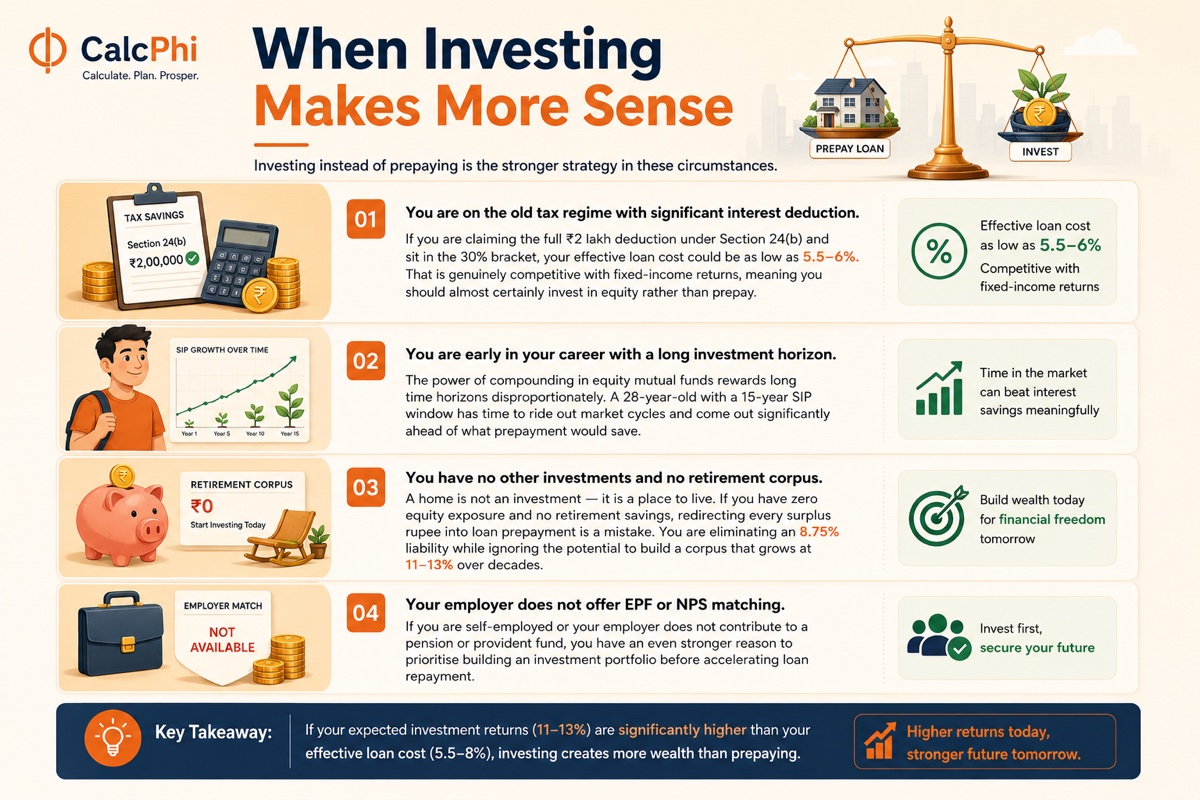
When Investing Makes More Sense
Investing instead of prepaying is the stronger strategy in these circumstances.
- You are on the old tax regime with significant interest deduction. If you are claiming the full ₹2 lakh deduction under Section 24(b) and sit in the 30% bracket, your effective loan cost could be as low as 5.5–6%. That is genuinely competitive with fixed-income returns, meaning you should almost certainly invest in equity rather than prepay.
- You are early in your career with a long investment horizon. The power of compounding in equity mutual funds rewards long time horizons disproportionately. A 28-year-old with a 15-year SIP window has time to ride out market cycles and come out significantly ahead of what prepayment would save.
- You have no other investments and no retirement corpus. A home is not an investment — it is a place to live. If you have zero equity exposure and no retirement savings, redirecting every surplus rupee into loan prepayment is a mistake. You are eliminating an 8.75% liability while ignoring the potential to build a corpus that grows at 11–13% over decades.
- Your employer does not offer EPF or NPS matching. If you are self-employed or your employer does not contribute to a pension or provident fund, you have an even stronger reason to prioritise building an investment portfolio before accelerating loan repayment.
The Hybrid Strategy: A Balanced Middle Path
For most people, the best answer is not a binary choice. A hybrid approach lets you get the psychological relief of reducing debt while still building wealth through investing. Consider this framework: allocate any surplus into three buckets. Put one-third toward loan prepayment, one-third into equity SIPs, and keep one-third liquid for near-term goals or emergencies. As your loan outstanding decreases and your investment corpus grows, you can gradually shift more toward investing.
This approach avoids the two biggest mistakes: being so aggressive on prepayment that you arrive at retirement debt-free but with no savings, or being so focused on investing that you carry a heavy loan into your 50s when your income may become less predictable.
If you are considering a hybrid approach, also read CalcPhi's guide on Home Loan Balance Transfer — because refinancing at a lower rate can change your effective loan cost and shift the prepayment-vs-invest equation in favour of investing.
Tax Efficiency: The Often-Ignored Variable
Both options have tax implications that most people overlook.
On the prepayment side, the principal repaid on a home loan qualifies for deduction under Section 80C (up to ₹1.5 lakh per year) under the old tax regime. If you are already maxing out your 80C limit through EPF, PPF, and ELSS, additional principal repayment gives you no further tax benefit. In that case, the tax argument for prepayment weakens.
On the investment side, ELSS mutual funds offer both market-linked returns and Section 80C deductions, making them one of the most tax-efficient investment options available to Indian investors. A ₹1.5 lakh annual investment in ELSS saves you ₹46,800 in tax (at the 30% slab plus cess) and simultaneously builds a market-linked corpus.
Under the new tax regime, neither the interest deduction nor the 80C principal deduction is available. This levels the playing field considerably — your decision shifts back to the pure mathematics of your loan rate versus expected investment returns.
Use CalcPhi's ELSS Calculator to see both the return potential and the 80C tax saving side by side.
ELSS Calculator → Income Tax Calculator →A Quick Decision Framework
If you are unsure which path to take, work through these four questions in order.
- Do you have an emergency fund covering at least 3 months of expenses? If no, build that before doing either.
- Do you have any debt costing more than 12% — credit cards, personal loans, or BNPL balances? Clear those first without exception.
- Are you on the old tax regime and claiming the full Section 24(b) interest deduction? If yes, your effective loan cost is likely below 7%, and investing in equity is likely the better long-run choice.
- Is your loan rate above 9%? If yes, and you are on the new regime with no deduction benefit, prepayment becomes increasingly competitive with equity investing.

Frequently Asked Questions
Is it better to prepay a home loan or invest in mutual funds in India?
It depends on your effective loan interest rate and tax situation. If your after-tax loan cost is below 7% (e.g., claiming Section 24b on the old regime) and you have a long investment horizon, equity mutual funds have historically outperformed this threshold. If your loan rate is 9% or higher and you are on the new tax regime with no interest deduction, prepayment becomes more competitive. Most people benefit from a hybrid approach — partial prepayment plus regular SIP investing.
Does prepaying a home loan save tax in India?
Under the old tax regime, interest paid on a home loan is deductible up to ₹2 lakh per year under Section 24(b), and principal repayment qualifies under Section 80C up to ₹1.5 lakh per year. Under the new tax regime (now the default from FY 2024-25), neither deduction is available. This significantly changes the after-tax cost of your home loan and the prepayment-vs-invest calculation. Use CalcPhi's Income Tax Calculator to compare both regimes.
What is a good rule of thumb for home loan prepayment in India?
A commonly used rule is: if your loan interest rate (after tax benefit) exceeds the expected post-tax return on your investment, prepay. If your investment returns exceed your effective loan cost, invest. For most salaried employees on the old tax regime with loan rates below 8.5%, investing in equity SIPs tends to win mathematically over a 10-year horizon.
Can I prepay a home loan partially without penalty in India?
Yes. Under RBI guidelines, floating rate home loans cannot attract prepayment penalties. Most major banks — SBI, HDFC Bank, ICICI Bank, Kotak — allow partial prepayment of floating-rate home loans at no extra charge. Fixed-rate loans may carry a prepayment fee of 1–2%. Always check your loan agreement before making a lump-sum payment.
How much does early home loan prepayment save?
The saving depends on your outstanding principal, remaining tenure, and how early in the loan you prepay. As a rough guide, prepaying ₹5 lakh on a ₹40 lakh outstanding loan at 8.75% with 12 years remaining saves approximately ₹6–7 lakh in total interest. The earlier in the loan tenure you prepay, the greater the saving — because home loan EMIs are heavily front-loaded with interest. Use CalcPhi's EMI Calculator to calculate your exact saving in seconds.
What is the opportunity cost of prepaying a home loan?
The opportunity cost is the return you forgo by not investing that money. If ₹5 lakh invested in equity mutual funds at 12% CAGR for 12 years grows to ₹19+ lakh, but prepayment only saves ₹7 lakh in interest, the opportunity cost is approximately ₹12 lakh (before tax). This does not mean investing is always right — the certainty of saving ₹7 lakh versus the uncertainty of earning ₹19 lakh is a risk consideration that only you can weigh.
The Bottom Line
Home loan prepayment and investing are not rivals — they are two tools solving two different problems. Prepayment buys certainty, reduces risk, and has real psychological value. Investing buys growth potential and builds long-term wealth that a paid-off home cannot provide on its own.
For most Indian homeowners in 2026, the optimal strategy looks like this: maintain your SIP contributions without interruption, build a 3–6 month emergency fund, clear any high-cost debt, and use any remaining surplus to make small, regular prepayments on your home loan. Over time, as your loan outstanding falls and your investment corpus grows, the balance will naturally shift.
Run your own numbers before making any decision. CalcPhi's free EMI Calculator, SIP Calculator, and ELSS Calculator give you the numbers you need to make this call with confidence, not guesswork.
Disclaimer: The calculations and comparisons in this article are for educational and estimation purposes only. Returns on mutual fund investments are subject to market risk and are not guaranteed. Tax rules cited are based on current Indian income tax provisions for AY 2026-27 and may change in future budgets. Nothing in this article constitutes personalised financial advice. Please consult a qualified SEBI-registered financial advisor or a Chartered Accountant before making significant financial decisions.