Lenders Mortgage Insurance (LMI) Australia: What It Costs and How to Avoid It
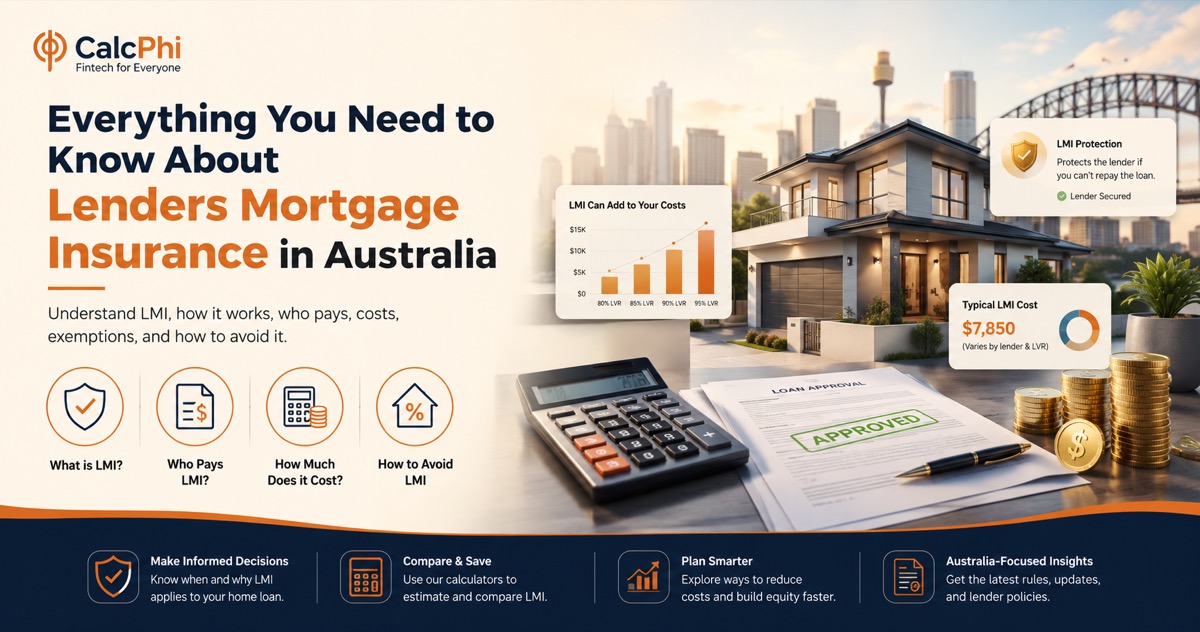
Buying your first home in Australia with less than a 20% deposit? There is a good chance you will encounter Lenders Mortgage Insurance — a cost that surprises many first-time buyers because, despite its name, it does nothing to protect you. Understanding exactly what LMI is, how much it costs at different deposit levels, and the legitimate ways to avoid it can save you thousands of dollars before you even get the keys.
What Is Lenders Mortgage Insurance?
Lenders Mortgage Insurance is a one-off premium that a borrower pays to protect the lender if the borrower defaults on a home loan. It kicks in whenever you borrow more than 80% of a property's value — in other words, when your deposit is less than 20%. The ratio of your loan to the property's value is called the Loan-to-Value Ratio, or LVR. Anything above 80% LVR is the trigger for LMI.
It is worth pausing on that distinction: LMI protects the bank, not you. If you fall behind on repayments and the lender eventually sells the property at a loss, the LMI insurer covers the gap. You, as the borrower, are still liable for any remaining shortfall — and the insurer can pursue you to recover what it paid the bank. You are paying a premium for a policy that offers you zero direct benefit.
In Australia, LMI is provided by two main insurers: Helia (formerly Genworth) and QBE. Some of the larger banks — Commonwealth Bank and Westpac among them — self-insure certain loan types, meaning they take on the risk themselves rather than using an external insurer. As a borrower, you generally cannot choose which insurer your lender uses; that arrangement is set at the lender level.
How Much Does LMI Cost in Australia?
LMI premiums are calculated as a percentage of the loan amount, not the property value. The rate itself is determined by two factors: your LVR and the size of your loan. Both push the premium higher as they increase, and the relationship is not linear — crossing certain LVR thresholds causes the rate to jump sharply.
At an 85% LVR, a borrower might pay around 0.9% of the loan amount, while at 95% LVR that figure can reach 3.5% or more. Here are indicative ranges based on current market data:
| Property Value | Deposit | LVR | Estimated LMI Range |
|---|---|---|---|
| $600,000 | $60,000 (10%) | 90% | $8,000 – $12,000 |
| $600,000 | $30,000 (5%) | 95% | $15,000 – $20,000 |
| $800,000 | $80,000 (10%) | 90% | $11,000 – $17,000 |
| $800,000 | $40,000 (5%) | 95% | $20,000 – $28,000 |
Indicative estimates based on published Helia and QBE rate cards. Your actual premium will vary by lender, state, and loan type. Use CalcPhi's free LMI Calculator to get a tailored estimate in seconds.
The Hidden Cost of Capitalising LMI
Most borrowers choose not to pay LMI upfront as a lump sum. Instead, they capitalise it — adding the premium onto the loan balance. This avoids a large cash outlay at settlement, but it comes with a significant hidden cost. A $20,000 LMI premium capitalised over 30 years at current rates could cost you significantly more in total interest — potentially adding another $20,000–$25,000 on top of the original premium. If you add a $30,000 LMI premium to a loan at 6% interest over 30 years, you will pay roughly $35,000 in additional interest on top of the premium itself, making the true cost of that LMI closer to $65,000.
This is why it is worth stress-testing your deposit strategy carefully. Use CalcPhi's Mortgage Calculator to compare your total repayments with and without a capitalised LMI premium — the difference over 30 years is often more sobering than the upfront number suggests.
Does LMI Vary by State?
Yes. State stamp duty on LMI applies in some states — for example, 10% in Victoria — and must be added to the base premium. GST also applies to the premium itself (at 10%, less a small Reduced Input Tax Credit offset). CalcPhi's LMI estimate automatically accounts for both of these in the total figure.
Why So Many Australians Pay LMI
Saving a 20% deposit sounds straightforward until you look at what that actually means in dollar terms across Australian capital cities. The average time to save a 20% deposit in Sydney now exceeds 11 years, and in Melbourne it exceeds 9 years, during which prices continue to climb. This is not a fringe problem — according to APRA data, over 60% of first home buyers in Australia enter the market with less than a 20% deposit.
For a buyer looking at a median Sydney home, a 20% deposit could mean finding $180,000 to $200,000 in cash before even considering stamp duty, conveyancing, and moving costs. Waiting to hit that threshold can mean spending years paying rent while the market moves further away. LMI, in that context, becomes a cost some buyers consciously choose to pay in exchange for entering the market sooner. Whether that trade-off makes sense depends heavily on your specific market, timeline, and borrowing costs — and it is a decision worth running through CalcPhi's Rent vs Buy Calculator before committing either way.
How to Avoid Paying LMI
LMI is not inevitable, even if you cannot reach a 20% deposit. There are several legitimate strategies that either eliminate or significantly reduce the premium.
1. The First Home Guarantee (No LMI with a 5% Deposit)
The most significant LMI-avoidance tool available to first home buyers in 2026 is the First Home Guarantee, a federal government scheme administered through Housing Australia. Under the scheme, the government guarantees the shortfall between your deposit and 20%, meaning the lender treats the loan as if it had an 80% LVR — and LMI is waived entirely.
The scheme was substantially expanded in October 2025. The previous annual cap of 35,000 guarantee places per year has been abolished, so all eligible first home buyers who meet the criteria can now apply without worrying about places running out. Income caps were also removed at the same time.
Property price caps were increased significantly in most capital cities to better reflect current market values. Key caps effective 1 October 2025 include: New South Wales (Sydney and regional centres) at $1,500,000; Queensland (Brisbane, Gold Coast, Sunshine Coast) at $1,000,000; Victoria (Melbourne and Geelong) at $950,000; Western Australia (Perth) at $850,000; and South Australia (Adelaide) at $900,000.
To qualify, you must be an Australian citizen or permanent resident aged 18 or over, a first home buyer (or someone who has not owned residential property in Australia for the past 10 years), and intend to occupy the property as your principal place of residence. Investment purchases are not eligible. The scheme is available through over 50 participating lenders including all four major banks.
Want to see what your repayments look like with a 5% deposit under the First Home Guarantee? Run the numbers instantly with CalcPhi's First Home Buyer Calculator — it covers stamp duty, FHOG eligibility, and deposit requirements by state.
2. Save a 20% Deposit
The most straightforward way to avoid LMI is to save until your deposit reaches 20% of the purchase price. At that point, your LVR drops to 80% and LMI is not required. The trade-off is time — particularly in high-growth markets where prices may rise faster than you can save.
Even a small increase in your deposit can shift you into a lower LVR tier and slash your LMI by thousands. If you are at 93% LVR, pushing to 90% through a few more months of saving could cut your premium significantly. The LVR tiers matter — it is not a smooth curve, but a step function where crossing certain thresholds reduces the rate materially.
3. Use a Family Guarantor
A guarantor loan allows a family member — typically a parent — to use equity in their own property as additional security for your loan. This can bring the lender's effective security above the 80% threshold without requiring you to have a 20% cash deposit, eliminating the need for LMI.
Guarantor arrangements come with real risk for the guarantor. If you default, the lender can pursue the guarantor's property. These structures should be entered into with clear legal and financial advice for both parties. The guarantee is usually limited to the portion of the loan above 80% LVR and can be released once you have built sufficient equity — typically when you hit 80% LVR through repayments and/or property growth.
4. Profession Waivers
Some lenders waive LMI entirely for borrowers in specific professions — typically those considered lower risk due to income stability and career trajectory. Professions that commonly qualify include doctors, dentists, lawyers, and certain other health professionals, depending on the lender's internal criteria.
If you work in one of these fields, ask your lender or broker directly whether a profession waiver applies — it is not always advertised prominently. A broker knows which lenders offer profession waivers, which accept the First Home Guarantee, and which have the most competitive LMI premiums when LMI cannot be avoided.
5. Choose a Lender with Lower LMI Premiums
LMI costs can vary significantly between lenders for the same loan, making it important to compare options. Because different banks have arrangements with different insurers, the same borrower at the same LVR can pay materially different premiums depending on who they borrow from. This is an often-overlooked factor in lender comparison — the headline interest rate gets all the attention, but a difference of $5,000 in LMI is just as real as a difference in rate. If LMI is unavoidable in your situation, comparing lenders specifically on LMI cost — not just the interest rate — is worthwhile.
Is It Ever Worth Paying LMI?
LMI is not always the enemy. In a fast-rising market, the cost of waiting to hit a 20% deposit can exceed the LMI premium several times over if property values increase significantly during that period. Paying $15,000 in LMI to enter a market that grows by $60,000 in the next two years is not necessarily a bad financial decision — though it involves judgment calls about future market conditions that nobody can make with certainty.
The key is to treat LMI as a known, quantifiable cost and model it explicitly rather than treating it as an unavoidable mystery fee. Use CalcPhi's LMI Calculator to get a clear number, then use the Mortgage Calculator to see what capitalising that premium does to your total repayments over the life of the loan. Armed with those two numbers, the decision about whether to wait or buy becomes a real financial comparison rather than a gut feeling.
Also consider the stamp duty implications of your purchase. First home buyers in most states receive concessions, but these vary significantly by state and purchase price. CalcPhi's Stamp Duty Calculator covers all states and territories, including first home buyer concessions, so you can see your total upfront costs clearly before making an offer.

Frequently Asked Questions
-
What is Lenders Mortgage Insurance and who does it protect?
LMI is a one-off insurance premium charged when you borrow more than 80% of a property's value. It protects the lender — not the borrower — if you default on the loan and the property sells for less than the outstanding balance. Despite being paid by the borrower, the policy benefit flows entirely to the bank or financial institution that issued the loan.
-
How much does LMI cost on a $700,000 property?
It depends on your deposit. With a 10% deposit (90% LVR), LMI on a $700,000 property is typically in the range of $9,000 to $15,000. With a 5% deposit (95% LVR), that range rises to approximately $18,000 to $25,000. Use CalcPhi's LMI Calculator for a more precise estimate based on your state and loan details.
-
Can I avoid LMI with a 5% deposit?
Yes, through the First Home Guarantee. The federal government scheme allows eligible first home buyers to purchase with a 5% deposit while the government guarantees the remaining 15%, so no LMI is required. As of October 2025, there are no income caps and no limits on the number of places available. Price caps apply by state — Sydney's cap is currently $1,500,000.
-
Can LMI be added to the loan instead of paid upfront?
Yes. Most lenders allow you to capitalise LMI, meaning the premium is added to your loan balance rather than paid as a cash lump sum at settlement. This avoids the immediate outlay but increases your loan amount, your LVR, and the total interest you pay over the life of the loan. A $20,000 LMI premium capitalised over 30 years can cost significantly more than $20,000 in additional interest.
-
Is LMI tax deductible in Australia?
For owner-occupied properties, LMI is generally not tax deductible. For investment properties, LMI may be deductible — however, it is typically spread over five years or the life of the loan (whichever is shorter) rather than claimed in full in the year it is paid. Always confirm your specific circumstances with a registered tax agent, as the ATO's treatment can vary based on individual situations.
-
Does LMI apply when I refinance?
If you refinance to a new lender and your LVR at the time of refinancing is above 80%, you may be required to pay LMI again — even if you already paid it on the original loan. LMI is a one-off policy tied to a specific loan with a specific lender, not to you as a borrower. Partial refunds may be available from your original insurer if you discharge the loan within the first year or two, but these vary by insurer and reduce over time.
This article is for educational and informational purposes only. CalcPhi calculators provide estimates based on general assumptions and should not be treated as a quote or formal financial advice. LMI premiums, government scheme eligibility criteria, and property price caps are subject to change. Always verify current details with Housing Australia and your participating lender. Consult a licensed mortgage broker or financial adviser for advice tailored to your personal circumstances.

Use our Australia calculators:
LMI Calculator → First Home Buyer Calculator → Mortgage Calculator → Stamp Duty Calculator → Rent vs Buy Calculator →