How Much Deposit Do You Need to Buy a House in Australia in 2026?
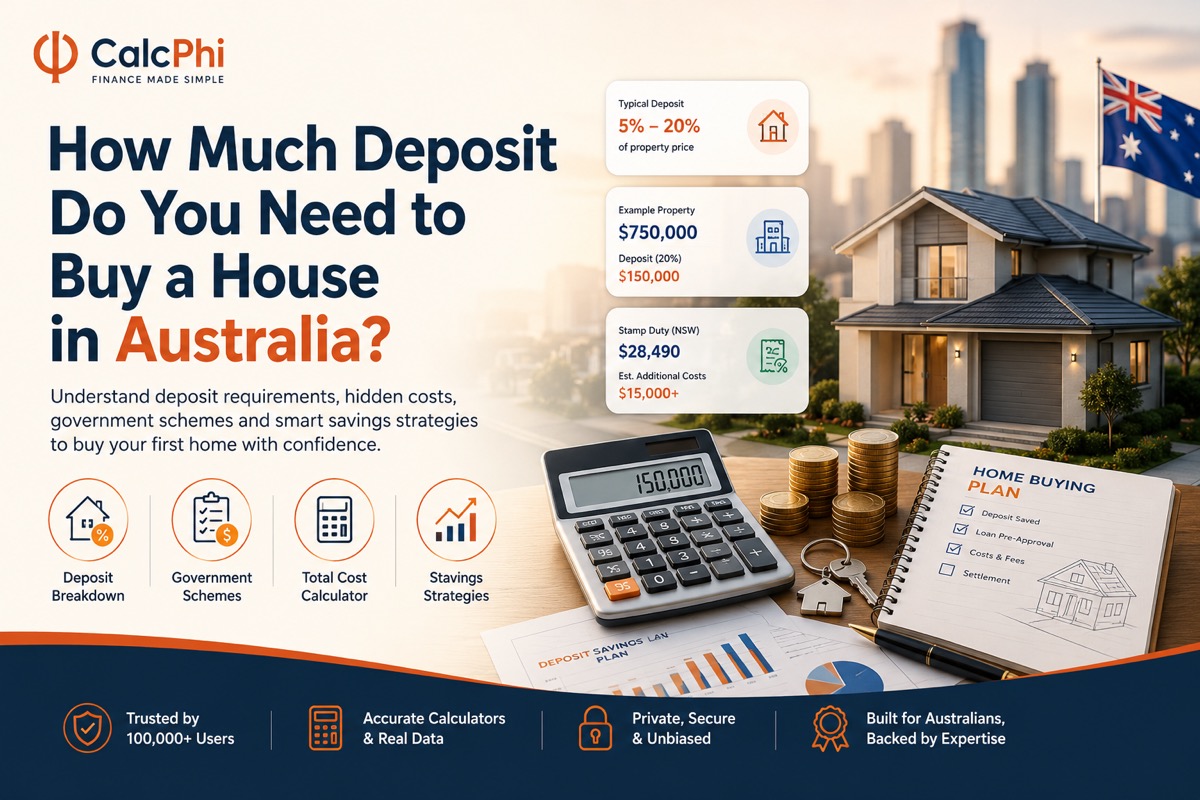
You have probably seen the number 20% thrown around everywhere when it comes to house deposits. And while that figure is not wrong, it is far from the full picture. In 2026, Australians can buy a home with as little as 2% deposit under government-backed schemes — and many buyers are doing exactly that. But the deposit is only one piece of the puzzle. Stamp duty, legal fees, building inspections, and lender requirements all add to the cash you need on settlement day. This guide breaks down every deposit scenario available to Australian buyers in 2026, explains what each one really costs, and shows you how to work out the exact number you need — by city, by purchase price, and by the scheme you qualify for.
Why the 20% Rule Exists — and When It Actually Applies
The 20% deposit benchmark comes from the way Australian lenders manage risk. When you borrow more than 80% of a property's purchase price — meaning your loan-to-value ratio (LVR) goes above 80% — the lender considers you a higher-risk borrower. To protect themselves, they require you to pay for Lenders Mortgage Insurance (LMI).
LMI is important to understand: it protects the lender, not you. If you default on the loan and the bank sells the property at a loss, the LMI insurer covers the lender's shortfall. You pay the premium, often by having it rolled into your loan amount, and you get no protection from it personally. On a $750,000 property with a 5% deposit, LMI can cost anywhere from $18,000 to $25,000 — and because it is capitalised into your loan, you end up paying interest on it for up to 30 years.
That said, a 20% deposit is not the only way to avoid LMI in 2026. Government guarantee schemes have changed the equation significantly for eligible buyers.
Minimum Deposit Requirements in 2026 — All Your Options
The Standard Route (No Government Scheme)
Without any government scheme, most Australian lenders will approve a loan with a 5% deposit, but you will pay LMI. Some lenders require 10% as a minimum. At 20% deposit, LMI drops to zero — this is the threshold most borrowers are targeting when they talk about "saving a proper deposit."
First Home Guarantee (Federal — 35,000 Places Per Year)
The First Home Guarantee allows eligible first home buyers to purchase with just a 5% deposit and pay no LMI. The federal government guarantees 15% of the property's value to the lender, bringing the effective LVR to 80% from the bank's perspective. To qualify in 2026, you need to earn under $125,000 as a single buyer or under $200,000 combined as a couple. Property price caps also apply — in Sydney and other capital cities, the cap is $900,000; in regional areas it is lower. You must be an Australian citizen or permanent resident intending to live in the property.
Regional First Home Buyer Guarantee (10,000 Places Per Year)
Identical conditions to the First Home Guarantee above, but reserved for buyers purchasing in regional Australia who have lived or worked in that region for at least 12 months. With 10,000 places allocated annually, competition for spots is meaningful in popular regional areas.
Family Home Guarantee (5,000 Places Per Year)
The Family Home Guarantee is aimed at single parents and single legal guardians with at least one dependent child. If you qualify, you can purchase with as little as a 2% deposit and pay no LMI — the government guarantees the remaining 18%. Income cap for this scheme is $125,000 for the single applicant. A 2% deposit on a $600,000 home is just $12,000 — a dramatically lower barrier than the standard route, designed specifically because single-income households face the steepest climb in getting onto the property ladder.
Help to Buy Scheme (Shared Equity — Launched 2024)
Under Help to Buy, the federal government co-purchases a share of your home alongside you — up to 40% for new builds and 30% for existing properties. You only need a 2% deposit, and because the government owns a portion of the property, your loan and your repayments are substantially smaller. You repay the government's share when you sell, or you can buy it out over time. Income caps are $90,000 for singles and $120,000 for couples.
No-LMI Professional Loans
Several major lenders offer LMI waivers for specific professions at up to 90% LVR — meaning a 10% deposit with no LMI. Eligible professions commonly include medical doctors, dentists, pharmacists, veterinarians, lawyers, accountants, engineers, and in some cases pilots and senior executives. Each lender sets its own list. A mortgage broker who specialises in professional loans is worth consulting if your occupation may qualify.
Guarantor Loans
If a parent or close family member is willing to use the equity in their own property as additional security for your loan, you may be able to borrow up to 100% of the purchase price with no deposit and no LMI. The parent does not hand over cash — they offer their property as collateral, which means their property is at risk if you default. This arrangement requires careful legal structuring and independent legal advice for both parties.
What Deposit Do You Need By City in 2026?
Median property prices vary enormously across Australia, so the deposit you need in dollars looks very different depending on where you want to buy. The figures below use approximate median house prices as of early 2026.
| City | Approx. Median House Price | 5% Deposit | 10% Deposit | 20% Deposit |
|---|---|---|---|---|
| Sydney | $1,450,000 | $72,500 | $145,000 | $290,000 |
| Melbourne | $920,000 | $46,000 | $92,000 | $184,000 |
| Brisbane | $870,000 | $43,500 | $87,000 | $174,000 |
| Perth | $760,000 | $38,000 | $76,000 | $152,000 |
| Adelaide | $780,000 | $39,000 | $78,000 | $156,000 |
| Canberra | $850,000 | $42,500 | $85,000 | $170,000 |
| Hobart | $660,000 | $33,000 | $66,000 | $132,000 |
| Darwin | $540,000 | $27,000 | $54,000 | $108,000 |
Note that many of these median prices exceed the First Home Guarantee property price cap for capital cities ($900,000). In Sydney in particular, buyers using the First Home Guarantee face the challenge of needing to buy below that threshold in a market where the median significantly exceeds it — which often means apartments or outer-suburb properties. Use CalcPhi's First Home Buyer Calculator to see your deposit requirement, estimated stamp duty, and total upfront costs by state.
LMI Cost by Loan Amount and LVR
The table below shows approximate LMI premiums (capitalised into the loan) for different scenarios. Actual premiums vary by insurer (Helia and QBE are the two main LMI providers in Australia) and individual lender arrangements. A $22,000 LMI premium on a 30-year loan at 6.2% costs approximately $47,000 in total repayments once interest is included.
| Purchase Price | LVR 95% (5% deposit) | LVR 90% (10% deposit) | LVR 85% (15% deposit) | LVR 80% (20% deposit) |
|---|---|---|---|---|
| $500,000 | ~$15,000 | ~$9,500 | ~$5,000 | $0 |
| $600,000 | ~$18,500 | ~$11,500 | ~$6,000 | $0 |
| $700,000 | ~$22,000 | ~$13,500 | ~$7,000 | $0 |
| $800,000 | ~$26,000 | ~$16,000 | ~$8,200 | $0 |
| $900,000 | ~$30,000 | ~$18,000 | ~$9,500 | $0 |
Use CalcPhi's LMI Calculator to estimate the cost for your specific loan size and LVR.
The Costs Beyond the Deposit: What You Actually Need on Settlement Day
This is where many first home buyers get caught out. The deposit is the biggest number, but it is not the only one.
- Stamp duty is a state government tax on the purchase of property. In most states, first home buyers receive concessions on properties below a certain threshold. In NSW, stamp duty is waived entirely for first home buyers purchasing properties up to $800,000. In Victoria, full exemption applies for purchases up to $600,000. In Queensland, the exemption applies up to $550,000 for new builds receiving the First Home Owner Grant. For properties above the concession threshold, stamp duty can add $15,000 to $50,000+ to your upfront costs. Use CalcPhi's Stamp Duty Calculator for your exact figure by state.
- Conveyancing and legal fees typically run between $1,500 and $3,000 for a standard residential purchase.
- Building and pest inspections cost between $400 and $800. Skipping these to save money is one of the most common and costly mistakes first home buyers make.
- Loan application and establishment fees vary by lender — many have moved to zero application fees, but some still charge up to $600.
- Moving costs of $500 to $2,500 depending on distance and volume.
A practical rule of thumb: budget 3% to 5% of the purchase price for total upfront costs beyond your deposit. On a $750,000 property, that means having $22,500 to $37,500 in additional cash available at settlement.
Total Cash Required at Settlement
The table below shows the total cash you need at settlement — deposit plus stamp duty plus other upfront costs — across different purchase prices and deposit levels in NSW. Figures assume first home buyer concessions apply where eligible.
| Purchase Price | Deposit Level | Deposit ($) | LMI (if no scheme) | Stamp Duty (NSW FHB) | Legal + Other | Total Cash Needed |
|---|---|---|---|---|---|---|
| $600,000 | 5% | $30,000 | $14,000 (or $0 with FHBG) | $0 (waived) | $2,500 | $32,500 (scheme) / $46,500 (no scheme) |
| $600,000 | 10% | $60,000 | $8,500 (or $0 with FHBG) | $0 (waived) | $2,500 | $62,500 (scheme) / $71,000 (no scheme) |
| $600,000 | 20% | $120,000 | $0 | $0 (waived) | $2,500 | $122,500 |
| $700,000 | 5% | $35,000 | $16,500 (or $0 with FHBG) | $0 (waived) | $2,500 | $37,500 (scheme) / $54,000 (no scheme) |
| $700,000 | 20% | $140,000 | $0 | $0 (waived) | $2,500 | $142,500 |
| $800,000 | 5% | $40,000 | $19,500 (or $0 with FHBG) | $0 (waived ≤$800K NSW) | $2,500 | $42,500 (scheme) / $62,000 (no scheme) |
| $800,000 | 20% | $160,000 | $0 | $0 (waived) | $2,500 | $162,500 |
| $900,000 | 5% | $45,000 | $22,500 (or $0 with FHBG) | $9,500 (concession) | $2,500 | $57,000 (scheme) / $79,500 (no scheme) |
| $900,000 | 20% | $180,000 | $0 | $9,500 (concession) | $2,500 | $192,000 |
FHBG = First Home Guarantee. Stamp duty figures are for NSW first home buyers — other states vary significantly. Use CalcPhi's Stamp Duty Calculator for your specific state.
Using the First Home Super Saver Scheme to Build Your Deposit
The First Home Super Saver (FHSS) scheme is one of the most tax-efficient ways for Australians to save a home deposit, and it is significantly underused. You make voluntary contributions to your superannuation fund — above and beyond your employer's compulsory contributions — of up to $15,000 per financial year. The total you can save under FHSS and later withdraw is capped at $50,000 per person.
Because these contributions go into super, they are taxed at just 15% (the concessional rate) rather than at your marginal tax rate, which for someone earning $80,000 per year is 32.5%. On a $15,000 contribution, the tax saving compared to saving the same money in a bank account (after paying income tax first) is around $2,600. Over three years of maximum contributions, that is close to $7,800 in additional savings just from the tax advantage — before you factor in any investment earnings inside super.
When you are ready to buy, you apply to the ATO to release the funds. FHSS withdrawals are typically treated as genuine savings by most lenders, though you should confirm this with your specific lender before relying on it as your primary deposit source.
How Lenders Assess "Genuine Savings"
Most lenders require evidence that your deposit has been accumulated over at least three to six months through your own income and disciplined saving. Money gifted by parents, a sudden windfall, or a tax refund deposited two weeks before your application does not automatically qualify as genuine savings.
The practical workaround is to have gifted funds deposited into your account at least three to six months before you apply — long enough that they appear "seasoned" in your statements. FHSS withdrawals are typically treated as genuine savings by most lenders. Funds from the sale of another asset (a car, for example) may or may not qualify depending on the lender. If you are in any doubt, speak to a mortgage broker before submitting an application, since a declined application can affect your credit file.
Should You Buy With a Small Deposit or Wait and Save More?
The case for buying sooner with a smaller deposit: In markets where property prices are rising faster than you can save — which describes Sydney and Melbourne through most of the last two decades — waiting to accumulate a 20% deposit can mean chasing a moving target. A property worth $800,000 today that grows at 6% per year is worth $1,070,000 in five years. The extra $122,000 in deposit you saved is dwarfed by the $270,000 increase in purchase price. Getting in sooner, even with LMI costs, can result in significantly more wealth over the long term.
The case for saving a larger deposit: In stable or slower-growing markets, the equation shifts. A larger deposit means a smaller loan, lower monthly repayments, and less financial stress. You also protect yourself against the risk of falling property prices — if prices dip 10% after you buy with a 5% deposit, you are in negative equity. That limits your ability to refinance or sell without a loss.
Use CalcPhi's Mortgage Calculator to model your monthly repayments at different loan sizes, and CalcPhi's Savings Goal Calculator to see exactly how long it will take you to reach your deposit target.

Related Guides
- First Home Buyer Australia 2026: The Complete Guide From Saving to Settlement
- First Home Buyer Grants Australia 2026: Every State Scheme Explained
- Lenders Mortgage Insurance (LMI): What It Costs and How to Avoid It
- Stamp Duty Australia 2026: What You Pay in Every State and Territory
- Home Loan Pre-Approval Australia: How It Works and What You Need
Frequently Asked Questions
-
How much deposit do I need to buy a house in Australia in 2026?
The minimum deposit is 2% under the Family Home Guarantee (for eligible single parents), 5% under the First Home Guarantee and Regional First Home Buyer Guarantee (no LMI for eligible buyers), and typically 5% to 10% through standard lender products (with LMI). A 20% deposit avoids LMI entirely on any loan. The exact cash you need on settlement day is higher once stamp duty, legal fees, and inspection costs are added — budget an additional 3% to 5% of the purchase price on top of your deposit.
-
What is the First Home Guarantee and how many places are available in 2026?
The First Home Guarantee is a federal government scheme that lets eligible first home buyers purchase with a 5% deposit and zero LMI. The government guarantees 15% of the property value to the lender. There are 35,000 places available per financial year. Income caps apply — $125,000 for singles, $200,000 for couples — and property price caps vary by location (up to $900,000 in major capital cities). Places are allocated on a first-come, first-served basis through participating lenders.
-
Do I have to pay stamp duty on top of my deposit?
Yes, stamp duty is a separate cost paid from your own cash at settlement — lenders do not include it in the mortgage. For first home buyers, many states provide concessions or full waivers on properties below a certain price. In NSW, stamp duty is fully waived on purchases up to $800,000 for established properties. In VIC, the full exemption applies up to $600,000. Above those thresholds, a reduced rate applies. Other states have their own thresholds and rules. Use CalcPhi's Stamp Duty Calculator to find your exact figure.
-
Can I use my superannuation to help fund a house deposit?
Yes, through the First Home Super Saver (FHSS) scheme. You can make voluntary contributions to super of up to $15,000 per year, with a total withdrawal cap of $50,000 per person. These contributions are taxed at just 15% going in, making it a tax-effective way to save your deposit compared to keeping money in a standard savings account. Apply to the ATO for a release once you are ready to purchase.
-
What is LMI and how much does it cost?
Lenders Mortgage Insurance (LMI) is paid by you but protects the lender if you default. It applies whenever you borrow more than 80% of the property's value (less than 20% deposit) outside of a government guarantee scheme. The premium depends on your loan size and LVR. On a $700,000 purchase with a 5% deposit (95% LVR), LMI is approximately $18,000 to $24,000. This is usually capitalised into your loan, meaning you pay interest on it over the full loan term. Use CalcPhi's LMI Calculator to estimate the cost for your specific loan.
-
Is it better to buy with a 5% deposit or wait and save 20%?
There is no universal answer — it depends on how fast property prices are growing in your target market, your income stability, and your risk tolerance. In high-growth markets like Sydney, buying sooner with a smaller deposit often results in greater long-term wealth, because price growth outpaces LMI costs. In stable or slower-growing markets, the case for saving a larger deposit is stronger. Compare the numbers for your specific situation using CalcPhi's Mortgage Calculator and Rent vs Buy Calculator.
Use our Australia calculators:
First Home Buyer Calculator → LMI Calculator → Stamp Duty Calculator → Mortgage Calculator → Borrowing Power Calculator → Savings Goal Calculator →Disclaimer: The information in this article is for educational and estimation purposes only. It does not constitute financial, legal, or tax advice. Figures such as stamp duty thresholds, grant amounts, scheme eligibility criteria, and property price caps are based on information current as at May 2026 and may change. Always verify details with the relevant state revenue office, the Australian Government's Housing Australia portal, or the ATO before making financial decisions. Consult a licensed financial adviser (holding an AFS licence) or mortgage broker for advice tailored to your personal circumstances.
