Term Insurance India 2026: How Much Cover Do You Actually Need?

Term insurance is the single most important financial product for any Indian who has someone depending on their income. Yet a majority of working Indians either skip it entirely, buy too little of it, or — worst of all — buy an endowment or ULIP plan that gives them a fraction of the protection they actually need. By the end of this guide, you will know exactly how much cover you need, what it costs in 2026, and the mistakes that lead to claim rejection.
What Is Term Insurance and Why Is It Different?
Term insurance is pure life cover. You pay a fixed annual premium, and if you pass away during the policy term, your nominees receive the full sum assured as a tax-free lump sum. If you survive the policy term, the policy simply ends — there is no payout. This is what makes it genuinely affordable.
A ₹1 crore term plan for a 30-year-old non-smoking male typically costs ₹9,000 to ₹12,000 per year — roughly ₹750 to ₹1,000 per month. For that amount, your family is protected against the financial consequences of losing your income — outstanding home loans, children's education, and day-to-day expenses — for the next 30 years. Nothing else in financial planning gives you that level of protection per rupee spent.
Why Not Endowment or ULIP?
Endowment plans and ULIPs are marketed as "life insurance plus savings," which sounds appealing. The reality is very different.
A ₹1 crore endowment plan costs ₹3 lakh to ₹5 lakh per year in premium. The same cover via a term plan costs ₹9,000 to ₹12,000 per year. The "savings" component in an endowment plan typically earns a 4–5% CAGR — well below what a simple FD or PPF would give you, and far below what a mutual fund SIP can deliver over the long term. You are paying a massive premium for substandard returns and inadequate insurance.
The correct approach is to keep insurance and investment completely separate. Buy a pure term plan for protection. For wealth creation, use a SIP in a mutual fund, park money in PPF, or contribute to NPS.
How Much Term Insurance Cover Do You Actually Need?
The right number depends on your income, outstanding liabilities, dependants, and the lifestyle your family needs to sustain if you are no longer there. There are two widely used methods.
Method 1: The Human Life Value (HLV) Approach
Human Life Value is the present value of all future income you would have earned had you lived and worked to retirement. The formula used in practice is:
Sum Assured = (Annual Income × Years to Retirement × 0.50) + Total Outstanding Loans
The 0.50 factor accounts for the fact that your family's expenses, while lower without you, are not zero — your income replacement need is roughly half your total earnings. Adding outstanding loans ensures your family is not left with debt.
Method 2: The 10–15x Income Rule
For most people, especially those in their 30s and early 40s, a simpler benchmark works well: your cover should be 10 to 15 times your annual gross income, plus the total of all outstanding loans.
| Annual Income | Outstanding Loans | Minimum Cover (10x) | Recommended Cover (15x) |
|---|---|---|---|
| ₹6,00,000 | None | ₹60 lakh | ₹90 lakh |
| ₹10,00,000 | ₹30L home loan | ₹1.30 crore | ₹1.80 crore |
| ₹15,00,000 | ₹50L home loan | ₹2.00 crore | ₹2.75 crore |
| ₹25,00,000 | ₹80L home loan | ₹3.30 crore | ₹4.55 crore |
| ₹50,00,000 | ₹1.5Cr home + car loan | ₹6.50 crore | ₹9.00 crore |
The 10x figure is the floor — the minimum your family needs to survive. The 15x figure is what most certified financial planners recommend as a comfortable buffer, factoring in inflation and rising costs of education and healthcare.
A Worked Example: Rahul, Age 32, Bengaluru
Rahul earns ₹18 lakh per year. He has a ₹55 lakh home loan, a ₹6 lakh car loan, a non-working spouse, and two children aged 4 and 7. He is 28 years from retirement.
- HLV method: (₹18L × 28 × 0.50) + ₹61L = ₹2.52 crore + ₹61L = approximately ₹3.1 crore
- 10–15x rule: ₹1.80 crore (10x) + ₹61L loans = ₹2.41 crore minimum; ₹3.31 crore recommended
A ₹3 crore term plan is the sensible choice. At 32, that costs roughly ₹24,000 to ₹30,000 per year — about ₹2,000 to ₹2,500 per month for complete financial protection for his family.
What Does Term Insurance Cost in India in 2026?
Premiums depend on your age, health, smoking status, and the policy term. The table below shows indicative annual premiums for non-smoking males buying online plans directly. Every year you wait, the premium increases — and it stays higher for the entire policy term.
| Age | ₹1 Crore Cover (30 yr) | ₹2 Crore Cover (30 yr) | ₹5 Crore Cover (30 yr) |
|---|---|---|---|
| 25 years | ₹7,000–9,000 | ₹13,000–17,000 | ₹30,000–40,000 |
| 30 years | ₹9,000–12,000 | ₹17,000–22,000 | ₹40,000–52,000 |
| 35 years | ₹13,000–17,000 | ₹24,000–32,000 | ₹58,000–75,000 |
| 40 years | ₹20,000–27,000 | ₹38,000–50,000 | ₹90,000–1,20,000 |
| 45 years | ₹35,000–45,000 | ₹65,000–85,000 | ₹1.5L–2.0L |
Female policyholders generally pay 15–20% lower premiums than males for the same cover. Smokers can expect premiums 50–100% higher. Buying at 25 instead of 35 can save ₹4,000 to ₹8,000 per year for 30+ years — a saving of ₹1.2 lakh to ₹2.4 lakh over the life of the policy.
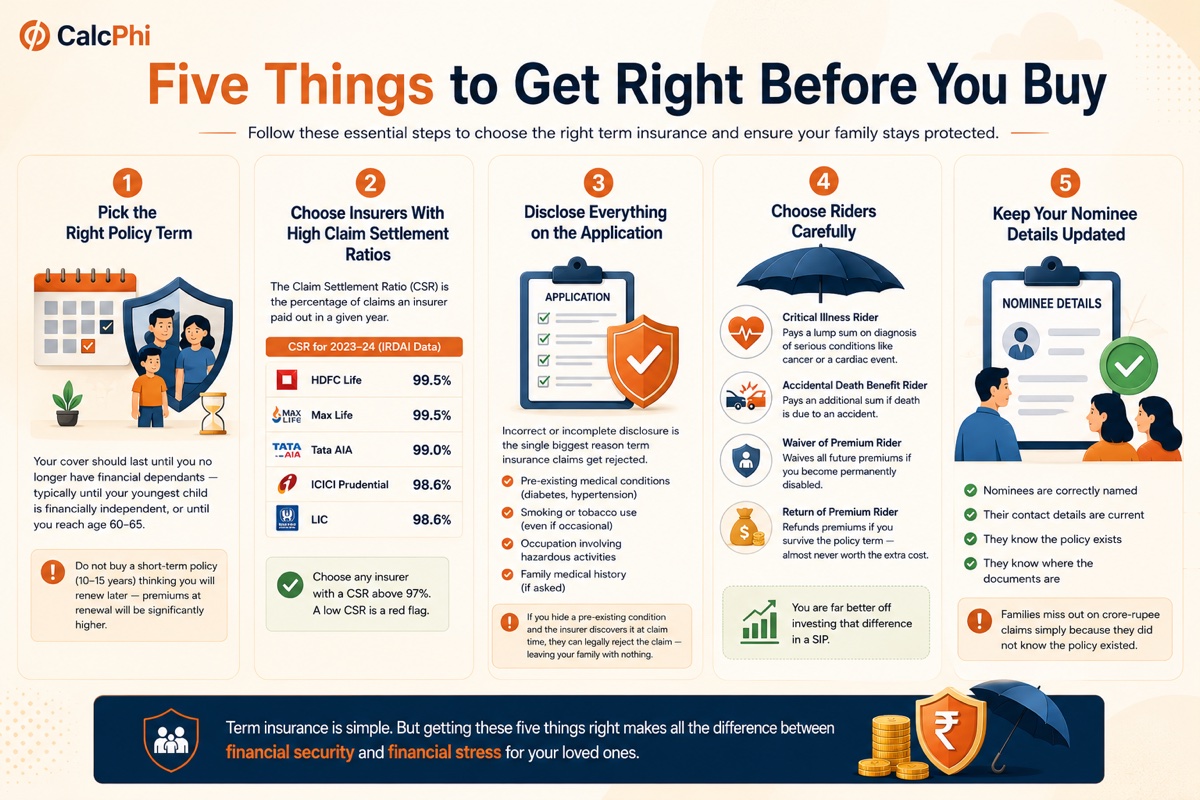
Five Things to Get Right Before You Buy
1. Pick the Right Policy Term
Your cover should last until you no longer have financial dependants — typically until your youngest child is financially independent, or until you reach age 60–65. Do not buy a short-term policy (10–15 years) thinking you will renew later — premiums at renewal will be significantly higher.
2. Choose Insurers With High Claim Settlement Ratios
The Claim Settlement Ratio (CSR) is the percentage of claims an insurer paid out in a given year. For 2023–24, IRDAI data shows: HDFC Life (99.5%), Max Life (99.5%), Tata AIA (99.0%), ICICI Prudential (98.6%), LIC (98.6%). Choose any insurer with a CSR above 97%. A low CSR is a red flag.
3. Disclose Everything on the Application
Incorrect or incomplete disclosure is the single biggest reason term insurance claims get rejected. You must disclose: pre-existing medical conditions (diabetes, hypertension), smoking or tobacco use (even if occasional), your occupation if it involves hazardous activities, and your family medical history if asked. If you hide a pre-existing condition and the insurer discovers it at claim time, they can legally reject the claim — leaving your family with nothing.
4. Choose Riders Carefully
A few riders are genuinely useful. The critical illness rider pays a lump sum on diagnosis of serious conditions like cancer or a cardiac event — worth considering if critical illness runs in your family. The accidental death benefit rider pays an additional sum if death is due to an accident. The waiver of premium rider waives all future premiums if you become permanently disabled. The return of premium rider — which refunds premiums if you survive the policy term — is almost never worth the extra cost. You are far better off investing that difference in a SIP.
5. Keep Your Nominee Details Updated
Your term policy is only as useful as your nominee details. Make sure nominees are correctly named, their contact details are current, and they know the policy exists and where the documents are. Families miss out on crore-rupee claims simply because they did not know the policy existed.
The Tax Angle: Section 80C and 10(10D)
Term insurance premiums qualify for a deduction under Section 80C of the Income Tax Act, up to ₹1.5 lakh per year. This is available under the old tax regime only. If you have opted for the new tax regime (the default for FY 2026-27), Section 80C deductions are not available — but the claim payout your nominees receive is still fully tax-free under Section 10(10D), regardless of the tax regime.
When Should You Buy Term Insurance?
The right time to buy is the moment you have a financial dependant. If a spouse, child, or parent depends on your income to meet their basic needs, you need term insurance now. Waiting until you "settle down" or "earn more" is the single most common and most expensive mistake people make.
If you already have a term plan but bought it three or more years ago, check whether your sum assured still reflects your current income and loan obligations. A ₹50 lakh policy bought when you were earning ₹6 lakh per year is likely badly underinsured now that you earn ₹15 lakh and have a home loan.
Term Insurance vs Home Loan Insurance: Which Is Better?
If you have a home loan, your bank may have pushed you to buy a Home Loan Protection Plan (HLPP) — an insurance product that pays off your outstanding loan balance if you die. These policies have a fundamental flaw: the cover decreases as your loan balance decreases, while your premium stays roughly the same.
A standalone term plan is almost always a better option. The sum assured stays fixed, your family receives the full amount rather than just the loan being cleared, and the premium is often lower. Compare both options for your loan amount before deciding.
Calculate your personalised term insurance cover requirement:
EMI Calculator →Frequently Asked Questions
-
How much term insurance cover do I need in India?
The standard recommendation is 10–15 times your annual gross income plus all outstanding loans. A person earning ₹15 lakh per year with a ₹50 lakh home loan should have at least ₹2 crore to ₹2.75 crore of cover. The exact figure depends on your number of dependants, their financial needs, and how many years of income they would need to replace.
-
What is the best age to buy term insurance in India?
As young as possible — ideally the moment you have a financial dependant, or when you start earning. Premiums are locked at the age of purchase. A ₹1 crore policy bought at 25 costs ₹7,000–9,000 per year; the same policy at 35 costs ₹13,000–17,000 per year. Buying 10 years earlier can save ₹60,000 to ₹80,000 in total premium over a 30-year term.
-
Is term insurance payout taxable in India?
No. The death benefit paid to your nominees is fully tax-free under Section 10(10D) of the Income Tax Act, regardless of the tax regime you are on. The premium you pay is deductible under Section 80C (up to ₹1.5 lakh per year), but only if you are on the old tax regime.
-
Can I have more than one term insurance policy in India?
Yes, you can hold multiple term policies from different insurers. Many financial planners recommend splitting a large cover — say, ₹3 crore — across two insurers (₹1.5 crore each) rather than putting it all with one. This reduces the risk of a single insurer's claim process causing delays and also staggers your premium commitments over time.
-
Why do term insurance claims get rejected in India?
The most common reasons are non-disclosure or misrepresentation of health information (hiding a pre-existing condition), incorrect nominee details, a lapsed policy due to non-payment of premiums, and claims outside the policy term. Disclose everything accurately when you apply, keep premiums paid, and keep nominee details updated.
-
Should I buy term insurance online or through an agent in India?
Online plans are typically 10–15% cheaper than agent-sold plans for identical cover, because there is no commission component. If you are comfortable completing the application online and doing your own research, buying directly from an insurer's website is the better financial decision. If you prefer guidance, an independent fee-based financial planner is preferable to a commission-based agent whose interests may not align with yours.
Disclaimer: The information in this article is for educational and estimation purposes only and does not constitute financial advice. Term insurance premiums and policy terms vary by insurer, age, health, and other factors. Always read the policy document carefully before purchasing. Consult a SEBI-registered financial advisor or IRDAI-licensed insurance advisor for personalised guidance.