Step-Up SIP: Why Increasing Your SIP by 10% a Year Changes Everything

Most people start a SIP, set a fixed monthly amount, and never touch it again. Consistency is the foundation of good investing — but if you leave your SIP amount unchanged year after year while your salary grows, you are quietly making one of the most expensive investment mistakes possible. The solution is a step-up SIP: a strategy so simple it takes under two minutes to activate, yet so powerful it can add lakhs or even crores to your final corpus over a long horizon.
What Is a Step-Up SIP?
A step-up SIP — also called a top-up SIP or booster SIP — is a mutual fund investment plan where your monthly contribution increases automatically by a fixed percentage every year. You set it once, and the increase happens without any manual action on your part.
For example, if you start a SIP of ₹10,000 per month with a 10% annual step-up, here is how your monthly contribution grows:
| Year | Monthly SIP |
|---|---|
| Year 1 | ₹10,000 |
| Year 2 | ₹11,000 |
| Year 3 | ₹12,100 |
| Year 5 | ₹14,641 |
| Year 10 | ₹23,579 |
| Year 20 | ₹61,159 |
By Year 5, you are paying roughly ₹4,600 more per month than when you started — about the cost of one dinner out per week. But the compounding effect on your final corpus is anything but modest.
The Numbers That Make the Case
Let us compare two investors — Priya and Rahul — who both start investing at age 30 in a diversified equity mutual fund delivering 12% annual returns. Both start with ₹10,000 per month.
| Priya (Flat SIP) | Rahul (10% Step-Up SIP) | |
|---|---|---|
| Starting monthly SIP | ₹10,000 | ₹10,000 |
| Monthly SIP in Year 20 | ₹10,000 | ₹61,159 |
| Total amount invested | ₹24 lakhs | ₹57.3 lakhs |
| Final corpus at 12% return | ₹99.9 lakhs | ₹1.76 crore |
| Extra wealth generated | — | +₹76 lakhs |
Rahul ends up with ₹76 lakhs more than Priya. He invested ₹33.3 lakhs more in total — but got back over ₹76 lakhs in additional corpus. That is the leverage of compounding when you keep feeding it a growing stream of capital. Use CalcPhi's free Step-Up SIP Calculator to plug in your own numbers and get the exact corpus comparison.
Why 10% Is the Magic Number
The 10% annual step-up is not arbitrary — it is grounded in the economic reality of the average Indian salaried professional. Industry surveys consistently show that annual salary hikes in India range between 8% and 12%. A 10% step-up aligns your SIP growth with your income growth, which means you are not actually feeling any lifestyle squeeze. The additional SIP amount comes directly out of your increment — before you have had time to inflate your lifestyle to absorb it.
This is the crucial psychological point. The reason most people never increase their SIP is not a lack of money — it is lifestyle creep. Every year, the increment gets absorbed into a slightly bigger restaurant budget, a streaming service upgrade, or an extra EMI. A step-up SIP locks in the increase before you even see the money. If your salary grows at a slower pace, even a 5% step-up adds approximately ₹40 lakhs more than a flat SIP over 20 years on a ₹10,000/month starting amount at 12% returns.
The Inflation Angle: Why a Flat SIP Loses Value Over Time
Here is a perspective most SIP investors miss entirely. Inflation in India has averaged around 5–6% per year over the last decade. If you started a flat SIP of ₹10,000/month in 2016 and kept it unchanged, the real value of your monthly contribution in 2026 is roughly ₹5,500 in today's purchasing power terms. You are not investing ₹10,000 per month in real terms — you are investing the equivalent of ₹5,500.
A step-up SIP of 10% per year does more than grow your corpus — it keeps your real contribution roughly constant after adjusting for inflation, and then goes beyond that to accelerate wealth creation. This is why financial planners consistently recommend a minimum 5% step-up just to stay even with inflation.
The 10-Year Picture: Three Scenarios
A starting SIP of ₹5,000/month at 12% expected annual return, over 10 years:
| Scenario | Starting SIP | Step-Up | Total Invested | Final Corpus |
|---|---|---|---|---|
| No step-up | ₹5,000 | 0% | ₹6.00 lakhs | ₹11.61 lakhs |
| Conservative step-up | ₹5,000 | 5% | ₹7.56 lakhs | ₹14.03 lakhs |
| Standard step-up | ₹5,000 | 10% | ₹9.56 lakhs | ₹17.38 lakhs |
The standard 10% step-up generates nearly ₹5.77 lakhs more than the flat SIP. The total invested difference is ₹3.56 lakhs — but the corpus difference is ₹5.77 lakhs. You are getting back ₹1.62 for every extra rupee invested through the step-up.
Step-Up SIP vs Starting a New SIP: Which Is Better?
Some investors wonder whether to increase an existing SIP or start a separate new one with the increment money. Both approaches work, but the step-up SIP has two practical advantages. First, everything stays in one fund and one folio — tracking is simpler. Second, the automatic nature removes the decision from your hands, and in personal finance, removing friction almost always leads to better outcomes.
That said, if you want to diversify into a different fund type with your annual increment — say, moving from large-cap to mid-cap — starting a separate SIP makes sense. The point is not to rigidly follow one path, but to ensure the increment gets invested somewhere, every year, automatically.
How to Calculate Your Step-Up SIP Goal
Before setting up a step-up SIP, it helps to work backwards from your goal. Say you want a retirement corpus of ₹3 crore by age 55. You are currently 35, giving you 20 years. At 12% expected returns, what monthly SIP with a 10% annual step-up do you need to start today? The Goal-Based SIP Calculator gives you this answer instantly. Because of the step-up mechanism, your required starting SIP is usually 20–30% lower than what a flat SIP would require to hit the same goal — making the target far more accessible, especially earlier in your career.
The Long Game: ₹5,000/Month at Different Step-Up Rates Over 25 Years
| Step-Up Rate | 25-Year Corpus | Total Invested |
|---|---|---|
| 0% (flat) | ₹94.88 lakhs | ₹15 lakhs |
| 5% per year | ₹1.81 crore | ₹23.9 lakhs |
| 10% per year | ₹3.50 crore | ₹35.8 lakhs |
| 15% per year | ₹6.90 crore | ₹55.9 lakhs |
At a 10% step-up over 25 years, a starting SIP of just ₹5,000/month produces a corpus of ₹3.5 crore — nearly 3.7 times what a flat SIP delivers. A flat SIP reaching ₹3.5 crore in the same period would require a starting amount of approximately ₹18,500/month. The step-up approach lets you get there starting with less than a third of that monthly commitment.
How to Set Up a Step-Up SIP in India
Most major investment platforms support step-up SIPs. On Zerodha Coin, Groww, and Kuvera, you can find the step-up or top-up option directly in the SIP setup flow — enter your preferred percentage (10% is the standard) and confirm. On direct mutual fund portals (SBI MF Direct, HDFC MF, ICICI Prudential), the option is usually labelled "SIP Top-Up" or "Booster SIP."
| Career Stage | Expected Annual Hike | Suggested Step-Up |
|---|---|---|
| Early career (0–5 years experience) | 15–25% | 15–20% |
| Mid-career (5–15 years experience) | 8–15% | 10% |
| Senior level (15+ years experience) | 5–10% | 5–7% |
| Pre-retirement (10 years to retire) | Stable | 0–5% (shift to debt) |
If you have an existing flat SIP and want to add a step-up, most platforms require you to cancel the existing SIP and create a new one with step-up instructions — your accrued units are unaffected.
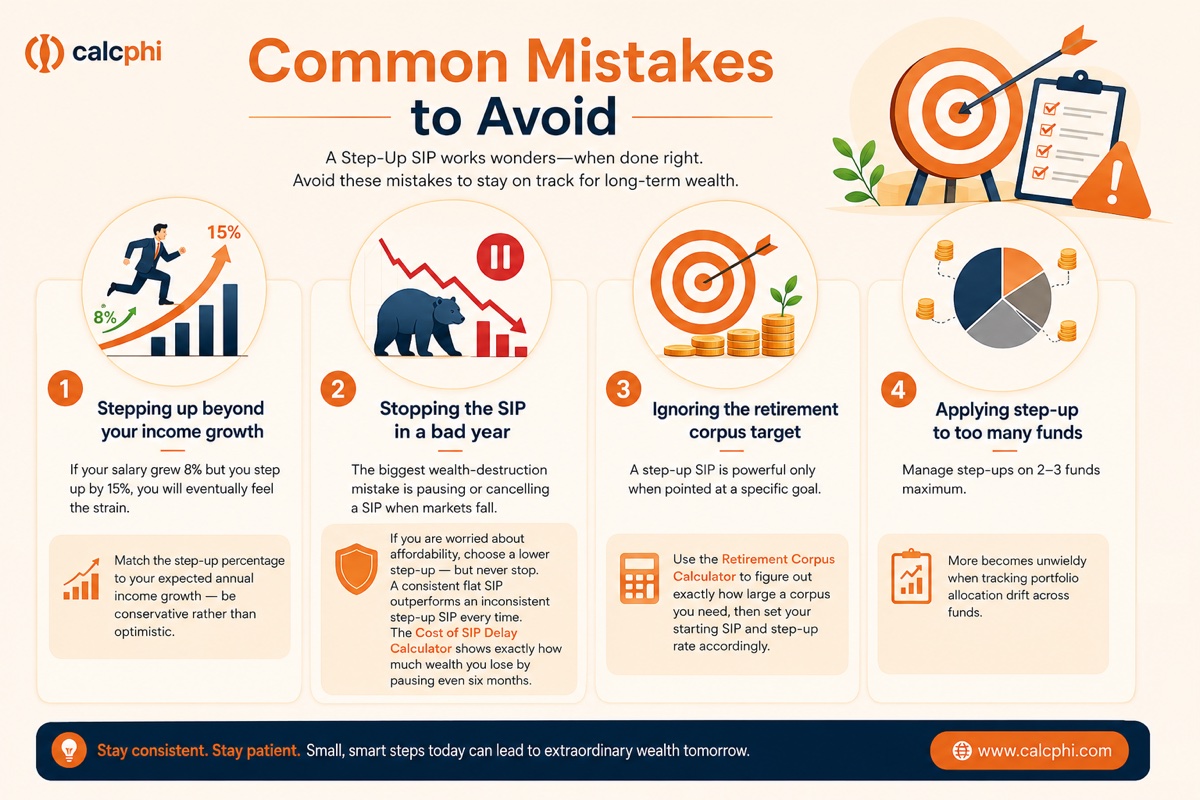
Common Mistakes to Avoid
- Stepping up beyond your income growth: If your salary grew 8% but you step up by 15%, you will eventually feel the strain. Match the step-up percentage to your expected annual income growth — be conservative rather than optimistic.
- Stopping the SIP in a bad year: The biggest wealth-destruction mistake is pausing or cancelling a SIP when markets fall. If you are worried about affordability, choose a lower step-up — but never stop. A consistent flat SIP outperforms an inconsistent step-up SIP every time. The Cost of SIP Delay Calculator shows exactly how much wealth you lose by pausing even six months.
- Ignoring the retirement corpus target: A step-up SIP is powerful only when pointed at a specific goal. Use the Retirement Corpus Calculator to figure out exactly how large a corpus you need, then set your starting SIP and step-up rate accordingly.
- Applying step-up to too many funds: Manage step-ups on 2–3 funds maximum. More becomes unwieldy when tracking portfolio allocation drift across funds.

Frequently Asked Questions
What is a step-up SIP and how is it different from a regular SIP?
A regular SIP keeps your monthly investment fixed for the entire tenure. A step-up SIP automatically increases your monthly contribution by a fixed percentage each year. Starting at ₹10,000/month with a 10% step-up means ₹11,000 in Year 2, ₹12,100 in Year 3, and so on. The result over 15–20 years is a corpus that is often 50% to 100% larger than a flat SIP, depending on tenure and step-up rate.
Is a 10% step-up right for everyone?
A 10% annual step-up works well for salaried professionals who receive annual increments in the 8–12% range, which covers the majority of India's corporate workforce. Freelancers and business owners with variable income should consider a 5% step-up. The key rule: never commit to a step-up percentage that could strain your budget in a low-income year.
Can I change my step-up percentage after I have started?
Most mutual fund platforms allow you to modify or cancel step-up instructions before the next increase date. On platforms like Groww and Kuvera, you can typically edit step-up settings directly in the app. If your fund house does not support in-place modification, you may need to cancel the existing SIP and start a new one — your accrued units remain unaffected.
Does a step-up SIP work for ELSS tax-saving funds?
Yes. You can set up a step-up SIP in ELSS funds and get the same wealth-building benefits, with the added advantage of Section 80C tax deductions on each instalment. Each SIP instalment in ELSS has its own three-year lock-in from the date of investment, so step-up amounts are treated as separate instalments with their own lock-in periods. Use the ELSS Calculator to estimate your returns and tax savings.
What is the minimum step-up that still makes a meaningful difference?
Even a 5% annual step-up adds significantly more wealth than a flat SIP over long tenures. On a ₹10,000/month SIP at 12% returns over 20 years, a 5% step-up adds approximately ₹40 lakhs compared to a flat SIP, while a 10% step-up adds approximately ₹76 lakhs. The difference between 0% and 5% is far larger than between 5% and 10% — so even a conservative step-up is far better than none.
How do I know if I am on track with my step-up SIP to meet my retirement goal?
Use the Retirement Corpus Calculator to define your target based on expected retirement age, monthly expenses, and inflation rate. Then cross-check the projected output of your step-up SIP using the Step-Up SIP Calculator. If there is a gap, increase either your starting SIP amount or your step-up percentage to close it. Doing this review once a year is sufficient.
The Bottom Line
A step-up SIP is not a product — it is a discipline. It takes the single most powerful wealth-building tool available to Indian investors (a SIP) and layers onto it the second most powerful wealth-building force (increasing contributions over time). The result is a corpus that can be 50% to 250% larger than a flat SIP over a 15–25 year period.
The most important thing you can do today is start. If you already have a flat SIP, adding a 10% step-up instruction takes under five minutes on any major investment platform. The investors who retire with the most wealth are rarely the ones who started with the most money — they are the ones who started early, stayed consistent, and increased their contributions every single year.
See how step-up SIP changes your wealth outcome:
Step-Up SIP Calculator → Flat SIP Calculator → Goal-Based SIP Calculator → Retirement Corpus Calculator →Disclaimer: The information in this article is for educational and estimation purposes only. All figures used are illustrative examples based on assumed return rates and are not guaranteed. Mutual fund investments are subject to market risks. Past performance is not indicative of future results. Nothing in this article constitutes financial advice. Please consult a SEBI-registered investment advisor before making any investment decisions.