Salary Increment Negotiation: How to Frame Your Ask With Numbers

Most Indian professionals walk into their annual appraisal hoping for the best and accepting whatever number HR puts on the table. If that sounds familiar, you are not alone — and you are almost certainly leaving significant money behind. A salary increment is not just a number for this year. It is the base on which every future raise, every ESOP calculation, every PF contribution, and every retirement projection is built. Negotiating even 5–8 percentage points more today can mean a difference of ₹50–₹80 lakh in lifetime earnings — not because of that one conversation, but because of compounding.
Why the Increment You Accept in Year 1 Matters More Than You Think
Salary growth compounds. Your manager does not start fresh every year — next year's increment is almost always calculated as a percentage of this year's CTC. So a lower base this year means a lower base next year, and the year after that.
Here is what that looks like on a ₹12 LPA starting salary over ten years:
| Annual Increment | Year 5 CTC | Year 10 CTC | Total Earnings Over 10 Years |
|---|---|---|---|
| 8% | ₹17.6L | ₹25.9L | ₹1.74 crore |
| 12% | ₹21.1L | ₹37.2L | ₹2.08 crore |
| 18% | ₹27.4L | ₹61.6L | ₹2.89 crore |
| 25% | ₹36.6L | ₹1.12 crore | ₹4.16 crore |
The difference between accepting a 12% increment versus negotiating an 18% one is ₹81 lakh in cumulative earnings over ten years — on the same starting salary. That is not a negotiation tactic. That is a financial strategy with a very measurable outcome.
Want to see your own numbers? Use CalcPhi's free Salary Hike Calculator to model your exact salary trajectory at different increment rates. Plug in your current CTC, expected hike percentage, and tenure — the tool shows your year-by-year CTC growth so you can see precisely what you stand to gain or lose.
Salary Hike Calculator →Step 1: Know Your Market Rate Before You Walk In
The single biggest mistake in salary negotiation is anchoring to your current CTC instead of anchoring to the market rate. Your current salary is what the company has been paying you. The market rate is what companies are willing to pay someone with your skills right now. Those two numbers are often very different — especially if you have been in the same role for two or more years without a major jump.
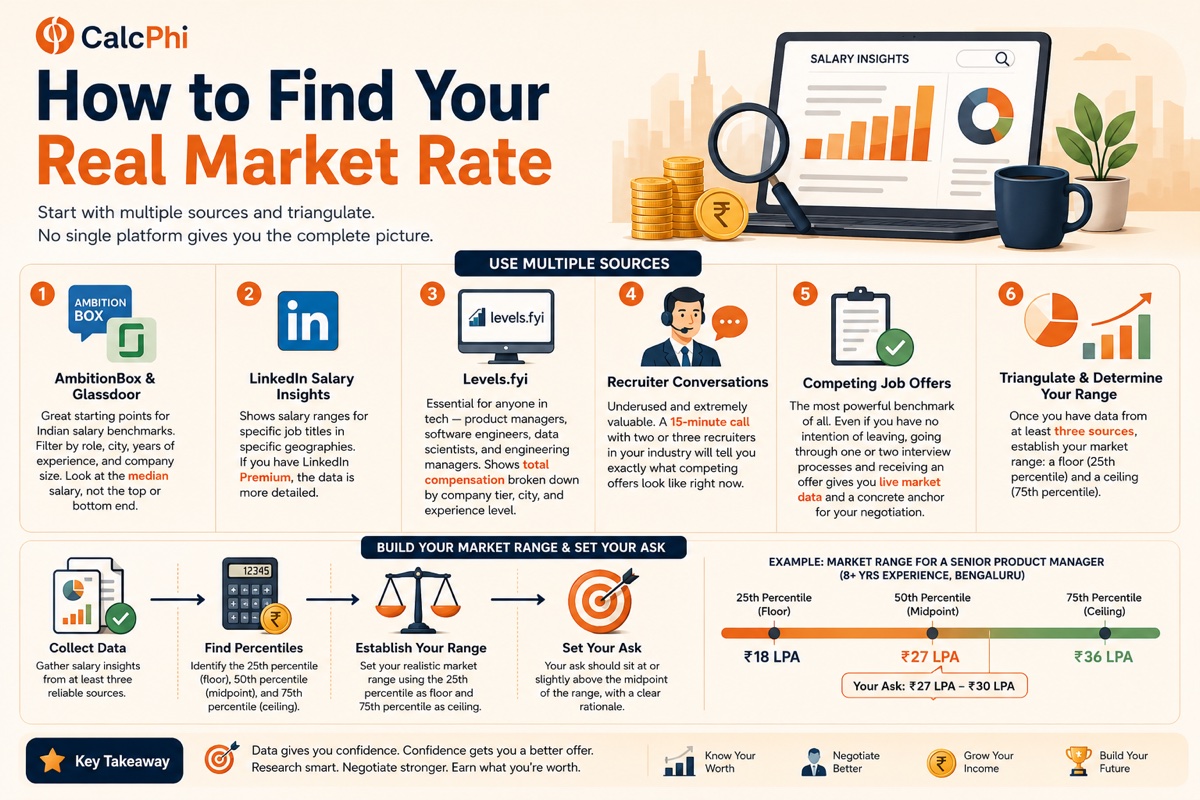
How to Find Your Real Market Rate
Start with multiple sources and triangulate. No single platform gives you the complete picture.
- AmbitionBox and Glassdoor are good starting points for Indian salary benchmarks. Filter by role, city, years of experience, and company size. Look at the median salary, not the top or bottom end.
- LinkedIn Salary Insights shows salary ranges for specific job titles in specific geographies. If you have LinkedIn Premium, the data is more detailed.
- Levels.fyi is essential for anyone in tech — product managers, software engineers, data scientists, and engineering managers. It shows total compensation broken down by company tier, city, and experience level.
- Recruiter conversations are underused and extremely valuable. A 15-minute call with two or three recruiters in your industry will tell you exactly what competing offers look like right now.
- Competing job offers are the most powerful benchmark of all. Even if you have no intention of leaving, going through one or two interview processes and receiving an offer gives you live market data and a concrete anchor for your negotiation.
Once you have data from at least three sources, establish your market range: a floor (the 25th percentile for your role and experience) and a ceiling (the 75th percentile). Your ask should sit at or slightly above the midpoint of that range, with a clear rationale.
Step 2: Quantify Your Contribution — in Rupees, Not Adjectives
"I worked really hard this year" is not a negotiation argument. "The campaign I ran generated ₹3.2 crore in pipeline, 40% above target" is. Before your appraisal conversation, prepare a one-page document — not for submission, but for your own clarity — that answers three questions:
- What did I deliver this year, in measurable terms? Think revenue generated or influenced, cost savings achieved, time saved for the team, deals closed, client retention percentages, projects shipped on time and under budget, headcount managed. Every role has metrics — even support, HR, and finance roles.
- What did I build or improve that will deliver value beyond this year? Processes you created, team members you trained, systems you implemented. These are future-value contributions that justify a forward-looking pay increase.
- How does my output compare to peers or benchmarks? If your team closed 120% of target and your contribution was above average within that team, say so. If you were the only person who could handle a particular client or technology, that scarcity has value.
Once you have this on paper, practice articulating it in under two minutes. Concise specificity is far more persuasive than a long list of everything you did.
Step 3: Frame the Conversation Around a Gap, Not a Demand
The language you use in a salary negotiation matters as much as the number you put on the table. A demand feels adversarial. A gap-closure feels collaborative. Here is the difference:
What not to say: "I want a 25% hike. I've been here three years and I deserve it."
What to say instead: "Based on market data from Glassdoor, AmbitionBox, and a couple of conversations with recruiters, roles with my experience and specialisation in Bengaluru are being offered between ₹32–₹40 lakh. I am currently at ₹27 lakh. Given the [specific deliverable] I led this year, I would like to discuss closing that gap. What is possible?"
This framing anchors the conversation to external market data rather than personal entitlement, references a specific achievement so the ask feels earned, and ends with an open question that invites your manager into collaborative problem-solving mode. Most importantly, it gives your manager something to take to HR — your market data and your deliverables are that case.
Step 4: Prepare for the Three Most Common Responses
"The budget is fixed — I can't do more than X%."
This is often true and sometimes not. Either way, your response should be: "I understand. If the base increment is fixed at X%, can we discuss other components — a one-time performance bonus, an accelerated review in six months, an additional leave allowance, a learning and development budget, or an equity top-up?" Total compensation is not just base salary, and sometimes the base is genuinely locked while other levers are not.
"You are already at the top of your band."
This is a signal that the conversation needs to shift from increment to promotion. Ask: "What would a move to the next band look like, and what would I need to demonstrate to get there by Q3?" You are now negotiating for a role upgrade, which carries a new salary band with it.
"Let us revisit this in six months."
Get specific commitments in writing. Ask: "What targets or milestones would trigger that review? Can we agree on those now?" A vague promise is not a commitment. A written set of objectives with a date attached is.
Step 5: Understand the Tax Impact of Your New Salary
A higher CTC is excellent news. But your in-hand salary after Tax Deducted at Source (TDS) depends on your tax slab under the new regime — and for FY 2026-27, the new tax regime is now the default for salaried employees in India.
Under the new regime for AY 2026-27, income up to ₹12 lakh attracts no tax (after the rebate under Section 87A), income between ₹12L–₹16L is taxed at 15%, ₹16L–₹20L at 20%, ₹20L–₹24L at 25%, and income above ₹24L at 30%. Understanding this matters for negotiation — if your CTC jumps from ₹22 lakh to ₹30 lakh, a significant portion of that increase will go to tax.
Use CalcPhi's India Income Tax Calculator to see your exact in-hand salary after TDS at any CTC level — this helps you set a realistic expectation for your monthly take-home before you accept an offer.
Income Tax Calculator →Step 6: Timing Your Ask — When to Negotiate and When to Wait
Timing is often the difference between a yes and a polite no.
Best times to negotiate: Immediately after a significant win — a deal closed, a project delivered, a crisis resolved. After receiving an external offer. At your annual appraisal, but with pre-work done at least a month before (the number is often decided before the formal meeting). When your manager is in a strong position — not during a cost-cutting quarter, not after a bad earnings call.
Times to avoid: Immediately after a setback or missed deadline. When your company has just announced layoffs or a hiring freeze. When your manager is under personal or professional pressure. Right before a big quarter-end push when everyone is stretched.
If you are in a job-change situation rather than an increment negotiation, the leverage dynamics are different. In that case, do not reveal your current salary unless legally required — anchor directly to the market range and the value you bring to the new role.
What to Do With Every Increment You Negotiate
Winning the negotiation is step one. Making the increment work for you is the step most people skip. The most powerful habit you can build is the increment SIP rule: every time your salary increases, raise your monthly SIP amount by at least 50% of the net monthly increase. If your increment adds ₹10,000 per month to your in-hand salary, invest ₹5,000 of it immediately — before lifestyle inflation absorbs it.
| SIP Strategy | Monthly SIP Growth | Corpus After 15 Years (12% CAGR) |
|---|---|---|
| Fixed ₹15,000/month SIP | 0% annual increase | ₹74.5 lakh |
| Step-up SIP (10% annually) | 10% increase per year | ₹1.58 crore |
| Aggressive step-up (20% annually) | 20% increase per year | ₹2.91 crore |
The difference between a static SIP and a step-up SIP over fifteen years is more than ₹2 crore — generated simply by increasing your SIP each time your salary increases.
Use CalcPhi's Step-Up SIP Calculator to model your own scenario. Plug in your current SIP amount, annual step-up percentage, expected return, and tenure to see your projected corpus.
Step-Up SIP Calculator →The Job Change vs. Stay Decision: A Financial Framework
If your increment request is rejected or comes in well below market, you face a real decision: stay and accept it, or explore the market. Calculate your salary gap: the difference between your current CTC and your realistic market rate. If the gap is more than 20%, the case for exploring externally is strong. A job change typically yields a 25–40% salary increase in India — significantly more than the average internal increment of 8–12%.
But a job change is not free. Factor in the loss of unvested ESOPs, the notice period income disruption, the potential loss of seniority and tenure benefits like gratuity, and the learning curve at a new organisation. A useful rule of thumb: if the external offer adds more than 30% to your total compensation after accounting for ESOP forfeiture and transition costs, and you have been in your current role for at least 18 months, the move is likely worth serious consideration. If the gap is 15–20%, an internal negotiation using the external offer as leverage is often more efficient.

Frequently Asked Questions
What is a good salary increment percentage in India in 2026?
Industry surveys from Aon, Deloitte, and Willis Towers Watson consistently show that average corporate increments in India range from 8% to 10% for FY 2026. The IT and tech sector averages slightly higher at 9–12%, while BFSI and manufacturing tend to track the broader 8–10% range. High performers at top companies often receive 15–20% or more. Changing jobs typically yields a 25–40% jump — which is why staying in the same role for more than two or three years without a major increment can be financially costly.
When should I negotiate my salary — before or after the appraisal letter?
Ideally before the formal appraisal letter is issued, because salary decisions are often made weeks before the letter arrives. Aim to raise the conversation at your mid-year or pre-appraisal check-in, making your market data and deliverables visible to your manager before the budget is finalised. If the letter has already been issued, you can still negotiate — many companies make off-cycle corrections for strong performers.
Can I negotiate salary without a competing offer?
Yes. Market data from platforms like AmbitionBox, Glassdoor, and LinkedIn Salary is a perfectly valid anchor even without an external offer in hand. Frame your ask around the market range for your role and experience, supported by your documented contributions. That said, a competing offer — even one you do not intend to accept — remains the single most powerful negotiating tool because it represents real market validation of your worth.
How does a salary hike affect my income tax in India?
A higher salary moves you up the income tax slabs under the new regime (default for AY 2026-27). For example, income above ₹24 lakh is taxed at 30%, so a significant portion of a large increment may go to tax. It is important to calculate your net in-hand increase, not just the CTC increase. Use CalcPhi's Income Tax Calculator to see your exact take-home at any CTC level before accepting an offer.
Is it unprofessional to negotiate salary in India?
Not at all — and this perception is changing fast. In 2026, salary negotiation is widely accepted as a standard part of professional life, particularly in the private sector and tech industry. Managers and HR professionals expect candidates and employees to negotiate. The key is to do it respectfully, with data, and without ultimatums. A calm, well-researched negotiation conversation signals professional maturity, not aggression.
What if my employer says they cannot give more than a fixed percentage?
Ask about the full compensation package. Base salary is one component — a performance bonus, an accelerated review in six months, additional ESOP grants, a learning and development budget, remote work flexibility, or extra leave days all have real monetary and quality-of-life value. If the base increment is truly fixed, negotiate the other levers. If nothing moves, you now have clear data to make an informed decision about whether to stay or explore the market.
Disclaimer: The financial figures and salary benchmarks referenced in this article are based on publicly available industry surveys and market data as of May 2026. All calculators on CalcPhi — including the Salary Hike Calculator, Step-Up SIP Calculator, and Income Tax Calculator — are free tools for educational and estimation purposes only. Results are indicative and should not be construed as financial advice. Every individual's situation is different. For personalised financial or career guidance, please consult a qualified financial advisor or HR professional.