How to Retire Early in India: A Complete FIRE Planning Guide (2026)

Most people picture retirement at 60 — a gold watch, a farewell party, and a pension kicking in. But a growing number of Indians in their 30s and 40s are choosing a different path: building enough wealth that work becomes optional long before 60. This is the FIRE movement — Financial Independence, Retire Early — and it is no longer just a Western concept. With the right strategy, the right instruments, and the discipline to stay the course, early retirement in India is genuinely achievable for middle-class professionals.
This guide covers the four different FIRE approaches, how to calculate your personalised FIRE number for India, which instruments to build your corpus with, how to draw down that corpus in a tax-efficient way, and what life after FIRE actually costs in 2026.
What FIRE Actually Means — and Why India is Different
FIRE stands for Financial Independence, Retire Early. Financial independence means your investments generate enough passive income to cover all your expenses indefinitely. "Retire early" does not necessarily mean doing nothing — it means you no longer depend on a salary to survive.
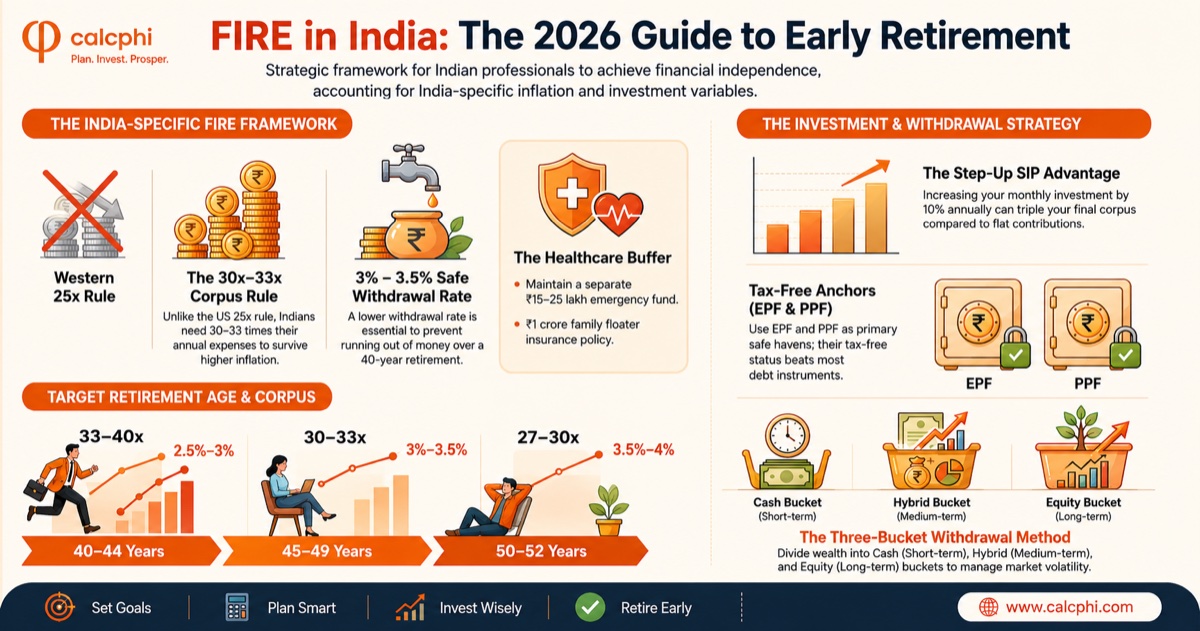
The concept originated in the US, and most of the rules of thumb — especially the famous "25x rule" and "4% withdrawal rate" — were built on US market data and US inflation of around 3%. India's reality is meaningfully different. Indian CPI inflation averages 6 to 7% per year. Healthcare costs inflate at 10 to 14% annually. And if you retire at 45 in India and live to 85, your corpus needs to last 40 years — not the 30 years the original research modelled.
The practical implication: if you use the American 4% rule in India, you are likely to run out of money. A more appropriate India withdrawal rate is 3% to 3.5%, which means a corpus of 28 to 33 times your annual expenses. Use this as your baseline — not the 25x number you may have read elsewhere.
The Four Types of FIRE — Choose Your Version
Not all FIRE is the same. Understanding which variant fits your life is the first real decision.
Lean FIRE
Lean FIRE means retiring early on a very modest budget — typically under ₹30,000 to ₹40,000 per month in today's money. The corpus required is smaller, so you reach financial independence faster. But the lifestyle is spartan. Healthcare, unexpected repairs, or a family emergency can strain a lean budget seriously. Lean FIRE works best for people with no dependants, low fixed costs, and a genuine preference for simple living.
A Lean FIRE corpus for someone spending ₹35,000 per month today, targeting retirement in 15 years at 6.5% inflation: monthly spend at retirement — ₹88,000, annual spend — ₹10.6 lakh, corpus needed at 30x — ₹3.17 crore. That is genuinely reachable on a ₹25,000 to ₹30,000 monthly SIP over 15 years at 12% returns. Use the SIP Calculator to check your own numbers →
Fat FIRE
Fat FIRE means retiring early and maintaining a comfortable, even premium lifestyle — dining out regularly, annual holidays, private schools for children, and quality healthcare. Monthly expenses in today's money might be ₹1.5 lakh to ₹3 lakh. The corpus required is substantial — often ₹8 crore to ₹20 crore depending on your target retirement age and lifestyle.
Fat FIRE is not out of reach for dual-income professional households in Tier-1 cities who start investing aggressively in their late 20s. But it requires a step-up SIP strategy, not flat monthly contributions. A ₹20,000 flat SIP over 25 years builds about ₹3.8 crore at 12%, while the same ₹20,000 stepping up 10% each year builds nearly ₹10.5 crore. That difference is the gap between Lean FIRE and Fat FIRE. Run the step-up SIP numbers →
Coast FIRE
Coast FIRE is the most underrated version for Indians in their early career. The idea: invest aggressively now and reach a portfolio large enough that — if you simply stop contributing and let compounding do its work — you will hit your full FIRE number by a traditional retirement age.
If a 28-year-old builds a corpus of ₹50 lakh by age 32 through aggressive saving and investing, and then simply leaves it alone at 12% return, that ₹50 lakh becomes approximately ₹4.3 crore by age 60. They can slow down, change careers, take a pay cut — secure in the knowledge that their retirement is effectively already funded. Coast FIRE offers optionality without requiring you to fully walk away.
Barista FIRE
Barista FIRE — the most India-relevant variant — means reaching partial financial independence and supplementing your portfolio income with part-time or low-stress work. You are not fully retired, but you are no longer dependent on a high-pressure career. You might do consulting, freelance writing, teaching, or run a small business you enjoy.
This approach is ideal for India because it solves two problems at once. First, it reduces the corpus you need before leaving your primary career. Second — and critically for India — part-time employment gives you access to group health insurance, which is one of the biggest hidden costs of early retirement. A Barista FIRE practitioner earning even ₹40,000 to ₹50,000 per month part-time only needs their portfolio to cover the remaining gap, which dramatically shrinks the FIRE target.
Calculating Your FIRE Number for India
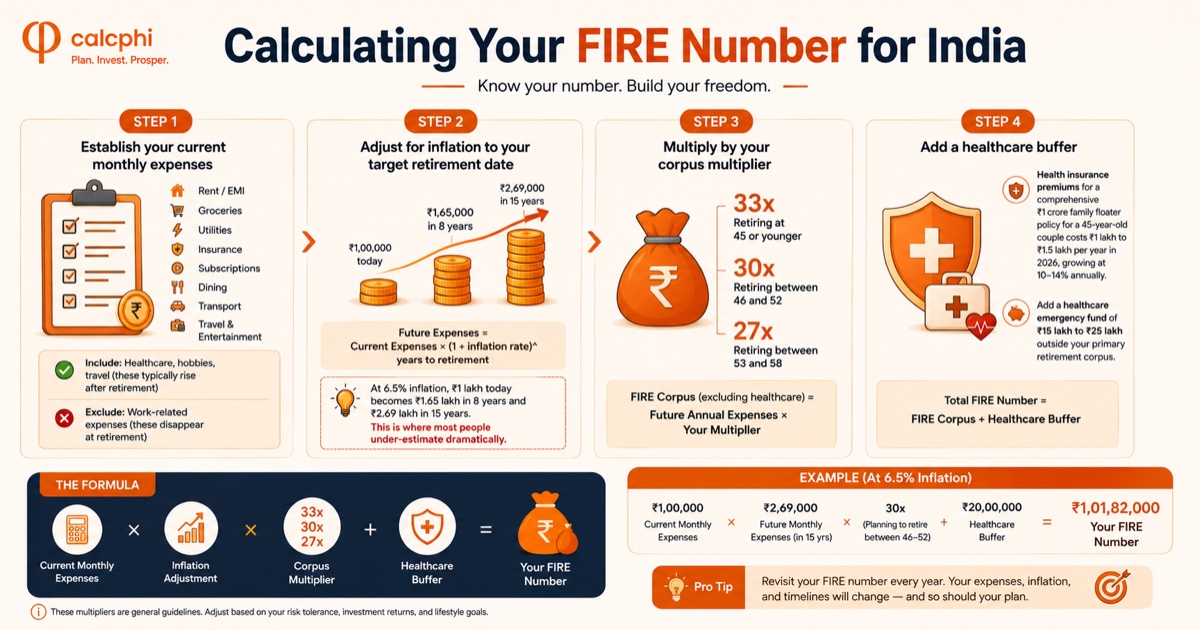
Before picking instruments or building a portfolio, you need to know your target. Here is the process, step by step.
Step 1: Establish your current monthly expenses. Be honest. Include rent or EMI, groceries, utilities, insurance premiums, subscriptions, dining, transport, and a realistic estimate for travel and entertainment. Do not include work-related expenses — these disappear at retirement. Do add expenses you expect to increase: healthcare, hobbies, and travel typically rise after you stop working.
Step 2: Adjust for inflation to your target retirement date. Future Expenses = Current Expenses × (1 + inflation rate) ^ years to retirement. At 6.5% inflation, ₹1 lakh today becomes ₹1.65 lakh in 8 years and ₹2.69 lakh in 15 years. This is where most people under-estimate dramatically.
Step 3: Multiply by your corpus multiplier. Use 33x if retiring at 45 or younger, 30x if retiring between 46 and 52, and 27x if retiring at 53 to 58.
Step 4: Add a healthcare buffer. Budget separately for health insurance premiums — a comprehensive ₹1 crore family floater policy for a 45-year-old couple costs ₹1 lakh to ₹1.5 lakh per year in 2026, growing at 10–14% annually. Add a healthcare emergency fund of ₹15 lakh to ₹25 lakh outside your primary retirement corpus.
| Target Retirement Age | Corpus Multiplier | Safe Withdrawal Rate | Retirement Duration |
|---|---|---|---|
| 60 (normal) | 20–22× | 4.5–5% | ~25 years |
| 50–52 | 27–30× | 3.5–4% | ~35 years |
| 45–49 | 30–33× | 3–3.5% | ~40 years |
| 40–44 | 33–40× | 2.5–3% | ~45+ years |
Worked example. Arjun is 33, spending ₹90,000 a month today, and wants to retire at 48. At 6.5% inflation over 15 years, his monthly spend becomes approximately ₹2.27 lakh. Annual expenses: ₹27.2 lakh. Corpus needed at 30x: approximately ₹8.17 crore. Plus healthcare buffer: ₹20 lakh. Total FIRE target: ₹8.37 crore.
→ Run the Step-Up SIP Calculator to see if your monthly investment gets you there
The Investment Stack: Which Instruments to Use and Why
Reaching your FIRE number is not about picking the hottest mutual fund. It is about using the right mix of instruments that balance growth, tax efficiency, and liquidity for your specific retirement timeline.
Equity Mutual Funds — Your Primary Growth Engine
For the accumulation phase, diversified equity mutual funds via SIP are the most efficient path in India. They offer market-linked returns — historically 11 to 14% CAGR over 15 to 20 year periods — combined with reasonable tax treatment and full liquidity.
Long-term capital gains (LTCG) on equity mutual funds above ₹1.25 lakh per year are taxed at 12.5% (Finance Act 2024, applicable for AY 2026-27). This is significantly better than paying income tax at your slab rate on FD interest. The strategy: hold for more than one year, and redeem only what you need each year — ideally staying within the ₹1.25 lakh LTCG exemption for as long as possible during early retirement years.
→ SIP Calculator | Step-Up SIP Calculator
PPF — The Tax-Free Safe Anchor
The Public Provident Fund at 7.1% per year may seem unimpressive next to equity returns. But its tax treatment is unmatched: contributions get a Section 80C deduction, interest is tax-free, and the maturity amount is completely exempt. For a 30% tax bracket investor, the effective post-tax return on PPF beats most debt instruments.
For FIRE planning, the 15-year lock-in actually works in your favour if you time it well. Start a PPF account at 30 or 32 and it matures right around your early retirement date. Extend by five years and it becomes a reliable, completely tax-free income source through your 50s.
→ Model your PPF maturity value →
EPF — Compulsory Wealth You Often Forget
If you are salaried, your Employee Provident Fund is quietly building a retirement corpus on your behalf. EPF currently earns 8.25% per year, and both your contribution (12% of basic) and your employer's contribution accumulate. The entire maturity amount is tax-free after five years of continuous service.
Many FIRE planners ignore EPF in their projections — and then get a pleasant surprise at withdrawal. Check your EPF balance via the EPFO portal and project its future value to get an accurate picture of your total corpus.
→ EPF future value calculator →
ELSS — For Tax Saving That Also Builds Wealth
Equity Linked Savings Schemes (ELSS) are equity mutual funds with a three-year lock-in that qualify for Section 80C deductions up to ₹1.5 lakh per year. For investors still in the old tax regime (where 80C matters), ELSS is one of the most efficient instruments available: you save income tax today, and the three-year minimum holding period builds investment discipline.
The key caveat: ELSS returns are market-linked. Do not treat it as a fixed instrument. Use it as part of your equity allocation, not as a separate "safe" bucket.
NPS — A Limited but Useful Tax Optimiser
The National Pension System's mandatory age-60 withdrawal structure makes it a poor primary FIRE vehicle. But the ₹50,000 additional deduction under Section 80CCD(1B) — over and above the ₹1.5 lakh 80C limit — is a pure tax saving worth pursuing. For someone in the 30% bracket, that is ₹15,000 to ₹16,250 back in your pocket each year. Redirect that saving into your equity SIP and over 15 years it compounds into meaningful additional corpus. Think of NPS as a tax optimiser, not a core retirement vehicle for years before 60.
→ NPS corpus and pension calculator →
The Decumulation Phase: Making Your Money Last
Accumulating the corpus is only half the job. Withdrawing it efficiently — without paying unnecessary tax and without running out — is the other half. This phase, called decumulation, is something most FIRE guides in India barely touch.
The Bucket Approach for Withdrawals
Once retired, think of your money in three buckets based on timeline.
The short-term bucket — two to three years of expenses — sits in liquid funds or short-duration debt funds. This is what you draw from monthly. It means you are never forced to sell equity in a downturn to pay your bills.
The medium-term bucket — the next four to seven years of expenses — sits in balanced or hybrid funds. It grows at moderate rates while being relatively stable.
The long-term bucket — everything beyond seven years — stays fully in equity. This is your growth engine, and you do not touch it. Every one to two years, you rebalance: sell from the long-term bucket (when markets are up) to replenish the short-term bucket.
Minimising Tax During Withdrawal
India's tax structure in 2026 means a retiree with no other income can receive up to ₹7 lakh per year completely tax-free under the new regime (₹3 lakh basic exemption plus ₹4 lakh rebate under Section 87A). Plan your withdrawals around this. In early retirement years, keep annual withdrawals below ₹12 lakh to ₹15 lakh through a combination of LTCG harvesting (up to ₹1.25 lakh tax-free each year) and income within the 87A rebate threshold.
| Source | Tax Treatment | Notes |
|---|---|---|
| PPF withdrawals | Completely tax-free | Best first draw in retirement |
| Equity MF LTCG (held > 1 year) | 12.5% on gains above ₹1.25L/year | Plan withdrawals near threshold |
| Debt MF (from 2023 onwards) | Taxed at income slab rate | Less efficient post-2023 law change |
| FD interest | Taxed at income slab rate | TDS deducted at source |
| EPF withdrawal (after 5 years service) | Completely tax-free | Include in corpus planning |
| NPS 60% lump sum (at age 60) | Completely tax-free | 40% annuity income taxed at slab |
→ Model your retirement year tax liability with the Income Tax Calculator →
Income Streams to Bridge the FIRE Gap
One of the smartest strategies for early retirement in India is not relying on a single passive income source. Diversifying how you generate monthly income from your corpus reduces sequence-of-returns risk — the danger that a bad market in your first few retirement years permanently damages your corpus.
- Dividends from equity funds and stocks can provide some income, but dividend yields in Indian equity markets are typically 1 to 2% — far below what you need. Do not build your withdrawal strategy around dividends alone.
- Rental income from a second property is popular among Indian retirees. Rental yield in India averages 2 to 3% on the property value — modest, but with appreciation potential. Be realistic about vacancy, maintenance (typically 1 to 2% of property value annually), and property tax when calculating actual returns.
- Interest income from FDs or RDs is the most predictable stream, but interest is taxed at your income slab — making it tax-inefficient compared to equity withdrawals. Use FDs for your short-term safety bucket, not as your primary income engine.
- Part-time or freelance work (the Barista FIRE model) is undervalued in Indian FIRE circles. Earning even ₹30,000 to ₹50,000 per month from consulting or teaching reduces portfolio withdrawals dramatically and extends the longevity of your corpus.
Healthcare: The Expense That Breaks FIRE Plans
Healthcare is the single most underestimated variable in Indian FIRE planning and it deserves its own section.
When you leave employment, you lose your group health insurance — which typically covers ₹3 lakh to ₹10 lakh with no waiting periods and lower premiums because the employer negotiates group rates. Replacing this with an individual policy after a gap — or after a health event — is expensive and sometimes impossible.
The right move: buy a comprehensive individual or family floater policy of at least ₹1 crore coverage while still employed. A ₹1 crore family floater for a healthy 35-year-old couple costs approximately ₹30,000 to ₹45,000 per year in 2026. The same cover bought at 48 after early retirement costs ₹90,000 to ₹1.5 lakh — and some pre-existing conditions from the intervening years may not be covered.
Beyond premiums, build a dedicated healthcare emergency reserve of ₹20 lakh to ₹30 lakh (separate from your retirement corpus) in a liquid instrument. Medical inflation running at 10 to 14% annually means healthcare costs double approximately every six to seven years. Treat this as a non-negotiable part of your FIRE plan.
A Realistic FIRE Timeline by Starting Age
The earlier you start, the more forgiving the math becomes. Here is what a realistic FIRE journey looks like at three starting ages, assuming a ₹1 lakh monthly expense target in today's money and a retirement target of age 50.
| Starting Age | Years to Build | Starting SIP Needed | Strategy |
|---|---|---|---|
| 25 | 25 years | ₹15,000/month (10% step-up) | Compounding does most of the work. Builds ~₹11.4 crore at 12% CAGR. |
| 30 | 20 years | ₹30,000/month (10% step-up) | Challenging but achievable. EPF and PPF close a meaningful part of the gap. |
| 35 | 15 years | ₹60,000/month (10% step-up) | High savings rate required. Lumpsum from existing savings plus aggressive SIP is the most effective approach. |
All three scenarios use 12% CAGR on equity — a reasonable historical average for Indian diversified equity funds over 15 to 20 year periods. Run your own numbers with the Step-Up SIP Calculator →
Your Next Steps: Calculators to Run Today

Frequently Asked Questions
There is no universal minimum — it depends on your lifestyle and target retirement age. Someone spending ₹60,000 per month today and targeting retirement at 50 needs approximately ₹6 to ₹7 crore. Someone spending ₹1.5 lakh monthly targeting the same age needs ₹15 to ₹17 crore. Use the 30x multiplier applied to your inflation-adjusted annual expenses at your target retirement age.
No, not without adjustment. The 4% rule was designed for US inflation of around 3% and 30-year retirements. Indian inflation of 6 to 7% and potentially 40-year retirements (if retiring at 45) require a safer 3% to 3.5% withdrawal rate. This translates to a 28x to 33x corpus multiplier depending on your retirement age.
There is no single best category. For the accumulation phase, flexi-cap or multi-cap equity funds offer broad diversification and strong long-term returns. As you approach and enter retirement, shift a portion into balanced advantage funds or hybrid funds to reduce volatility. Consult a SEBI-registered financial advisor before building your FIRE portfolio.
You can withdraw your full EPF corpus after two months of unemployment following resignation. Withdrawals after five years of continuous service are completely tax-free. If you leave before five years, TDS applies on the withdrawal. For FIRE planners, EPF is a tax-efficient lump sum available at early retirement — include it in your corpus calculation.
Buy a comprehensive individual or family floater policy (minimum ₹1 crore coverage) while still employed, so your pre-existing condition history is already on record with the insurer. After leaving employment, continue this policy with annual renewals. Budget ₹1 lakh to ₹2 lakh annually for premiums by your mid-to-late 40s, and maintain a separate healthcare emergency fund outside your primary retirement corpus.
Yes, but it requires aggressive savings rates — ideally 40% to 50% of take-home income — and a long timeline. A 28-year-old earning ₹1 lakh net who saves and invests ₹45,000 per month with a step-up strategy can build a significant corpus over 20 years. The key is starting early and increasing contributions as income grows.
Disclaimer: The information in this article is for educational and estimation purposes only. All figures, return assumptions, and corpus calculations are illustrative and based on historical averages — they do not constitute a guarantee of future returns. Tax rules referenced are based on the Finance Act 2024 applicable for AY 2026-27. Tax laws may change. Nothing in this article constitutes personalised financial, tax, or investment advice. Please consult a SEBI-registered investment advisor and a qualified CA or CFP before making significant financial decisions.