Property Registration and Stamp Duty in India 2026: Complete State-by-State Guide
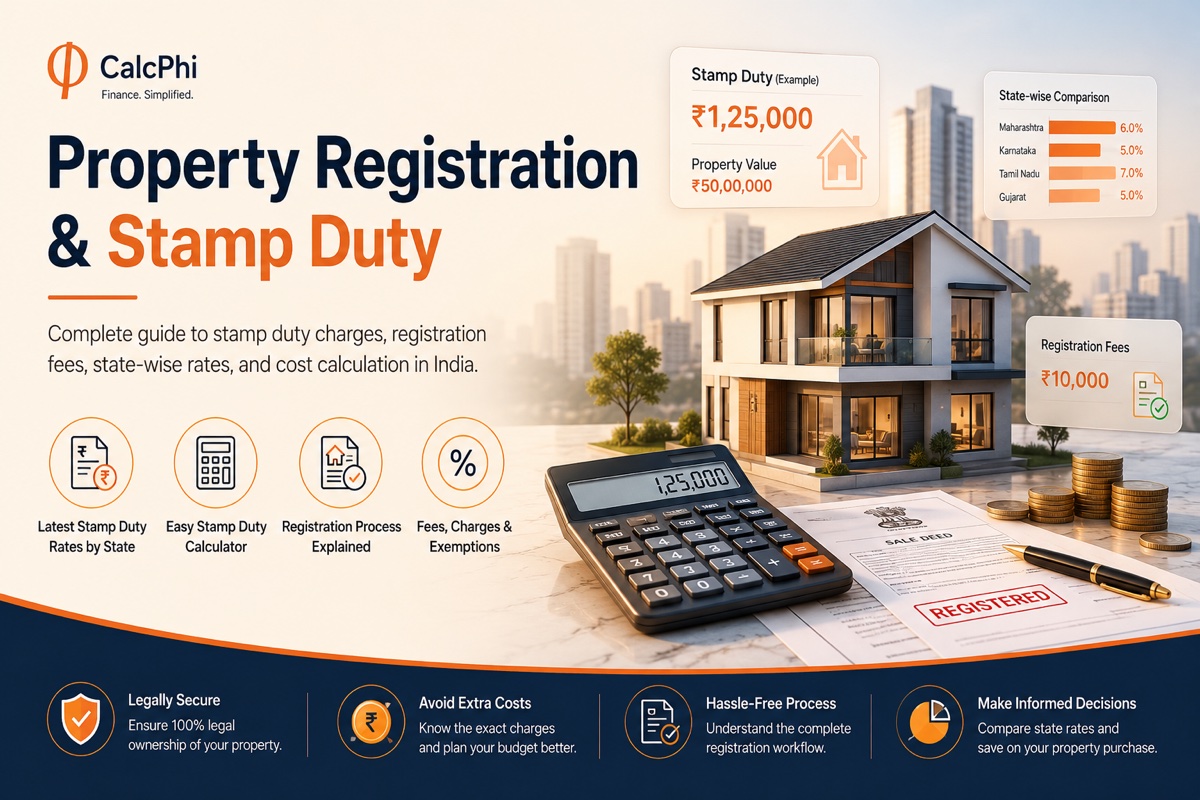
Buying a property in India involves more than just paying the seller. Before you can legally call a home yours, the government requires you to pay two mandatory charges — stamp duty and property registration fees. Together, these can add anywhere from 5% to 10% on top of the property's price, and many first-time buyers are caught off-guard when they see the final bill.
This guide breaks down exactly what stamp duty and registration charges are, how they vary across 12 major Indian states in 2026, what concessions are available for women buyers, and how to calculate your total property purchase cost before you sign anything.
What Is Stamp Duty and Why Does It Matter?
Stamp duty is a tax levied by the state government when you buy or transfer property. Think of it as the government's fee for recognising that the property has legally changed hands. Without paying stamp duty and completing registration, your sale deed is not legally valid — even if you've moved in and paid the full price to the seller.
Registration charges are a separate fee paid to the Sub-Registrar's office to officially record your property in government records. Once registered, your ownership becomes a matter of public record, which protects you from future disputes and fraud.
Both charges are calculated as a percentage of the property's market value or the agreement value — whichever is higher. This distinction matters. If you buy a property for ₹40 lakh but the government's circle rate (the minimum valuation set by the state) for that area is ₹50 lakh, your stamp duty will be calculated on ₹50 lakh, not ₹40 lakh.
How Stamp Duty Is Calculated: The Basics
The formula is straightforward: Stamp Duty = Property Value × Applicable Rate. Registration charges are usually 1% of the property value, subject to a cap in some states.
For example, if you buy a flat in Mumbai worth ₹75 lakh as a male buyer, the calculation looks like this. Stamp duty at 6% = ₹4,50,000. Registration fee at 1% (capped at ₹30,000 for properties above ₹30 lakh in Maharashtra) = ₹30,000. Total government charges = ₹4,80,000 — nearly 6.4% of the deal value, on top of your EMIs.
Want to quickly check your own numbers? Use CalcPhi's free Stamp Duty Calculator to get the exact stamp duty and registration cost for your state in seconds — no login needed.
| State | Stamp Duty (Men) | Stamp Duty (Women) | Registration Charge |
|---|---|---|---|
| Maharashtra (Mumbai) | 6% + 1% metro cess | 5% + 1% metro cess | 1% (capped ₹30,000) |
| Karnataka | 5% (above ₹45L) | 5% (no concession) | 1% |
| Delhi | 6% | 4% | 1% |
| Uttar Pradesh | 7% | 6% | 1% + cess |
| Tamil Nadu | 7% | 7% (no concession) | 4% |
| West Bengal | 5–7% (tiered) | 1% rebate | 1% |
| Gujarat | 4.9% | ~2.9% | Included |
| Rajasthan | 6% | 5% | 1% |
| Telangana | 5% + 0.5% transfer duty | 5% (no major concession) | 0.5% |
| Madhya Pradesh | 7.5% | 5% | 3% |
| Punjab | 7% | 5% | 1% |
| Kerala | 8% | 8% (no concession) | 2% |
State-by-State Stamp Duty Rates in India 2026
Stamp duty is a state subject, which means every state sets its own rates. Here is a detailed breakdown of current rates across 12 major states.
Maharashtra
Maharashtra has one of the more layered stamp duty structures in India. For properties in urban areas (under municipal corporations), the stamp duty is 6% for male buyers. Women buyers get a 1% concession, bringing their rate to 5%. This concession can save ₹50,000 on a ₹50 lakh property.
There is an additional 1% metro cess applicable in Mumbai Metropolitan Region (MMR) and Pune, which effectively takes the total to 7% for male buyers in those cities. Registration charges are capped at ₹30,000 for properties valued above ₹30 lakh. For properties in rural areas (gram panchayat zones), the stamp duty is lower at around 3–4%.
Karnataka
Karnataka charges a flat 5% stamp duty on properties valued above ₹45 lakh. For properties between ₹21 lakh and ₹45 lakh, the rate is 3%. Properties below ₹20 lakh attract a flat duty of 2%. Registration charges are 1% of the property value. In the BBMP (Bruhat Bengaluru Mahanagara Palike) limits, a betterment levy may also apply in certain layouts. There is currently no gender-based concession in Karnataka.
Delhi
Delhi charges 6% stamp duty for male buyers and 4% for female buyers — one of the most significant gender concessions in the country. Joint registrations with a woman included as a co-owner qualify for the 4% rate as well. Registration charges are 1% of the property value. Properties purchased via Delhi Development Authority (DDA) follow the same rates.
Uttar Pradesh
UP levies a stamp duty of 7% for male buyers. Female buyers receive a flat 1% concession, making their rate 6%. Additional charges include a 2% stamp duty surcharge applicable in urban development authorities (like NOIDA, LDA, etc.), which pushes the effective rate higher in practice. Registration charges are 1%, with an additional cess. Budget at least 9–10% over the property price for total charges in UP.
Tamil Nadu
Tamil Nadu charges a flat 7% stamp duty across the state with no gender-based concession. Registration charges are 4% — the highest in this list. This means buyers in Tamil Nadu effectively pay 11% in government charges on top of the property price, making it one of the costliest states for registration. The state also levies an additional 2% corporation tax within Chennai city limits in some cases.
West Bengal
West Bengal has a tiered structure. Properties valued up to ₹25 lakh attract stamp duty of 5%. Those valued between ₹25 lakh and ₹40 lakh attract 6%, and properties above ₹40 lakh attract 7%. Women buyers get a 1% rebate across all slabs. Registration charges are 1% of the property value. An additional urban development fee of 1% applies in Kolkata Municipal Corporation limits.
Gujarat
Gujarat charges a combined stamp duty and registration fee of approximately 4.9% for male buyers. Women buyers receive a 2% concession on stamp duty alone, bringing their effective rate to around 2.9%. This makes Gujarat one of the more affordable states for women buyers in terms of government charges.
Rajasthan
Rajasthan levies a stamp duty of 6% for male buyers and 5% for female buyers. Registration charges are 1%. In addition, a local body fee of 15–20% on the stamp duty value is imposed in municipal corporation areas. This cess can add nearly 1% to the overall cost.
Telangana
Telangana charges a stamp duty of 5% with a flat 0.5% transfer duty and 0.5% registration charge. The effective combined rate for most buyers in Hyderabad is around 6% of the property value. No major gender concession exists, though joint ownership registrations get marginal rebates in some sub-registrar offices.
Madhya Pradesh
Madhya Pradesh levies a stamp duty of 7.5% for male buyers. Women buyers receive a significant concession at just 5%. Registration charges are 3% — on the higher end nationally. Tribal areas and SC/ST buyers may be eligible for further concessions under state schemes.
Punjab
Punjab charges a stamp duty of 7% for male buyers and 5% for female buyers. Registration charges are 1%. The state also levies an additional rural development fee of 2% on agricultural land transactions, which does not apply to urban residential properties.
Kerala
Kerala applies a stamp duty of 8% across all property types and buyers, with no gender-based concession — making it the highest stamp duty state in this guide. Registration charges are 2%. Budget around 10% above property value for total government costs in Kerala. However, the state has a favourable online registration process, and E-stamp certificates are widely accepted.
Women Buyers: Stamp Duty Concessions That Can Save You Lakhs
Multiple states offer reduced stamp duty specifically for women buyers or when a woman is included as a co-owner. This policy is designed to encourage property ownership among women and formalise jointly-held assets.
The most buyer-friendly states for women are Delhi (saving 2%), Gujarat (saving 2%), and Maharashtra (saving 1%). On a ₹1 crore property in Delhi, a woman buyer saves ₹2,00,000 in stamp duty alone compared to a male buyer. For joint purchases, the strategy of registering property in the wife's name or as a joint owner can reduce the overall tax outgo significantly.
The Registration Process: Step by Step
Understanding the process helps you avoid delays and penalties. Here is how property registration typically works in India.
First, you need to pay stamp duty before or at the time of presenting the document for registration. In most states, you can pay online via the state's stamp portal (like GRAS in Maharashtra or IGRS in UP). The stamp paper or e-stamp certificate is then printed or generated.
Second, both buyer and seller visit the Sub-Registrar's office with the sale deed, identity documents, photographs, and PAN cards. Properties above ₹50 lakh require Form 26QB to be filed for TDS deduction under Section 194-IA of the Income Tax Act — the buyer must deduct 1% TDS on the purchase price and deposit it before registration.
Third, the Sub-Registrar verifies documents, collects registration charges, and records the transaction. You receive a certified copy of the registered deed, which is your proof of legal ownership.
The full process typically takes one to three hours on the day of registration if all documents are in order. Delays usually occur due to incomplete documentation or mismatch in circle rates.
Is Stamp Duty Tax-Deductible?
Yes — stamp duty and registration charges paid on a residential property purchase are deductible under Section 80C of the Income Tax Act, within the overall limit of ₹1.5 lakh. This deduction is available only under the old tax regime. So if you are already maxing out your 80C limit through EPF, PPF, or ELSS, this deduction may not provide additional benefit unless you restructure your 80C basket.
The deduction can only be claimed in the year in which you actually pay the stamp duty — not in subsequent years. If the property is under construction and you pay stamp duty on the agreement in Year 1, you claim the deduction in Year 1's ITR, not when possession is received.
To understand how this interacts with your home loan tax benefits, use CalcPhi's Home Loan Tax Benefit Calculator to see your total Section 24B and 80C savings in one place.

Total Cost of Buying Property: What You Should Budget For
Stamp duty and registration are just two components of your total property purchase cost. A realistic budget should include all of the following.
- The property agreement value itself
- Stamp duty (ranges from 4% to 11% depending on state and gender)
- Registration charges (ranges from 0.5% to 4%)
- GST of 5% on under-construction properties (with no Input Tax Credit)
- Home loan processing fees (typically 0.5% to 1% of the loan amount)
- Legal and documentation fees paid to your lawyer or property consultant
- Society charges and maintenance deposits if buying in a housing society
For a ₹60 lakh ready-to-move flat in Bengaluru, the cost breakdown looks like this: property price ₹60,00,000; stamp duty at 5% = ₹3,00,000; registration at 1% = ₹60,000; legal fees approximately ₹15,000; total cost approximately ₹63,75,000.
Use CalcPhi's Property Registration Cost Calculator to model your specific situation before you negotiate or finalise a property deal.
Capital Gains Tax When You Sell: What Happens Later
Stamp duty also has implications when you eventually sell the property. Your cost of acquisition for capital gains tax purposes includes the stamp duty and registration charges you originally paid. This increases your indexed cost basis, which reduces the long-term capital gains (LTCG) taxable amount.
Under current rules (post Budget 2024), LTCG on property is taxed at 12.5% without the benefit of indexation. This change, introduced in the Union Budget 2024-25, significantly altered the math for property held over long periods. Understanding how this affects your net return from property is critical before making any sale decision. Use CalcPhi's Capital Gains Tax Calculator to model both STCG and LTCG scenarios on real estate.
Frequently Asked Questions
What is the average stamp duty rate in India in 2026?
Stamp duty in India ranges from 3% to 8% depending on the state, the buyer's gender, property type, and location. On average, most urban buyers pay between 5% and 7%. When you add registration charges, the combined government cost typically falls between 6% and 11% of the property value.
Do women always pay less stamp duty than men?
Not in every state. States like Delhi, Maharashtra, Gujarat, Rajasthan, Madhya Pradesh, UP, and West Bengal offer a concession of 1–2% for female buyers. States like Tamil Nadu, Karnataka, Telangana, and Kerala do not currently offer gender-based stamp duty concessions. Always verify the current rate with your state's stamp and registration department before finalising a property deal.
What happens if you don't register a property?
An unregistered property deed is not admissible as evidence in court and cannot be used to establish legal ownership. You also cannot apply for a home loan against an unregistered property. Under the Registration Act 1908, registration of any immovable property transaction valued above ₹100 is compulsory in India, though in practice every property purchase should be registered.
Can stamp duty be paid online in India?
Yes. Most states now allow online stamp duty payment through their respective portals — GRAS (Maharashtra), IGRS (Delhi, UP), Kaveri Online (Karnataka), and similar systems. E-stamp certificates are legally valid and accepted for registration. Online payment has significantly reduced delays and the risk of using fraudulent stamp papers.
Is GST applicable on stamp duty?
No. Stamp duty and registration charges are state taxes and are not subject to GST. However, GST of 5% is separately applicable on under-construction property purchases. Ready-to-move properties with a completion certificate are exempt from GST, which is one financial reason many buyers prefer ready-to-move inventory.
Can NRIs buy property and pay stamp duty in India?
Yes. Non-Resident Indians (NRIs) and Persons of Indian Origin (PIOs) are eligible to buy residential and commercial property in India, subject to FEMA guidelines. They pay the same stamp duty rates as resident buyers. However, payment must be routed through an NRE or NRO bank account and relevant TDS provisions under Section 195 may apply at the time of eventual sale.
Disclaimer: The information in this article is for educational and estimation purposes only. Stamp duty rates are set by state governments and may change without notice. Always verify current rates with your state's stamp and registration authority or a qualified property lawyer before completing any transaction. Nothing in this article constitutes legal or financial advice. Consult a SEBI-registered financial advisor or a licensed property consultant for guidance specific to your situation.