Post Office Schemes vs Bank FDs: Which Pays More After Tax in 2026?
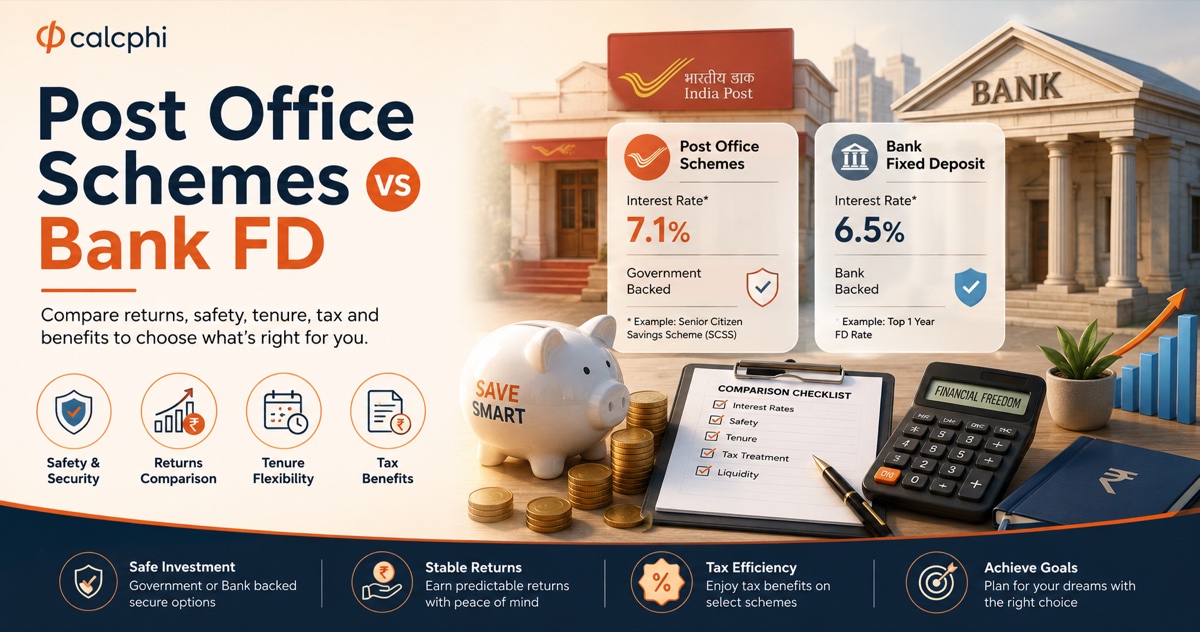
When it comes to safe, guaranteed savings in India, two options dominate the conversation: Post Office small savings schemes and bank Fixed Deposits. On the surface, they look similar — you deposit money, you earn interest, your principal is protected. But once you dig into the actual numbers — interest rates, tax treatment, liquidity rules, and deposit limits — the two options diverge in ways that can mean lakhs of rupees of difference over a five-year horizon.
What Are Post Office Small Savings Schemes?
Post Office small savings schemes are savings and investment products offered through India Post, backed by the Government of India. Because they are sovereign-guaranteed, there is zero credit risk — your money is as safe as it can possibly be in the Indian financial system. The Department of Economic Affairs under the Ministry of Finance reviews and sets interest rates on these schemes every quarter. For Q1 FY 2026-27 (April to June 2026), rates have remained stable across most instruments.
Current Interest Rates: Post Office Schemes vs Bank FDs (April 2026)
| Tenure | Post Office TD | SBI FD | HDFC Bank FD | ICICI Bank FD |
|---|---|---|---|---|
| 1 Year | 6.9% | 6.8% | 6.6% | 6.7% |
| 2 Years | 7.0% | 7.0% | 7.0% | 7.0% |
| 3 Years | 7.1% | 6.75% | 7.0% | 7.0% |
| 5 Years | 7.5% | 6.5% | 7.0% | 6.9% |
For the most popular tenure — 5 years — the Post Office TD at 7.5% comfortably beats SBI (6.5%) and ICICI (6.9%), and edges ahead of HDFC (7.0%) as well. The gap widens further when you factor in the sovereign guarantee, which no private or public sector bank can match.
| Scheme | Rate | Tenure | Max Investment |
|---|---|---|---|
| NSC | 7.7% | 5 years | No limit |
| MIS | 7.4% | 5 years | ₹9L single / ₹15L joint |
| SCSS | 8.2% | 5 years | ₹30 lakh |
| KVP | 7.5% | ~9 yr 7 months | No limit |
| PPF | 7.1% | 15 years | ₹1.5L per year |
| Post Office RD | 6.7% | 5 years | No limit |
SCSS at 8.2% is currently the highest guaranteed-return instrument available to any Indian investor aged 60 and above — higher than any major bank's senior citizen FD rate.
The Real Question: What Do You Earn After Tax?
Interest rates on paper mean little if you don't account for tax. Both Post Office schemes and bank FDs are subject to income tax — but the rules differ by scheme, and that changes the effective return significantly.
How Bank FD Interest Is Taxed
Interest earned on a bank FD is added to your total income and taxed at your applicable slab rate. TDS is deducted by the bank at 10% if your total FD interest in a financial year exceeds ₹40,000 (₹50,000 for senior citizens). If you fall in the 30% tax bracket, you owe an additional 20% on top of what the bank has already deducted. Use CalcPhi's TDS on FD Calculator to see exactly how much TDS applies to your FD and what your net return will be.
How Post Office Scheme Interest Is Taxed
NSC: Interest accrues annually and is taxable each year — but the same accrued interest qualifies as a fresh NSC investment eligible for Section 80C deduction (up to the ₹1.5 lakh cap). For most investors, this effectively cancels out the tax on accrual for the first four years. At maturity, the final year's interest is taxable without the 80C offset.
Post Office 5-Year TD: Interest is taxable annually. However, the principal invested qualifies for Section 80C deduction up to ₹1.5 lakh — exactly the same as a 5-year Tax Saver FD at a bank.
SCSS: Interest is taxable quarterly as income. TDS applies if quarterly interest exceeds ₹50,000 for the year. With a maximum investment of ₹30 lakh at 8.2%, annual interest is ₹2,46,000 — well above the threshold, so TDS will apply for most investors.
MIS: Monthly payouts are fully taxable as income in the year received.
PPF: The most tax-efficient of all — EEE status (Exempt-Exempt-Exempt). Contributions qualify for 80C, interest earned is tax-free, and the maturity amount is tax-free. This makes PPF's effective return significantly higher than its nominal 7.1% for anyone in the 20% or 30% bracket.
| Instrument | Pre-Tax Rate | After-Tax Return (30% bracket) |
|---|---|---|
| Bank FD 5-yr (SBI) | 6.5% | ~4.55% |
| Bank FD 5-yr (HDFC) | 7.0% | ~4.90% |
| Post Office TD 5-yr | 7.5% | ~5.25% |
| NSC 5-yr | 7.7% | ~5.39% (effectively higher with 80C offset) |
| SCSS 5-yr | 8.2% | ~5.74% |
| PPF 15-yr | 7.1% | 7.1% (fully tax-free) |
PPF wins outright on an after-tax basis for long-term savings, despite having the second-lowest nominal rate. For medium-term 5-year deposits, Post Office instruments consistently beat equivalent bank FDs on after-tax returns for investors in higher tax brackets. Use CalcPhi's FD Calculator and the NSC Calculator side by side to run these numbers with your actual investment amount and tax slab.
Liquidity: Can You Exit Early?
Bank FDs typically allow premature withdrawal with a penalty of 0.5% to 1% on the applicable rate. Most banks process premature closure within a day or two — a genuine advantage for investors who may need emergency access to funds.
Post Office schemes are considerably more restrictive. The Post Office TD allows premature withdrawal after 6 months, but you earn only the 4% savings account rate if withdrawn in the first year, and a 2% penalty on the applicable rate after that. NSC cannot be prematurely withdrawn at all except on the holder's death, forfeiture by a pledgee, or a court order — there is no routine early exit. SCSS can be closed prematurely with a 1.5% penalty after 1 year and 1% after 2 years. MIS allows premature closure after 1 year with a 2% deduction before 3 years and 1% deduction after. PPF is the most restrictive — funds are locked for 15 years, with partial withdrawal allowed only from year 7 onwards.
The key takeaway: if you have any chance of needing the money before maturity, bank FDs offer far more flexibility. Post Office schemes reward those who can commit to the full tenure.
Safety: How Much Is Actually Protected?
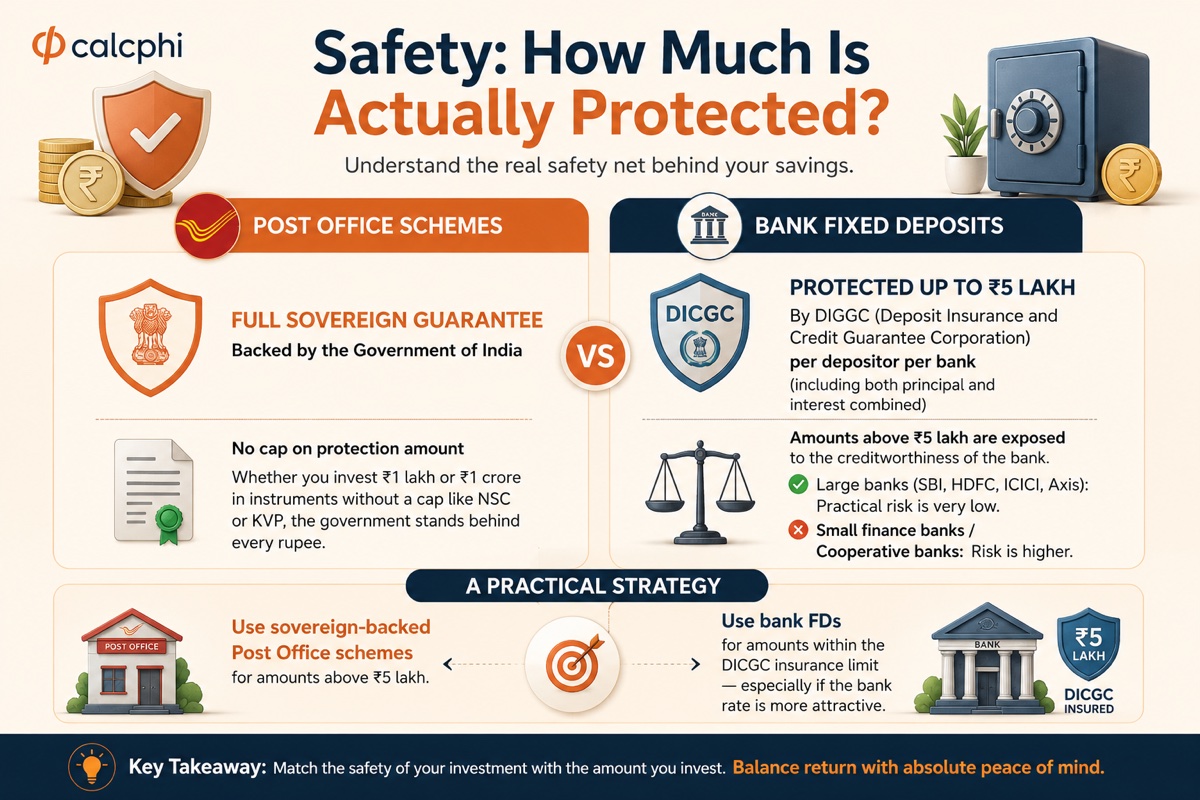
Post Office schemes carry a full sovereign guarantee from the Government of India. There is no cap on the protection amount — whether you invest ₹1 lakh or ₹1 crore in instruments without a cap like NSC or KVP, the government stands behind every rupee.
Bank FDs are protected by DICGC up to ₹5 lakh per depositor per bank — including both principal and interest combined. Amounts above ₹5 lakh are exposed to the creditworthiness of the individual bank. For large banks like SBI, HDFC, ICICI, and Axis, the practical risk is very low. For small finance banks or cooperative banks, the risk is higher.
A practical strategy: use sovereign-backed Post Office schemes for amounts above ₹5 lakh, and use bank FDs for amounts within the DICGC insurance limit — especially if the bank rate is more attractive.
A Real ₹ Example: ₹10 Lakh Invested for 5 Years (20% Tax Bracket)
| Option | Rate | Gross Maturity | Tax on Interest | Net Proceeds |
|---|---|---|---|---|
| SBI 5-Year FD | 6.5% | ~₹13,80,000 | ~₹76,000 | ~₹13,04,000 |
| Post Office TD 5-Year | 7.5% | ~₹13,75,000 | ~₹75,000 | ~₹13,00,000 |
| NSC 5-Year (80C benefit maxed) | 7.7% | ~₹14,47,000 | ~₹89,400 | ~₹13,57,600 |
| SCSS (60+ only) | 8.2% | ~₹14,10,000 | ~₹82,000 | ~₹13,28,000 |
Post Office schemes consistently outperform major bank FDs on a net-after-tax basis for investors in the 20% and 30% brackets. Use CalcPhi's FD Calculator to model your specific deposit amount and tenure.
Who Should Choose Post Office Schemes — And Who Should Stick With Bank FDs
Choose Post Office schemes if you are a retiree with ₹15 lakh or more to invest and want the absolute safest guaranteed return — SCSS at 8.2% is unbeatable. Or you are a long-term saver in the 20% or 30% tax bracket who wants to maximise after-tax returns on a 5-year horizon. Or you have a daughter under 10 and want to build her education corpus — SSY at 8.2% with EEE tax status is the best guaranteed instrument in India. Or you want 80C tax benefits without market risk — the 5-year Post Office TD and NSC both qualify.
Choose bank FDs if you need flexibility to exit early without significant penalties. Or you are investing a smaller amount (under ₹2–3 lakh) and the convenience of your existing bank account matters. Or you want to ladder deposits across multiple tenures easily — most banks allow this online in minutes. Or a small finance bank is offering 8%+ on 1–2 year FDs and you are comfortable with the risk within the ₹5 lakh DICGC cover.
The Digital Access Question
A common concern is that Post Office schemes require visiting a branch, filling paper forms, and dealing with queues. This is increasingly outdated. India Post's Internet Banking portal and the India Post Payments Bank (IPPB) app now allow digital opening and management of PPF, RD, and TD accounts. SCSS and SSY accounts can also be managed digitally after the initial account opening at a branch. For most urban investors, the initial branch visit is a one-time step — after that, you can manage deposits, check balances, and renew accounts online.
Combining Both for Maximum Return and Safety
The smartest strategy for most risk-averse Indian investors is not to choose one over the other — it is to use both. For long-term savings (15+ years), use PPF up to the ₹1.5 lakh annual cap — the EEE tax status makes this the default choice. For medium-term savings needing monthly income, use Post Office MIS up to the ₹15 lakh joint limit at 7.4%. For amounts above MIS limits, complement with bank FD ladders across 1-year, 2-year, and 3-year tenures. For senior citizens, max out SCSS at ₹30 lakh first — no other instrument comes close to 8.2% with sovereign backing. Keep an emergency fund portion in liquid bank FDs or savings accounts for quick access.
Model your Post Office returns before deciding:
Post Office TD Calculator → NSC Calculator → MIS Calculator →Frequently Asked Questions
-
Is Post Office FD (Time Deposit) better than SBI FD in 2026?
Yes, for most tenures in 2026. The Post Office 5-year TD offers 7.5%, compared to SBI's 6.5% for the same tenure. The Post Office rate is also sovereign-guaranteed, meaning no credit risk whatsoever. For 1-year tenures, the difference is smaller, and some small finance banks offer competitive rates — but without the same safety.
-
Is SCSS better than a senior citizen bank FD?
For deposits above ₹5 lakh, SCSS at 8.2% is almost certainly better. Most major banks offer senior citizen FD rates between 7.0% and 7.75% for 5-year tenures. SCSS also pays out quarterly, which suits retirees needing regular income. The main limitation is the ₹30 lakh maximum investment across all SCSS accounts.
-
Is NSC interest tax-free?
No. NSC interest is taxable each year, even though it is physically paid at maturity. However, the annually accrued interest is also treated as a fresh NSC investment and qualifies for Section 80C deduction (up to ₹1.5 lakh total across all 80C instruments). This 80C offset reduces the effective tax burden for most investors during the first four years of the NSC's life.
-
Can I lose money in Post Office schemes?
No, as long as you hold to maturity. Post Office schemes carry a full Government of India guarantee — both principal and promised interest are fully protected. Early withdrawal penalties can reduce your effective return, but you will never receive less than your principal (except in the narrow case of SCSS premature closure in the first year).
-
Which Post Office scheme is best for regular monthly income?
Post Office MIS (Monthly Income Scheme) is designed precisely for this. At 7.4%, a joint deposit of ₹15 lakh generates monthly interest of approximately ₹9,250 — directly credited to your linked savings account. There is no equivalent bank product that combines sovereign safety, monthly payouts, and a 7.4% rate.
-
Do Post Office schemes qualify for Section 80C deduction?
Some do and some don't. The 5-year Post Office TD and NSC both qualify for 80C deduction up to ₹1.5 lakh per year. PPF also qualifies. MIS, KVP, SCSS, and Post Office RD do not qualify for 80C. If your goal is tax saving alongside returns, the 5-year TD or NSC is the right Post Office instrument to use.
Disclaimer: The interest rates, tax rules, and investment limits cited in this article are based on publicly available information for Q1 FY 2026-27 (April–June 2026). Rates are subject to revision by the Ministry of Finance each quarter. Tax treatment depends on your individual income and applicable slab rates. All CalcPhi calculators are for educational and estimation purposes only — nothing in this article constitutes financial advice. Please consult a SEBI-registered financial advisor or Chartered Accountant for guidance tailored to your specific situation.