NPS Tier 1 vs Tier 2: How to Use NPS Smartly for Tax and Retirement

The National Pension System is one of the most powerful retirement tools available to Indian investors, yet it remains one of the most misunderstood. Many salaried employees contribute to NPS only because their employer asks them to, without ever understanding the difference between Tier 1 and Tier 2. Many miss out on an extra ₹50,000 tax deduction simply because they did not know it existed. This guide breaks it all down — with real numbers — so you can decide exactly how to use NPS for both tax saving and long-term retirement planning.
What Is NPS, and Who Can Join?
The National Pension System is a government-regulated, market-linked retirement savings scheme administered by the Pension Fund Regulatory and Development Authority (PFRDA). Originally launched for central government employees in 2004, it was opened to all Indian citizens — including the self-employed — in 2009.
Any Indian citizen between 18 and 70 years of age can open an NPS account. NRIs are also eligible. There are two types of accounts within NPS: Tier 1 and Tier 2. Understanding the purpose and rules of each is the foundation for using NPS wisely.
NPS Tier 1: The Core Retirement Account
Tier 1 is the primary NPS account, designed specifically for retirement savings — which is why the money is locked in until you turn 60. The minimum annual contribution is just ₹1,000, making it accessible even on a modest income.
You can choose how your money is invested across four asset classes: Equity (E), Corporate Bonds (C), Government Securities (G), and Alternative Assets (A). The equity allocation is capped at 75% under the Active Choice option, and gradually reduces after age 50 under the Auto Choice (lifecycle fund) option.
At age 60, you can withdraw up to 60% of your total corpus as a lump sum, completely tax-free. The remaining 40% must be used to purchase an annuity — a financial product that pays a regular monthly pension. Annuity income is taxed at your applicable slab rate in retirement.
NPS Tier 2: The Flexible Add-On
Tier 2 is an optional account that you can activate on top of your existing Tier 1 account. You cannot open a Tier 2 account without an active Tier 1 PRAN (Permanent Retirement Account Number). The minimum contribution to activate a Tier 2 account is ₹250.
The key difference from Tier 1 is that there are no withdrawal restrictions on Tier 2. You can withdraw the full amount at any time, for any reason — no lock-in, no minimum holding period, no mandatory annuity requirement.
However, Tier 2 contributions do not qualify for any tax deduction. When you withdraw from Tier 2, the gains are taxed just like mutual fund capital gains: short-term gains are taxed at your slab rate, and long-term gains are taxed at 12.5% for equity-oriented funds (above ₹1.25 lakh) or at 20% with indexation for debt-oriented funds held over three years.
There is one exception: Central Government employees who contribute to Tier 2 with a 3-year lock-in can claim deductions under Section 80C, up to ₹1.5 lakh. This benefit is not available to private sector employees or the self-employed.
The Tax Benefits of NPS Tier 1 (AY 2026-27)
This is where NPS genuinely shines for salaried investors. There are three separate layers of NPS tax benefits under the old tax regime:
Section 80CCD(1): Employee contributions to NPS Tier 1 are deductible up to 10% of your basic salary + DA. This deduction is within the overall ₹1.5 lakh Section 80C limit — your NPS contribution counts as part of your ₹1.5 lakh 80C basket alongside EPF, PPF, ELSS, and LIC premiums.
Section 80CCD(1B): This is the most underused tax benefit in India. You can claim an additional deduction of up to ₹50,000 per year for contributions made to NPS Tier 1 — completely over and above the ₹1.5 lakh 80C ceiling. This is exclusive to NPS. No other 80C instrument qualifies for this extra deduction. For someone in the 30% tax bracket, this ₹50,000 additional deduction saves ₹15,600 per year in tax (₹50,000 × 30% + 4% cess). Over 20 years, that is over ₹3 lakh in tax savings from this deduction alone — not counting the compounding benefit of the corpus itself.
Section 80CCD(2): If your employer contributes to your NPS account, that contribution is deductible up to 10% of your basic salary + DA for private sector employees, or up to 14% for Central Government employees. This deduction is entirely separate from both 80C and 80CCD(1B).
Under the new tax regime, the 80C and 80CCD(1B) deductions are not available. However, the employer contribution benefit under 80CCD(2) is available under both regimes. Use CalcPhi's Income Tax Calculator to check which regime saves you more money before making a decision.
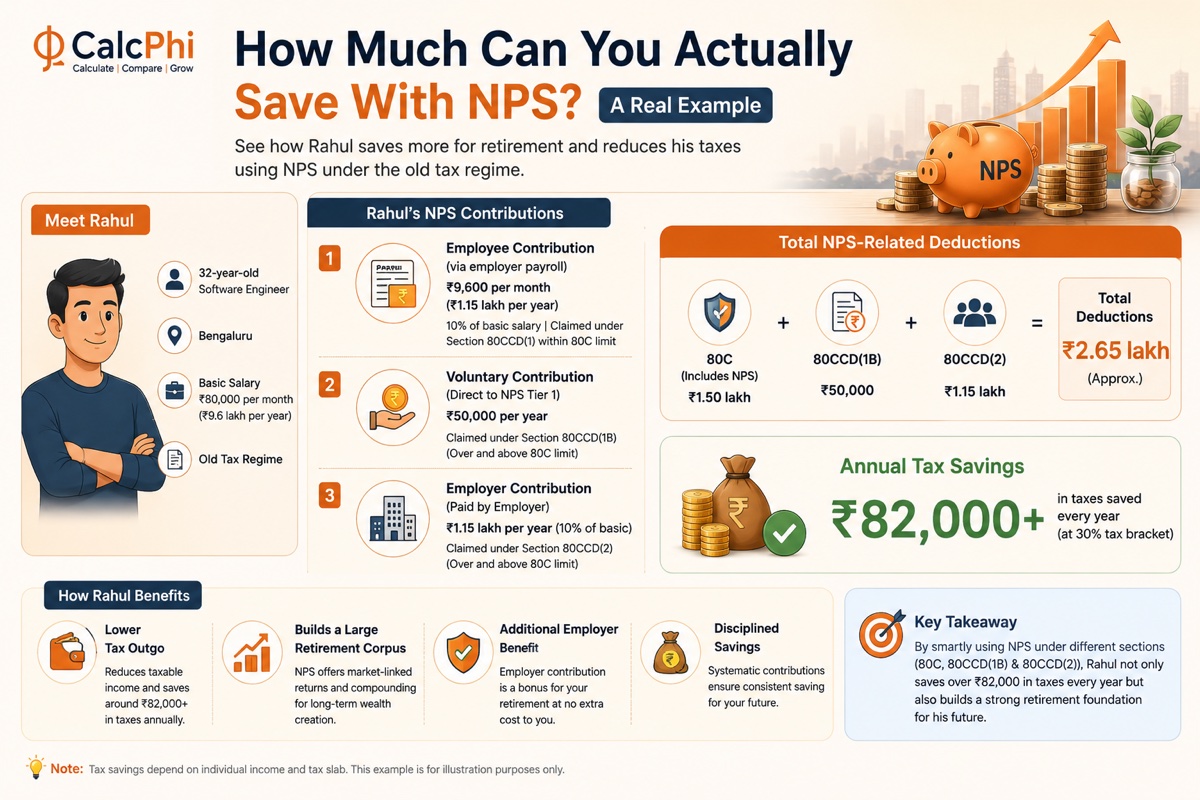
How Much Can You Actually Save With NPS? A Real Example
Rahul is a 32-year-old software engineer in Bengaluru with a basic salary of ₹80,000 per month (₹9.6 lakh/year). He files under the old tax regime.
- He contributes ₹9,600/month (₹1.15 lakh/year) to NPS Tier 1 through his employer payroll (10% of basic) — qualifies under Section 80CCD(1) within his 80C limit.
- He makes an additional voluntary contribution of ₹50,000/year directly to NPS Tier 1 — claimed under Section 80CCD(1B).
- His employer also contributes 10% of his basic into NPS (₹1.15 lakh/year) — claimed under Section 80CCD(2).
Total NPS-related deductions: ₹1.5 lakh (80C, of which NPS forms a part) + ₹50,000 (80CCD1B) + ₹1.15 lakh (80CCD2) = roughly ₹2.65 lakh in deductions, saving approximately ₹82,000+ in taxes annually at the 30% bracket.
NPS Equity Returns: What to Expect
NPS funds are managed by PFRDA-approved pension fund managers including SBI Pension Funds, HDFC Pension Fund, ICICI Prudential Pension Fund, and Kotak Pension Fund. You choose the fund manager when you open your account, and you can switch once per year.
The equity (E) fund within NPS has historically delivered returns in the range of 13% to 17% per annum over a 10-year period, depending on the fund manager — broadly comparable to Nifty 50 index funds, which makes sense since the E fund primarily invests in Nifty 50 stocks.
The advantage of staying with NPS for decades is compounding on a tax-deferred basis. You are not paying capital gains tax every year on the equity gains inside NPS, unlike a mutual fund where switching or rebalancing triggers taxes. The entire corpus grows uninterrupted until you exit at 60.
The Exit Tax Trap — and How to Plan Around It
At age 60, when you exit NPS, the 60% lump sum withdrawal is fully exempt from tax — no other market-linked instrument offers a tax-free lump sum of this size.
But the 40% corpus that goes into an annuity will generate monthly pension income, and that income is taxed at your slab rate every year. If your NPS corpus at 60 is ₹2 crore, then ₹80 lakh goes into an annuity. At a current annuity rate of around 6% per year, that generates ₹4.8 lakh per year — taxed at your applicable rate.
The smart strategy is to ensure your total income in retirement stays below the taxable threshold or within the lowest slab. Many retirees have this level of control if planned well. If your annuity income alone is ₹4.8 lakh and you have no other significant income, you would pay zero to minimal tax after the basic exemption limit.
When Does NPS Tier 2 Actually Make Sense?
Given that Tier 2 has no tax benefits and is taxed like a mutual fund, why would anyone use it? There is one narrow but genuine use case.
If you have already maxed out your Tier 1 contribution for the year and want market-linked exposure within the NPS ecosystem, Tier 2 can work. The expense ratios within NPS are among the lowest in India — as low as 0.01% for some fund managers, even cheaper than many direct mutual funds. For a disciplined investor who wants ultra-low-cost equity exposure and does not need the money for three or more years, Tier 2 with the equity option can deliver returns comparable to a Nifty 50 index fund at a fraction of the cost.
For most private sector investors with a goal less than 3 years away, or for anyone who values flexibility, direct mutual funds through a direct plan route remain the better choice — they offer tax-loss harvesting, easier goal-based tracking, and a wider selection of fund categories.
NPS vs PPF: Key Trade-offs at a Glance
Both NPS and PPF are popular long-term retirement tools. PPF gives a guaranteed, tax-free return (currently 7.1% per annum) with a 15-year lock-in and zero market risk. The entire PPF maturity amount is tax-free — no annuity requirement, no slab-rate exit tax. NPS, on the other hand, gives market-linked returns that can significantly outperform PPF over 20–30 years, plus the unique ₹50,000 extra deduction under 80CCD(1B).
A practical strategy many financial planners suggest: max out NPS Tier 1 first for the tax deductions — especially the ₹50,000 extra — and then invest in PPF for the guaranteed, fully tax-free retirement income. Use CalcPhi's NPS Calculator alongside the PPF Calculator to see both projections side by side.
Project your NPS corpus and monthly pension at retirement:
NPS Calculator →Frequently Asked Questions
-
Can I open an NPS Tier 2 account without having a Tier 1 account?
No. You must have an active Tier 1 account (with a valid PRAN) before you can activate Tier 2. Opening Tier 1 first is mandatory. The minimum contribution to open Tier 1 is ₹500 at account opening and ₹1,000 per year to keep it active.
-
Is the ₹50,000 NPS deduction under 80CCD(1B) available under the new tax regime?
No. The Section 80CCD(1B) deduction of ₹50,000 is available only under the old tax regime. Under the new tax regime, you cannot claim 80C or 80CCD(1B) deductions. The only NPS-related deduction available under the new regime is the employer contribution under Section 80CCD(2).
-
What happens to my NPS if I change jobs?
Your NPS account is fully portable. Since the PRAN (Permanent Retirement Account Number) is linked to you as an individual — not to your employer — it stays with you when you switch jobs. You can either continue contributing yourself or ask your new employer to route contributions through the same PRAN.
-
How is NPS Tier 2 taxed on withdrawal?
Tier 2 withdrawals are taxed based on how long you held the investment. For equity-oriented NPS Tier 2 funds, gains held for more than one year are taxed at 12.5% (LTCG) above ₹1.25 lakh. For debt-oriented funds, long-term gains (after three years) are taxed at 20% with indexation. Short-term gains in both cases are taxed at your applicable income slab rate — the same treatment as mutual funds.
-
Can I withdraw partially from NPS Tier 1 before age 60?
Yes, but only under specific conditions: higher education or marriage of children, purchase or construction of a first home, treatment of critical illness, and disability. You can withdraw up to 25% of your own contributions (excluding employer contributions and returns), only after completing three years of membership. A maximum of three partial withdrawals are allowed in the entire tenure.
-
What is the difference between Active Choice and Auto Choice in NPS?
Under Active Choice, you manually decide how to allocate contributions across equity (E), corporate bonds (C), government securities (G), and alternatives (A) — with a cap of 75% on equity. Under Auto Choice (lifecycle fund), the allocation is automatically managed based on your age: higher equity when young, shifting gradually to safer assets as you approach 60. If you are not comfortable actively managing allocations, Auto Choice is the simpler and well-designed default.
Disclaimer: The information in this article is for educational and informational purposes only. NPS returns are subject to market risks and are not guaranteed. Tax rules are based on Income Tax Act provisions applicable for AY 2026-27 and may change in future budgets. Nothing in this article constitutes personalised financial advice. Please consult a SEBI-registered investment advisor or a qualified Chartered Accountant before making investment decisions.