Income Tax on Fixed Deposits: How TDS Works and How to Legally Reduce It
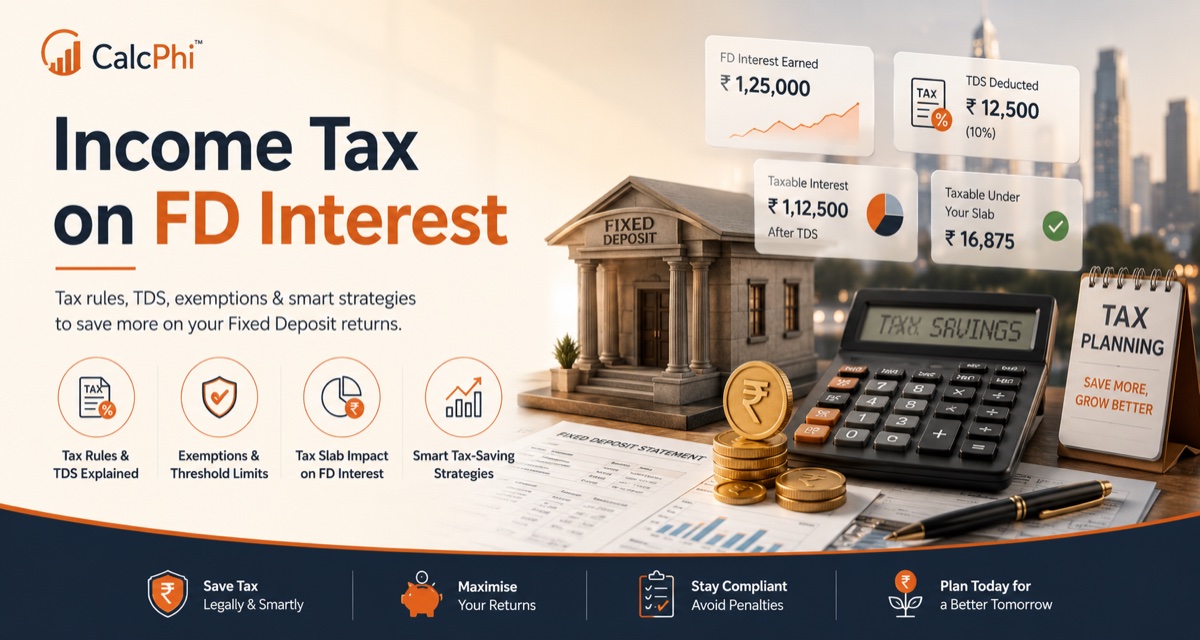
Fixed deposits are India's most-trusted savings instrument. Millions of families park their savings in FDs because they feel safe, predictable, and hassle-free. But there is one thing most FD investors do not fully understand until they file their income tax return — FD interest is fully taxable, and the bank only deducts a fraction of the tax you actually owe. If you are in the 30% tax bracket and your bank is deducting TDS at just 10%, you are quietly accumulating a tax liability that shows up as a shock demand when you file.
What Kind of Income Is FD Interest?
FD interest is classified as "Income from Other Sources" under the Income Tax Act, 1961. This means it is added directly to your total income for the year and taxed at whatever slab rate applies to you. There is no flat tax, no special rate, and no indexation benefit. If you earn ₹12 lakh from salary and ₹1 lakh from FD interest, your taxable income is ₹13 lakh — and the FD interest is taxed at the marginal rate that applies at that income level.
This applies to all types of fixed income products: regular bank FDs, corporate FDs, recurring deposits, and Post Office Time Deposits. The only partial exception is the Tax Saver FD — a 5-year bank FD where the principal qualifies for a deduction under Section 80C (up to ₹1.5 lakh per year). Even then, the interest earned on a Tax Saver FD is fully taxable. The "tax saver" label refers only to the principal investment, not the returns.
How TDS on FD Interest Works
TDS (Tax Deducted at Source) is a mechanism where the bank deducts a percentage of your interest income and deposits it with the Income Tax Department on your behalf, before you even receive the money. Think of it as a tax advance — the government collects it early rather than waiting for you to file a return.
For FY 2026-27 (AY 2026-27), TDS rules on FD interest are as follows:
| Depositor Type | Annual Interest Threshold | TDS Rate |
|---|---|---|
| Individuals below 60 years | ₹40,000 | 10% |
| Senior citizens (60+ years) | ₹50,000 | 10% |
| Without a valid PAN | ₹40,000 / ₹50,000 | 20% |
The threshold applies per bank, per branch. If you have three FDs at the same SBI branch earning a combined ₹80,000 in interest, TDS will be deducted on ₹40,000 (the portion above the threshold) at 10% — meaning ₹4,000 will be deducted. If your PAN is not registered with the bank, that rate jumps to 20%.
The Accrual Rule: Why Cumulative FD Tax Surprises People
This is the part that catches most investors off guard. For cumulative FDs — the popular type where interest is compounded and paid at maturity — the Income Tax Department does not tax the interest only when you receive it. Under the accrual method, the interest that accumulates each financial year is taxable in that year, even if you do not physically receive a rupee until the FD matures.
So if you open a 3-year cumulative FD in April 2023, you are expected to declare a portion of the accrued interest in your ITR for FY 2023-24, FY 2024-25, and FY 2025-26, even though the entire amount hits your account only when the FD matures in 2026.
Many investors skip this and declare the full interest only in the maturity year. This can push them into a higher tax slab in the maturity year and also trigger notices from the IT Department for under-reporting in earlier years. The correct approach is to check the interest accrued each year from your bank statement or Form 26AS, declare it annually, and claim TDS credit accordingly.
Five Legal Ways to Reduce Tax on Your FD Interest
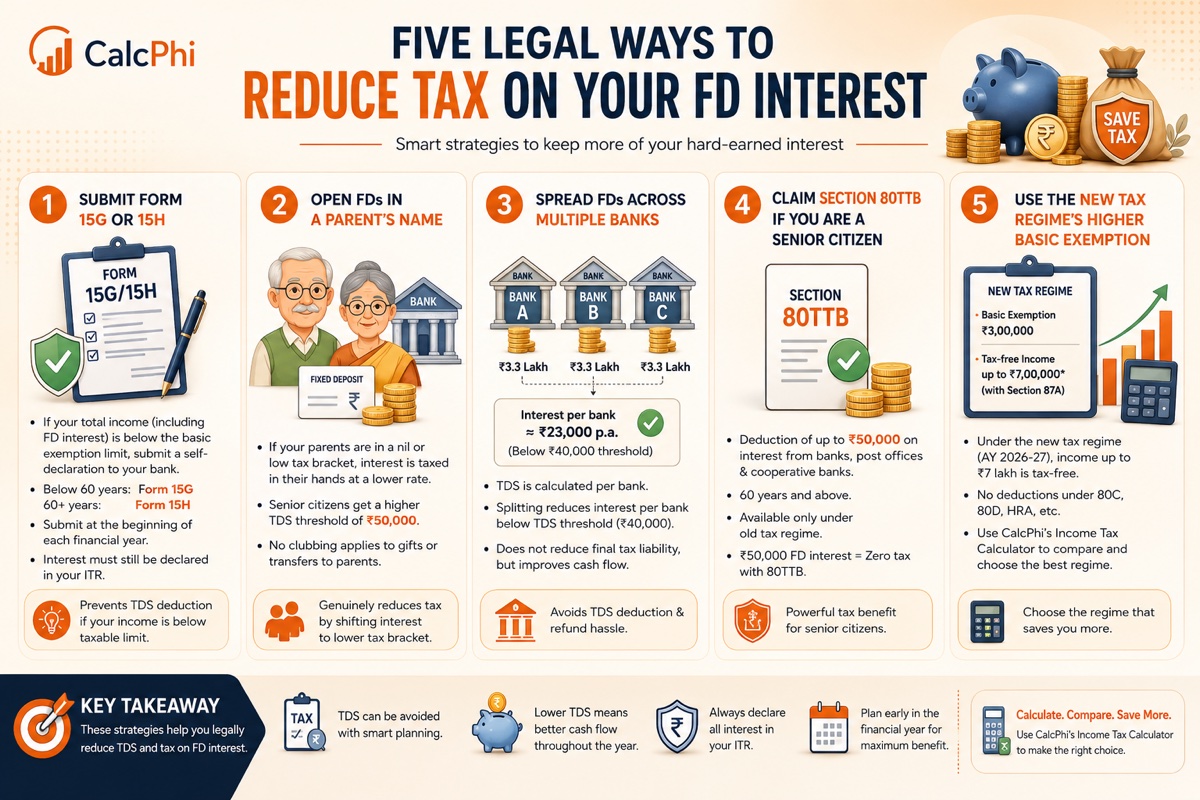
1. Submit Form 15G or Form 15H
If your total annual income — including FD interest — is expected to fall below the basic exemption limit, you can submit a self-declaration to your bank to prevent TDS from being deducted at all. The form for individuals below 60 years is Form 15G; for senior citizens aged 60 and above, it is Form 15H.
The key condition is that your total income for the year must be below the taxable threshold. Submit the form at the beginning of each financial year — it is not automatically carried forward. Even if TDS is not deducted, you must still declare the interest in your ITR.
2. Open FDs in a Parent's Name
If your parents are retired and fall in the nil or low tax bracket, opening an FD in their name means the interest is taxed in their hands at their lower rate. Senior citizens also get a higher TDS threshold of ₹50,000 per year.
The clubbing provisions under the Income Tax Act do not apply to gifts or transfers to parents. So if you transfer money to your retired parent's account and they open an FD, the interest is genuinely theirs for tax purposes. Compare this with a spouse's FD: if you fund an FD in your spouse's name, the interest is clubbed back into your income under Section 64 of the IT Act.
3. Spread FDs Across Multiple Banks
TDS is calculated per bank. If you keep ₹10 lakh in a single bank FD earning 7% annually, your annual interest is ₹70,000 — well above the ₹40,000 threshold, triggering TDS. But if you split the same ₹10 lakh across three banks at roughly ₹3.3 lakh each, annual interest per bank falls to approximately ₹23,000 — below the threshold at each bank.
This does not reduce your final tax liability (you still declare all the interest in your ITR), but it prevents TDS from being deducted at source, improving your cash flow throughout the year and avoiding the process of claiming refunds.
4. Claim Section 80TTB if You Are a Senior Citizen
Section 80TTB provides a deduction of up to ₹50,000 on interest income from banks, post offices, and cooperative banks for senior citizens (60 years and above). This is one of the most valuable tax benefits available to retirees and is often underutilised.
A senior citizen earning ₹50,000 in FD interest pays zero tax on that income if they claim 80TTB correctly. Even for those earning ₹1 lakh in interest, the effective taxable interest reduces to just ₹50,000. This deduction is available only under the old tax regime, so senior citizens should carefully compare regimes before filing.
5. Use the New Tax Regime's Higher Basic Exemption
Under the new tax regime for AY 2026-27, there is a basic exemption of ₹3 lakh and a rebate under Section 87A that makes income up to ₹7 lakh effectively tax-free for resident individuals. If your total income including FD interest stays below ₹7 lakh, you owe zero tax under the new regime.
The tradeoff is that the new regime does not allow deductions under 80C, 80D, HRA, and most other exemptions. Use CalcPhi's Income Tax Calculator to figure out which regime saves you more based on your actual income and investments.
TDS Versus Final Tax: The Critical Distinction
Many FD investors assume that once TDS has been deducted by the bank, their tax obligation on that income is complete. This is incorrect, and it is one of the most common reasons for IT notices and demand letters.
TDS is only a prepayment of tax. If your slab rate is 30% and the bank deducted 10%, you still owe 20% on that interest when you file your ITR. Conversely, if your total income is below the exemption limit or your effective rate is lower than 10%, you are entitled to claim the TDS as a refund by filing your return.
Always reconcile FD interest with your Form 26AS or Annual Information Statement (AIS) before filing. The bank reports all TDS deductions to the IT Department, and discrepancies between what you declare and what the bank reported are a common trigger for scrutiny.
Calculate your FD maturity value and exact TDS impact:
FD Calculator →Frequently Asked Questions
-
Is TDS on FD a final tax payment?
No. TDS is only an advance collection of tax. If your slab rate is higher than 10%, you owe the difference when you file your ITR. If your income is below the taxable limit, you can claim the entire TDS as a refund by filing a return.
-
Can I avoid TDS on FD by not linking my PAN?
No — TDS will still be deducted, but at a higher rate of 20% instead of 10%. Not linking your PAN to the FD increases the tax deducted, not reduces it. Always provide a valid PAN to your bank.
-
Is interest on NRE FDs taxable in India?
No. Interest on NRE (Non-Resident External) fixed deposits is fully exempt from income tax in India as long as the account holder maintains NRI status. NRO FD interest, however, is fully taxable and subject to TDS at 30%.
-
What is Form 15G and who can submit it?
Form 15G is a self-declaration that your total income for the financial year will be below the basic exemption limit. Resident individuals below 60 years who meet this condition can submit it to their bank to request that no TDS is deducted on their FD interest. Senior citizens submit Form 15H, which has slightly more relaxed conditions.
-
Does the ₹40,000 TDS threshold apply per FD or per bank?
The threshold applies per bank, per PAN. All FDs held at different branches of the same bank are aggregated. If your total FD interest from one bank exceeds ₹40,000 in a year, TDS is deducted on the amount above the threshold — regardless of how many FDs or branches are involved.
-
What deduction is available to senior citizens on FD interest?
Senior citizens can claim a deduction of up to ₹50,000 on interest income from banks, post offices, and cooperative banks under Section 80TTB of the Income Tax Act. This deduction is available only under the old tax regime and can significantly reduce or eliminate the tax liability on FD income for retirees.
Disclaimer: All CalcPhi calculators and articles are for educational and estimation purposes only. Nothing in this article constitutes financial, tax, or investment advice. Tax rules can change and individual circumstances vary — consult a qualified Chartered Accountant or SEBI-registered financial advisor for personalised guidance before making investment or tax decisions.