How to Save Maximum Tax Under Section 80C in 2026 — A Complete Checklist

Every year, millions of Indian taxpayers scramble in February and March to make last-minute investments just to save tax. But rushing into the wrong instruments — or worse, not using the full ₹1.5 lakh limit at all — means you are leaving real money on the table. Section 80C of the Income Tax Act is one of the most powerful tools available to salaried employees and self-employed professionals alike, and using it wisely can save you anywhere from ₹15,600 to ₹46,800 in tax every single financial year. This guide breaks down every eligible investment under Section 80C, explains exactly how much tax you can save at each income slab, and gives you a practical checklist to make sure you never miss the limit again.
What Is Section 80C and Who Can Use It
Section 80C of the Income Tax Act, 1961 allows you to reduce your gross taxable income by up to ₹1,50,000 per financial year by investing in or spending on specific approved instruments. This means if your taxable income is ₹12 lakh and you invest ₹1.5 lakh in eligible instruments, your income for tax calculation purposes drops to ₹10.5 lakh.
This deduction is available only under the old tax regime. If you have opted for the new tax regime (which has been the default since FY 2020-21), Section 80C deductions do not apply. The very first step, therefore, is to decide which regime suits you better. Use CalcPhi's New vs Old Tax Regime Calculator to compare your tax liability under both regimes instantly — it takes less than a minute.
The ₹1.5 lakh limit has remained unchanged since FY 2014-15. It applies to individuals and Hindu Undivided Families (HUFs), but not to companies or partnership firms.
How Much Tax Can You Actually Save Under 80C
The amount you save depends on the income tax slab you fall under. Here is how the math works for AY 2026-27 under the old regime (including 4% health and education cess):
At the 5% slab (income between ₹2.5 lakh and ₹5 lakh), claiming the full ₹1.5 lakh deduction saves you ₹7,800 in tax. At the 20% slab (income between ₹10 lakh and ₹12.5 lakh), the saving jumps to ₹31,200. If you fall in the 30% slab (income above ₹15 lakh), you save ₹46,800 on the full ₹1.5 lakh investment.
To see exactly how much you will save based on your income, plug your numbers into CalcPhi's Section 80C Deduction Calculator. It accounts for all income levels, cess, and surcharge where applicable.
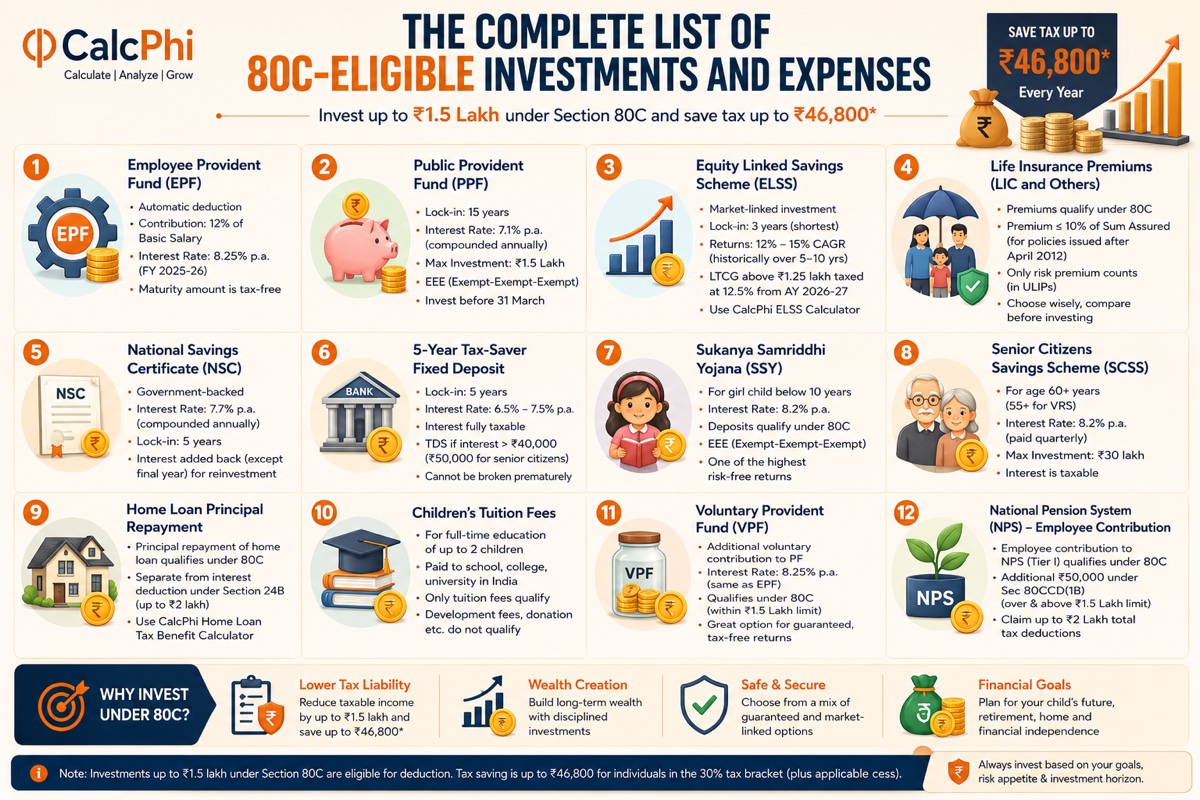
The Complete List of 80C-Eligible Investments and Expenses
Employee Provident Fund (EPF)
If you are a salaried employee, your contribution to the EPF automatically counts under 80C. The standard employee contribution is 12% of your basic salary. This is the most effortless 80C investment because it happens automatically every month without you having to do anything extra. EPF currently earns an interest rate of 8.25% per annum for FY 2025-26, and the maturity amount is fully exempt from tax.
Public Provident Fund (PPF)
PPF is one of the safest long-term investment options in India. It has a 15-year lock-in period and currently offers an interest rate of 7.1% per annum (compounded annually, reviewed quarterly by the government). The maximum annual investment is ₹1.5 lakh. Both the interest earned and the maturity amount are completely tax-free, making PPF an EEE (Exempt-Exempt-Exempt) instrument. Contributions must be made before 31 March to count for that financial year.
Equity Linked Savings Scheme (ELSS)
ELSS mutual funds are the only market-linked investment that qualifies under 80C. They invest primarily in equities and have the shortest lock-in period among all 80C instruments — just 3 years. Historically, ELSS funds have delivered returns in the range of 12% to 15% CAGR over 5–10 year periods, though past performance does not guarantee future returns. Long-term capital gains above ₹1.25 lakh are taxed at 12.5% from AY 2026-27 onwards. Use CalcPhi's ELSS Calculator to estimate your returns and tax savings together.
Life Insurance Premiums (LIC and Others)
Premiums paid on life insurance policies — whether from LIC or any private insurer — qualify under 80C, subject to a key condition: the premium must not exceed 10% of the sum assured for policies issued after April 2012. Note that only the risk premium component of ULIPs effectively contributes; ULIP charges can reduce net returns significantly, so compare them carefully before choosing one purely for 80C purposes.
National Savings Certificate (NSC)
NSC is a government-backed fixed income instrument available at post offices. It currently earns 7.7% per annum (compounded annually but paid at maturity). The lock-in is 5 years. The interest accrued each year is added back as a fresh 80C investment in subsequent years (except the final year), which gives you an additional reinvestment benefit. NSC is best suited for conservative investors who want guaranteed returns.
5-Year Tax-Saver Fixed Deposit
Most major banks and India Post offer tax-saver FDs with a mandatory 5-year lock-in that qualify under 80C. Interest rates generally range from 6.5% to 7.5% depending on the bank. Unlike regular FDs, these cannot be broken prematurely. However, the interest earned is fully taxable as per your income slab, and TDS is deducted if interest exceeds ₹40,000 per year (₹50,000 for senior citizens).
Sukanya Samriddhi Yojana (SSY)
SSY is a government savings scheme specifically for the girl child, offering one of the highest risk-free returns available — currently 8.2% per annum. Deposits qualify under 80C, and the scheme falls under the EEE category. A parent or legal guardian can open an SSY account for a girl child below the age of 10.
Senior Citizens Savings Scheme (SCSS)
Available to individuals above 60 years of age (or 55 for those who have taken voluntary retirement), SCSS offers 8.2% per annum interest payable quarterly. The maximum investment is ₹30 lakh per individual. SCSS contributions qualify for 80C deduction, though the interest income is taxable.
Home Loan Principal Repayment
If you have a home loan, the principal repayment component of your EMI qualifies under 80C. This is separate from the interest deduction available under Section 24B (up to ₹2 lakh for self-occupied property). To understand how much of your EMI goes toward principal versus interest and how much total tax you can save across both sections, use CalcPhi's Home Loan Tax Benefit Calculator.
Children's Tuition Fees
Tuition fees paid to any school, college, university, or educational institution in India for full-time education of up to two children qualify under 80C. Only tuition fees are eligible — development fees, capitation fees, or donation payments do not qualify.
Voluntary Provident Fund (VPF)
Salaried employees can voluntarily contribute more than the mandatory 12% to their PF account through VPF. VPF earns the same rate as EPF (8.25%) and the additional contribution also qualifies under 80C (within the ₹1.5 lakh overall cap). For employees in the 30% bracket who want a guaranteed, tax-free return, VPF is one of the best options available.
National Pension System (NPS) — Employee Contribution
The employee's own contribution to NPS (Tier I) qualifies under Section 80C. Additionally, an extra ₹50,000 can be claimed under Section 80CCD(1B) — this is over and above the ₹1.5 lakh 80C limit, making NPS a powerful tool to claim up to ₹2 lakh in total tax deductions.
Your Section 80C Checklist for FY 2025-26 (AY 2026-27)
Step 1 — Know your regime. Confirm you are on the old tax regime. Use CalcPhi's New vs Old Tax Regime Calculator to verify which regime saves you more.
Step 2 — Total your automatic contributions. Add up your EPF deductions from your salary slips for the full year. Many employees are surprised to find they have already utilised ₹70,000 to ₹1 lakh of their 80C limit without any active investment.
Step 3 — Add your home loan principal. Check your home loan statement and note the principal repaid during the year.
Step 4 — Add insurance premiums. Note any LIC or other term/endowment plan premiums paid during the year.
Step 5 — Calculate the remaining gap. Subtract Steps 2, 3, and 4 from ₹1,50,000. This is the additional investment you need to make.
Step 6 — Choose the right instrument for the gap. If you have a long investment horizon (7 years or more) and can tolerate equity risk, ELSS is typically the best choice for returns. If you want guaranteed, tax-free returns, add to PPF. If you need liquidity after 3 years, choose ELSS. If you are conservative, go with NSC or tax-saver FD.
Step 7 — Invest before 31 March. Investments made between 1 April and 31 March count for that financial year. For PPF, ensure the transfer hits your PPF account before the financial year closes.
Step 8 — Verify and submit proofs to your employer. Ensure you submit investment proofs (ELSS statements, insurance receipts, PPF passbook) before the employer's proof submission deadline — usually January or February.
Ready to calculate your exact 80C savings? Use CalcPhi's free Section 80C Deduction Calculator — enter your income, your existing investments, and see your tax savings in real time. No login, no sign-up needed.
Beyond 80C — Additional Deductions You Should Not Miss
Section 80C is powerful, but it is not the only deduction available under the old regime. Once you have maxed out 80C, look at these:
Section 80D allows deductions for health insurance premiums — up to ₹25,000 for self, spouse, and children (₹50,000 if any of them are senior citizens). Use CalcPhi's Section 80D Calculator to check your eligibility.
Section 80CCD(1B) gives an additional ₹50,000 deduction for NPS contributions over and above the 80C limit. For a 30% bracket taxpayer, this alone can save an additional ₹15,600.
Section 24B allows up to ₹2 lakh deduction on home loan interest for self-occupied property.
Together, these three sections can help a 30% bracket taxpayer save over ₹1 lakh in tax in a single year — a significant amount that compounds meaningfully if reinvested.
Common Mistakes to Avoid
Many taxpayers invest in instruments they do not need (like endowment plans with high charges) just to hit the 80C limit. A 30-year endowment plan that earns 5% returns and saves you ₹46,800 in tax once is not a good deal compared to ELSS earning 13% with a 3-year lock-in.
Another common mistake is investing above ₹1.5 lakh in 80C instruments and expecting additional tax benefit — there is no benefit beyond the cap. Invest the excess in instruments that suit your financial goals, not your tax-saving target.
Finally, many people forget to account for EPF contributions already made during the year, leading to over-investment in other 80C instruments — which locks up money unnecessarily. Always calculate your EPF contribution first before deciding how much more to invest.
Frequently Asked Questions
Is Section 80C available under the new tax regime in 2026?
No, Section 80C deductions are not available if you have opted for the new tax regime. The new regime offers lower slab rates but removes most deductions and exemptions, including 80C. Whether the new or old regime is better for you depends on your total deductions — if your deductions (80C, HRA, 80D, home loan interest, etc.) exceed approximately ₹3.75 lakh, the old regime is likely to save you more tax at the 30% slab.
Can I invest more than ₹1.5 lakh under 80C for a higher deduction?
No. The maximum deduction under Section 80C is capped at ₹1,50,000 per financial year, regardless of how much you invest in eligible instruments. Investments beyond this limit get no additional 80C benefit, though they may still be worthwhile purely as investments for their returns.
Which 80C investment gives the best returns in 2026?
ELSS mutual funds have historically delivered the highest returns (12%–15% CAGR over 10 years) among 80C instruments, with the shortest lock-in of just 3 years. PPF (7.1%) and SSY (8.2%) are the best risk-free options. EPF (8.25%) is excellent for salaried employees. The best choice depends on your risk tolerance, time horizon, and whether you need guaranteed or market-linked returns.
What happens if I don't invest in 80C at all?
If you are on the old tax regime and do not claim any 80C deductions, you pay tax on the full taxable income without any reduction. At a 30% slab, this means you could be paying up to ₹46,800 more in tax than necessary — money that could otherwise be working in investments like ELSS or PPF.
Can I claim both home loan principal (80C) and home loan interest (24B) in the same year?
Yes. The principal repayment component of your home loan EMI qualifies under Section 80C (within the ₹1.5 lakh cap), while the interest component is separately deductible under Section 24B (up to ₹2 lakh for a self-occupied property). These are two different sections and both can be claimed simultaneously.
Can self-employed individuals claim 80C deductions?
Yes, self-employed individuals and professionals can claim 80C deductions just like salaried employees. They can invest in PPF, ELSS, NSC, 5-year tax-saver FDs, and pay life insurance premiums — all of which qualify. The only difference is that EPF contributions are specific to salaried employees.
Disclaimer: The information in this article is for educational and general informational purposes only. It does not constitute personalised financial or tax advice. Tax rules, slab rates, and investment terms can change with each Union Budget. Please consult a qualified Chartered Accountant or SEBI-registered financial advisor before making investment or tax-planning decisions. CalcPhi's calculators are estimation tools and should be used as a starting point for planning, not as a substitute for professional advice.