Financial Planning in Your 30s India 2026 — 10 Money Moves That Change Everything

Your 30s are the most financially defining decade of your life. You are earning more than you ever did in your 20s, but you also have real responsibilities pulling your money in every direction — home loans, parents, maybe a child on the way, and a retirement that suddenly feels a lot closer than it used to. The decisions you make between 30 and 40 will either compound powerfully in your favour or haunt you when you hit 50.
This guide is not about vague advice like "save more" or "invest wisely." It is about ten specific, actionable money moves — grounded in real Indian numbers for 2026 — that can genuinely change your financial trajectory. Each move builds on the last, and together they form a complete financial plan for the decade that matters most.
Why Your 30s Are the Most Leveraged Decade for Wealth Building
Compound interest — the process where your investment earns returns on both the original amount and the returns already accumulated — is the most powerful force in personal finance. And it is ruthlessly time-dependent. A ₹10,000 SIP started at age 30 and run for 30 years at 12% CAGR grows to approximately ₹3.5 crore by age 60. Start the same SIP at 35 and you get roughly ₹1.9 crore. That five-year gap costs you over ₹1.5 crore — for the exact same monthly investment.
This is why your 30s matter. You still have 25–30 years of compounding runway ahead. Every year you delay is disproportionately expensive.
Move 1: Build a Proper Emergency Fund — First, Before Anything Else
Before you invest a single rupee, you need a financial buffer. An emergency fund is 4 to 6 months of your total monthly expenses, kept in an instrument you can access within 24 hours — a high-yield savings account or a liquid mutual fund.
In your 30s, your monthly obligations are serious: EMIs, school fees, insurance premiums. If you lose your income for two months with no buffer, you will break your SIPs, take a personal loan, or sell investments at the wrong time. All of these set you back significantly. Aim for at least ₹2–3 lakh if you are single, and ₹4–6 lakh if you have dependants.
Move 2: Lock In Term Insurance Before You Turn 35
If anyone depends on your income — a spouse, a child, parents — you need term life insurance. And the best time to buy it is right now, in your early 30s, while you are young and healthy.
A ₹1 crore term plan for a 30-year-old non-smoker costs roughly ₹8,000–₹12,000 per year. Wait until 38 and the same cover costs nearly double. Wait until 40 and you may face medical underwriting complications. The cover you need is simple to estimate: at minimum, 10 to 15 times your annual income. On a ₹12 LPA salary, that means ₹1.2–₹1.8 crore in cover.
Do not confuse term insurance with endowment plans, money-back policies, or ULIPs. Those mix investment and insurance, and they do both poorly. Buy pure term insurance for protection, and invest separately.
Use CalcPhi's Term Insurance Calculator to estimate the exact cover you need based on your income, liabilities, and number of dependants.
Move 3: Get ₹10–25 Lakh Health Insurance for Your Family
Your employer's group health cover is not enough. It typically provides ₹3–5 lakh, which barely covers a single hospitalisation at a private hospital in a metro city. Cardiac surgery, cancer treatment, or a serious accident can cost ₹10–25 lakh today. And group covers vanish the moment you switch jobs.
Buy a separate family floater health plan in your early 30s. A ₹10 lakh family floater for a couple in their early 30s with one child costs roughly ₹15,000–₹22,000 per year depending on the insurer and city. You can also claim this under Section 80D of the Income Tax Act, getting a tax deduction of up to ₹25,000 for self and family.
Move 4: Maximise Your Section 80C — But Do It Strategically
Under Section 80C of the Income Tax Act, you can deduct up to ₹1.5 lakh from your taxable income every financial year. Most people fill this passively through their EPF contribution and forget about it. But ₹1.5 lakh deducted at a 30% tax slab saves you ₹46,800 per year — that is real money.
The best 80C instruments for someone in their 30s are ELSS mutual funds (3-year lock-in, highest return potential among 80C options), EPF (already contributing through salary), and PPF (safe, sovereign-backed, 15-year lock-in at 7.1%). Avoid locking too much into traditional insurance-linked 80C instruments like endowment LIC policies — their returns rarely beat inflation.
If you are on the old tax regime, use CalcPhi's Section 80C Deductions Calculator to see exactly how much tax you save by maximising each instrument. If you are unsure which tax regime suits you, the New vs Old Tax Regime Calculator can settle it in under two minutes.
Move 5: Start a SIP — and Step It Up Every Year
A Systematic Investment Plan, or SIP, is the most practical way to invest in equity mutual funds. You invest a fixed amount every month, and over time, your money grows through the power of rupee cost averaging and compounding. You do not need to time the market — the discipline of investing every month does the work.
But the real game-changer in your 30s is the Step-Up SIP. Instead of investing ₹10,000 every month for the next 25 years, you increase your SIP by 10% every year in line with your salary hike. CalcPhi's Step-Up SIP Calculator shows a compelling picture: a ₹10,000/month SIP stepped up by 10% annually for 25 years at 12% CAGR can grow to over ₹5 crore, compared to roughly ₹1.9 crore for a flat SIP. That difference is purely from increasing your SIP annually — not from finding a better fund or timing the market.
Want to see how your current SIP will grow over the next 20 years? Use CalcPhi's free SIP Calculator and get the exact projections in seconds — no sign-up needed.
Move 6: Start Contributing to NPS for Retirement
The National Pension System (NPS) is a government-backed retirement scheme regulated by PFRDA. You contribute regularly, your money is invested in a mix of equity, bonds, and government securities, and at retirement (age 60), you receive a lump sum plus a monthly pension.
What makes NPS uniquely valuable in your 30s is the additional tax benefit under Section 80CCD(1B): you can deduct an extra ₹50,000 over and above your ₹1.5 lakh 80C limit. At a 30% tax slab, that saves an additional ₹15,600 per year. You are essentially getting a 30% instant return on your NPS contribution before the money even gets invested.
Use CalcPhi's NPS Calculator to see what your monthly pension could look like at 60, based on your current age, contribution, and chosen asset allocation.
Move 7: Think Seriously About Buying a Home — But Run the Numbers First
Homeownership is a deeply personal and cultural goal for most Indians. But in your 30s, you are also in the strongest position to evaluate it financially. And the honest truth is: in many Indian cities, buying is significantly more expensive than renting when you account for the full cost of ownership.
A ₹80 lakh flat in a tier-1 city financed over 20 years at 8.75% interest requires an EMI of roughly ₹71,000 per month. You also pay stamp duty of 5–7%, registration charges, GST on under-construction properties, and maintenance costs. The total cost of ownership over 20 years — including interest paid — often exceeds ₹1.5–1.8 crore on an ₹80 lakh property.
This does not mean renting is always better. It means you should do the math before deciding. Use CalcPhi's Rent vs Buy Calculator to see the break-even point for your specific city, income, and loan size. If you are buying, the Home Loan EMI Calculator will show you the exact EMI and total interest outgo across different tenures.
Also note: a home loan gives you dual tax benefits — deduction on principal repayment under Section 80C (up to ₹1.5 lakh) and on interest paid under Section 24B (up to ₹2 lakh per year for a self-occupied property).
Move 8: Build a Retirement Corpus Target — And Know Your Number
Most people in their 30s have never calculated how much money they actually need to retire. This is a costly oversight. Your retirement corpus — the total wealth you need at age 60 to sustain your lifestyle indefinitely — depends on your current expenses, expected inflation, and how long you plan to live.
A rough rule: multiply your expected annual expenses at retirement by 25. If you spend ₹6 lakh per year today (₹50,000/month) and retirement is 25 years away, inflation at 6% means your expenses will be around ₹25 lakh per year at 60. You would need approximately ₹6 crore in your corpus to sustain that. That sounds large until you realise a ₹15,000/month SIP at 12% over 25 years gets you there.
CalcPhi's Retirement Corpus Calculator takes your current age, expenses, expected retirement age, and inflation rate to give you your exact target. Once you know your number, building toward it systematically becomes straightforward.
Move 9: Invest in Your Earning Potential — It Is Your Biggest Asset
At 32, if you earn ₹12 lakh per year and your career stretches to age 55, you have over ₹2.7 crore in future earning power left — before any raises. This is called your human capital, and it is your single most valuable financial asset in your 30s.
Investing ₹50,000 to ₹1 lakh in a course, certification, or skill upgrade that pushes your CTC from ₹12 LPA to ₹18 LPA has a financial return that no mutual fund can match. At the same time, make sure your increasing income gets partially channelled into investments — not just lifestyle upgrades. For every 10% salary hike, increase your SIP by at least 5–7%.
Move 10: Review and Rebalance Every Year — Financial Plans Are Not Set-and-Forget
The most common mistake in personal finance is treating it as a one-time event. You set up a SIP at 31, buy a term plan, open a PPF account, and then never look at it again for five years. Markets change. Your income changes. Your family situation changes. Tax laws change.
Make it a habit to review your complete financial picture once a year — ideally at the start of every financial year in April. Check whether your insurance cover still reflects your income and liabilities. Check if your asset allocation (equity vs debt vs gold) has drifted from your target. Check whether your SIP amount is growing with your salary.
And always file your ITR on time. Use CalcPhi's Income Tax Calculator to estimate your tax liability for FY 2026-27 before the deadline, so there are no surprises.
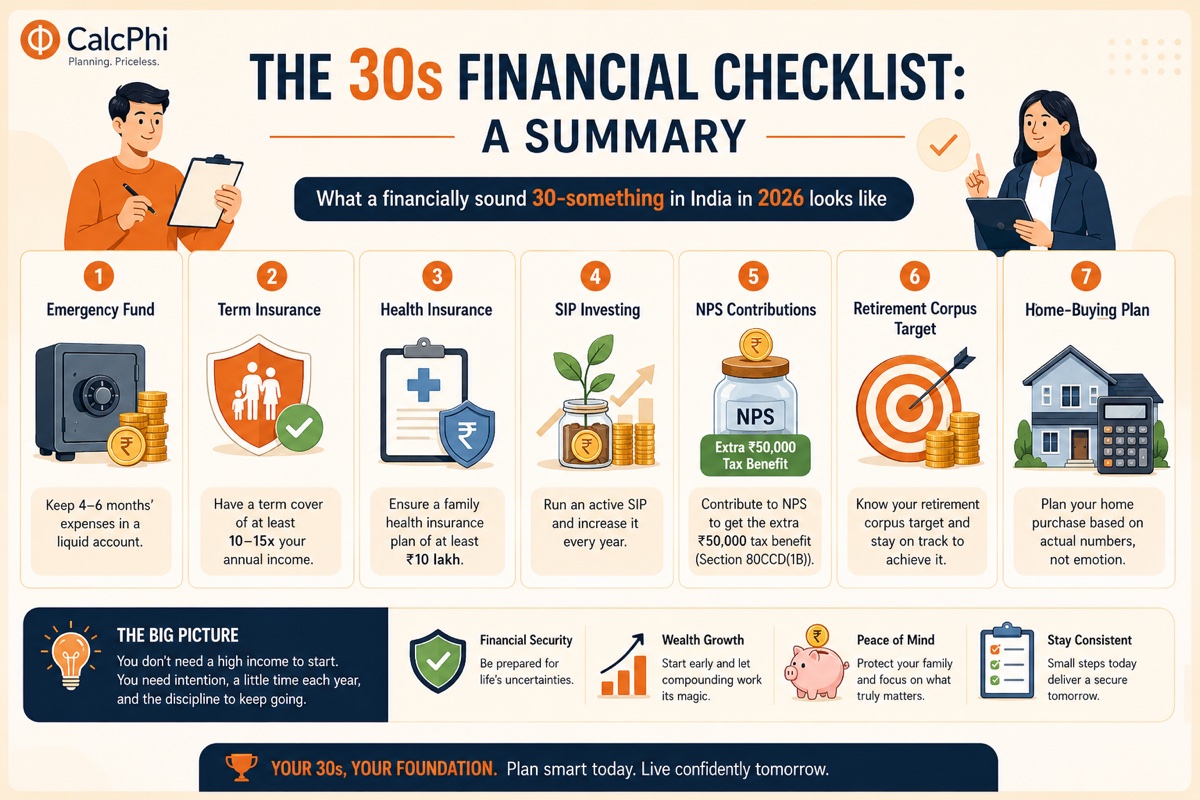
The 30s Financial Checklist: A Summary
To bring it all together, here is what a financially sound 30-something in India in 2026 looks like: they have an emergency fund of 4–6 months' expenses in a liquid account; a term insurance cover of at least 10–15x annual income; a family health insurance plan of at least ₹10 lakh; an active SIP that grows every year; NPS contributions for the extra ₹50,000 tax benefit; a retirement corpus target they know and are working toward; and a home-buying plan based on actual numbers, not emotion.
None of these moves requires a high income to start. They require intention, a small amount of time each year, and the discipline to keep going.
Frequently Asked Questions
How much should I save and invest in my 30s in India?
A commonly used benchmark is the 50-30-20 rule: 50% of your take-home salary on needs, 30% on wants, and 20% on savings and investments. In your 30s, if possible, push savings to 25–30% of income, since compound growth is most powerful over 25+ year horizons. On a ₹1 lakh monthly take-home, this means investing at least ₹20,000–₹30,000 per month across SIPs, PPF, and NPS.
Which is better for tax saving in your 30s — ELSS or PPF?
Both are eligible under Section 80C for up to ₹1.5 lakh deduction. ELSS has a shorter 3-year lock-in and historically higher returns (12–15% CAGR over long periods) but carries market risk. PPF is sovereign-backed at 7.1% with a 15-year lock-in. For someone in their 30s with a long time horizon and risk tolerance, ELSS is generally better for wealth creation, while PPF serves as the debt anchor of the portfolio.
Should I prepay my home loan or continue investing in my 30s?
If your home loan interest rate is 8.5–9%, prepaying it gives you a guaranteed post-tax return of approximately 8.5–9%. Equity SIPs have historically returned 12–15% over 10+ years, which is higher. The general advice is to maintain your SIPs and use surplus to prepay the home loan only if the psychological relief of being debt-free is important to you — or if your loan tenure exceeds 15 years.
How much life insurance cover do I need in my 30s?
Your life insurance cover should be at least 10 to 15 times your annual income. If you earn ₹12 LPA, you need ₹1.2–₹1.8 crore in cover. Also factor in any outstanding liabilities like a home loan. A ₹50 lakh home loan means your effective cover requirement rises to ₹1.7–₹2.3 crore.
Is NPS worth it in your 30s?
Yes, especially for the extra tax benefit. The Section 80CCD(1B) deduction of ₹50,000 per year is over and above the ₹1.5 lakh 80C limit. At a 30% tax bracket, this saves ₹15,600 per year. Over 25 years with that tax saving reinvested, the benefit compounds substantially. The lock-in until 60 is real, so treat NPS as retirement money specifically.
What is the best way to plan for a child's education in your 30s?
Start a dedicated SIP as soon as your child is born. A ₹5,000/month SIP for 18 years at 12% CAGR grows to approximately ₹47 lakh — which comfortably covers premier engineering or management college fees at today's rates adjusted for inflation. Use CalcPhi's Goal-Based SIP Calculator to find the exact monthly investment needed for your target education cost and timeline.
Disclaimer: The information in this article is for educational and general awareness purposes only. All financial figures, tax slabs, and interest rates are based on publicly available data for AY 2026-27. CalcPhi's calculators are estimation tools and do not constitute financial advice. Please consult a SEBI-registered investment advisor or a qualified Chartered Accountant before making financial decisions.