SMSF Australia: Is a Self-Managed Super Fund Worth It in 2026?
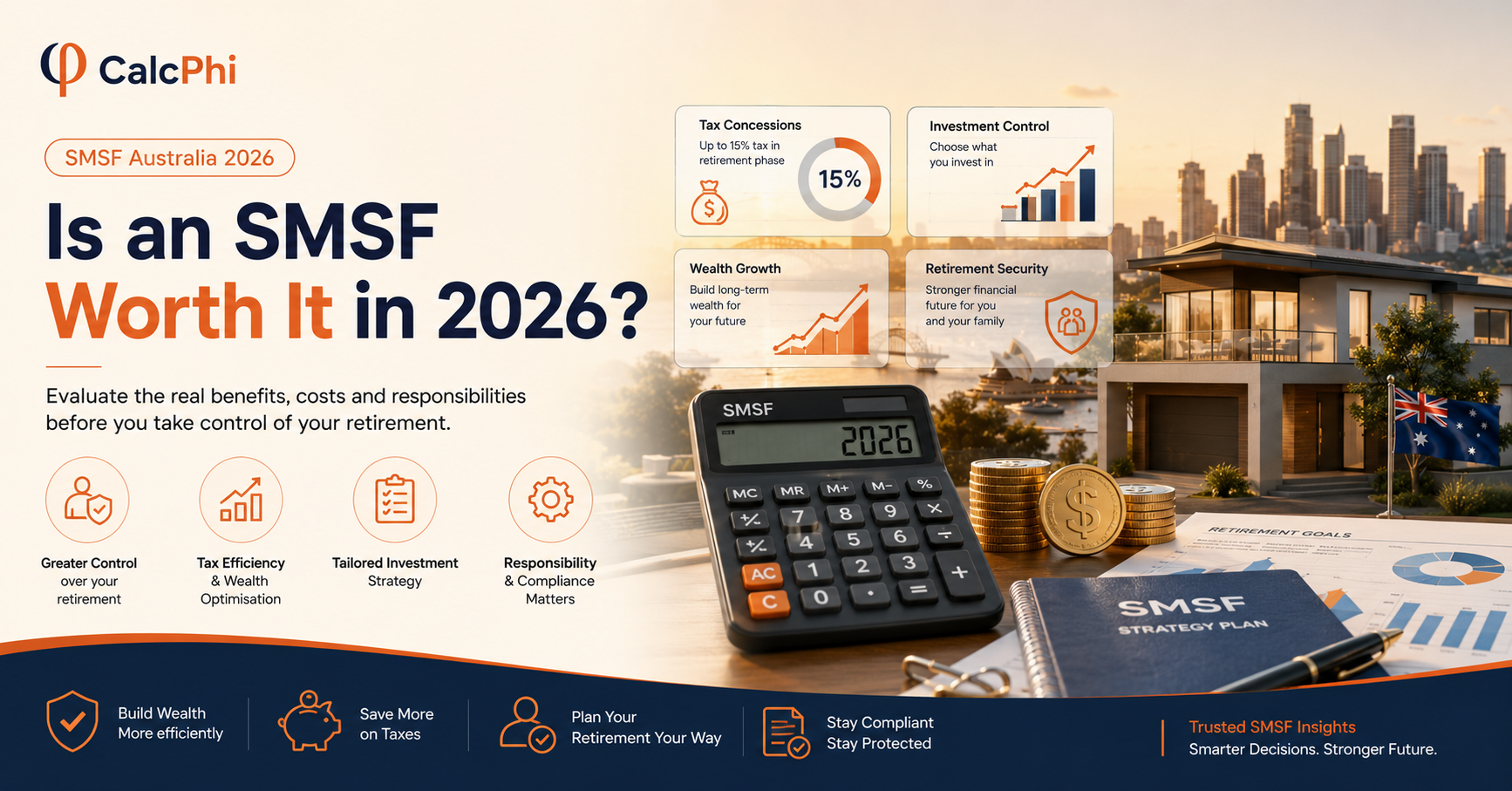
Self-managed super funds — better known as SMSFs — have become one of the most talked-about retirement strategies in Australia. With around 615,000 SMSFs collectively managing approximately $960 billion in assets, it is clear that a significant slice of Australians have chosen to take control of their own retirement savings. But is setting up an SMSF actually the right move for you in 2026? That depends heavily on how much you have, how much time you are willing to invest, and what you want to do with your money. This guide cuts through the noise and gives you a plain-language breakdown of what an SMSF is, what it costs, what the tax advantages look like, and most importantly — when it makes sense and when it does not.
What Is an SMSF?
An SMSF is a private superannuation fund that you set up and manage yourself. Unlike an industry fund (like AustralianSuper or Hostplus) or a retail fund, you are both the member and the trustee of an SMSF. That means the investment decisions are entirely in your hands — and so is the compliance responsibility.
You can have up to six members in one SMSF. Every member must also be a trustee (or a director of the corporate trustee), which makes SMSFs most common among couples, families, or small business partners who want to pool their super savings.
The Australian Taxation Office (ATO) regulates SMSFs, and compliance is not optional. You must lodge an annual SMSF Annual Return, have your fund independently audited every year, meet minimum pension payment requirements if you are in retirement phase, and ensure all investments comply with the sole purpose test — meaning every investment decision must be made purely for the purpose of providing retirement benefits.
How Much Does It Cost to Run an SMSF in 2026?
Cost is the number one reason to either start or avoid an SMSF. Because most SMSF expenses are fixed — not percentage-based like industry fund fees — whether the numbers work for you depends entirely on your balance.
Setup Costs
Getting an SMSF off the ground typically costs between $2,500 and $6,000 in the first year when using a licensed financial planner and professional setup service. Here is what that usually includes:
- Trust deed preparation by a solicitor: $500–$1,500
- Corporate trustee setup (recommended over individual trustees): $800–$1,200, covering ASIC registration and legal fees
- ATO registration and ABN: free, but time-intensive if done without help
- Financial advice fees if you engage a planner: $1,500–$3,500
- ATO Supervisory Levy for 2025-26: $374 (included in the annual return)
Ongoing Annual Costs
Running costs year-on-year typically land between $2,000 and $5,000 for a straightforward fund, covering accounting, the mandatory independent audit, tax return preparation, ASIC fees for a corporate trustee, and the ATO levy. The ATO's own data based on 2023-2025 lodgements shows median administration and operating costs of around $4,628 per year. For a fund with complex investments like direct property or an LRBA (a limited recourse borrowing arrangement used to buy property inside super), costs can push above $7,000 annually.
Compare that to an industry fund, where fees typically run at 0.5–1.0% of your balance. If your SMSF holds $300,000, your effective fee rate at $4,500 annual cost is 1.5%. That is higher than most industry funds. At $600,000, that same $4,500 becomes 0.75% — getting more competitive. At $1,000,000 or above, the SMSF almost always wins on cost.
Want to see exactly how your super balance is projected to grow over time? Use CalcPhi's free Super Balance Calculator to model your retirement balance under different contribution and growth scenarios — no sign-up needed.
The Minimum Balance Question
There is no legal minimum balance required by the ATO to start an SMSF. You could, technically, set one up with $50,000. But most financial planners, ASIC, and the Productivity Commission recommend a minimum of $200,000 in combined super savings before the structure becomes cost-competitive. For funds that plan to invest in direct property using borrowing (an LRBA), the practical minimum rises to $300,000–$400,000 to account for the deposit, loan buffer, and compliance costs without straining liquidity.
If you are still building your super balance through employer contributions and salary sacrifice, you are almost certainly better served by a well-performing industry or retail fund for now, with an SMSF on the horizon once you cross the $250,000–$300,000 threshold.
SMSF Tax Advantages — And What Has Changed in 2026
This is where SMSFs genuinely shine. The tax treatment inside a superannuation fund is far more favourable than holding investments personally or through a trust.
Accumulation Phase
While your money is growing inside the SMSF (before you retire), investment income is taxed at just 15%. Capital gains on assets held for more than 12 months attract an effective rate of 10% — because the fund applies a one-third CGT discount before the 15% tax rate is applied. Compare that to your personal marginal rate, which could be 32.5%, 37%, or even 45% depending on your income.
Pension Phase
Once a member starts drawing a retirement income stream from the fund (called an account-based pension), earnings on assets supporting that pension become entirely tax-free — 0% on income and 0% on capital gains. This is one of the most powerful tax structures in the Australian retirement system, and it has been left completely untouched by recent budget changes.
The Transfer Balance Cap currently sits at $2 million (as of 1 July 2025, indexed). This is the maximum amount you can move into pension phase. Earnings on amounts above the cap remain in accumulation phase at 15%.
Division 296: The New Tax for Large Balances
From 1 July 2026, a new tax called Division 296 comes into effect. It applies an additional 15% tax on superannuation earnings for any member whose Total Superannuation Balance (TSB) exceeds $3 million — effectively doubling the earnings tax rate on the portion of the balance above that threshold from 15% to 30%.
Importantly, this is a personal tax assessed against the individual member, not the fund itself. The ATO adds up all your super balances across every fund you hold. If the total is above $3 million, you are in scope. According to Treasury estimates, roughly 80,000 Australians — about 0.5% of those with super — will be affected in the first year.
For most SMSF members, Division 296 is simply not relevant. The existing tax advantages — 15% in accumulation, 0% in pension — remain completely unchanged below the $3 million threshold.
What Can You Invest In Through an SMSF?
This is perhaps the biggest draw for sophisticated investors. An SMSF can invest in a much broader range of assets than a standard industry fund, including:
- Australian and international shares (listed and unlisted)
- Residential and commercial property
- Fixed income and term deposits
- Managed funds and ETFs
- Gold and other commodities
- Cryptocurrency (subject to strict documentation and compliance)
The key rule governing all SMSF investments is the sole purpose test: every investment must be made solely to provide retirement benefits to members. You cannot, for example, buy a holiday house in Queensland through your SMSF and then stay in it yourself. Residential properties cannot be leased to family members or related parties. Violating these rules can result in the fund losing its concessional tax treatment and significant penalties from the ATO.
Commercial property is treated differently. If you own a small business, your SMSF can buy the commercial premises your business operates from and lease it back to you at market rates — a popular strategy among self-employed Australians.
SMSF Property Investing in 2026: Still Worth It?
Buying property through an SMSF has been a major strategy for Australian investors, and the case for it has actually strengthened significantly after the 2026 Federal Budget. Here is why.
The Budget changed CGT rules for individuals — replacing the 50% CGT discount with cost-base indexation plus a 30% minimum tax from July 2027 for personally held assets. But SMSF CGT rules were explicitly left unchanged. Inside an SMSF, the effective capital gains tax rate remains 10% in accumulation phase and 0% in pension phase. The gap between personal investing and an SMSF has never been wider.
SMSF borrowing through an LRBA (limited recourse borrowing arrangement) is also intact and unchanged by the budget. However, most lenders require a minimum SMSF balance of $250,000–$300,000 before approving an LRBA, plus a 30–40% deposit for the property itself and a cash buffer of 12–18 months of expenses.
Before purchasing property in your SMSF, model the capital gains tax impact carefully. Use CalcPhi's Capital Gains Tax Calculator to estimate what you would pay personally — and compare that against the 10% effective rate inside your SMSF.
SMSF vs Industry Fund: A Side-by-Side Comparison
To make this concrete, consider two investors — both aged 45 with $500,000 in super and 20 years to retirement.
Investor A stays in a low-cost industry fund charging 0.65% per annum ($3,250/year at that balance). The fund performs broadly in line with the ASX 200.
Investor B sets up an SMSF with annual running costs of $4,500, invests directly in a diversified share portfolio with similar returns, and uses the 15% tax rate to boost compounding.
At $500,000, Investor B pays roughly $1,250 more per year in fees. Over 20 years, that gap is real but modest. Where Investor B typically pulls ahead is in pension phase: the 0% tax rate on earnings means every dollar of income and capital gains in retirement stays in the fund rather than being reduced by tax. For larger balances, the long-run advantage compounds substantially.
Compliance Obligations: The Real Hidden Cost
What the fee figures do not capture is your time. Running an SMSF properly is not passive. As trustee, you are personally responsible for:
- Meeting all investment strategy requirements and reviewing it annually
- Ensuring all assets are valued at market value as at 30 June each year
- Meeting minimum pension payment requirements each financial year (missing a year means losing the tax-exempt status on all earnings for that year — no exceptions)
- Keeping financial statements, member accounts, and trustee minutes up to date
- Engaging a registered SMSF auditor every year
- Lodging the SMSF Annual Return on time
The ATO takes a dim view of non-compliance, and the penalties can be severe. Most trustees work with an SMSF administrator or accountant to manage these obligations, but the ultimate responsibility always sits with you.
Is an SMSF Worth It in 2026? The Verdict
An SMSF is genuinely worth considering if you meet the following conditions. You have a combined super balance of at least $200,000–$250,000, and ideally $300,000 or more if you plan to borrow for property. You want genuine investment flexibility — direct shares, property, or asset classes not available in a standard fund. You are willing to engage with the compliance obligations either personally or through a trusted administrator. And you are in or approaching retirement, where the 0% tax rate in pension phase becomes an extraordinarily powerful advantage.
It is probably not the right structure for you right now if your balance is under $200,000, you want a completely hands-off approach to super, or you have limited financial literacy and no access to professional advice.
Already thinking about your retirement number? Use CalcPhi's Salary Sacrifice Calculator to model how boosting your pre-tax contributions today can dramatically accelerate your super balance — whether you end up in an SMSF or not.

Frequently Asked Questions
-
What is the minimum balance needed to start an SMSF in Australia?
The ATO sets no legal minimum, but financial regulators including ASIC and the Productivity Commission recommend a combined balance of at least $200,000 to make the structure cost-effective compared to an industry or retail fund. For SMSF property investing with borrowing, the practical minimum rises to $300,000–$400,000.
-
How much does an SMSF cost to run per year?
Annual running costs typically range from $2,000 to $5,000 for a straightforward SMSF, covering accounting, the mandatory independent audit, tax return lodgement, and the ATO Supervisory Levy of $374. Funds with direct property or complex investments can exceed $7,000 per year.
-
What is Division 296 and how does it affect my SMSF?
Division 296, effective from 1 July 2026, applies an additional 15% personal tax on superannuation earnings for individuals whose Total Superannuation Balance exceeds $3 million — doubling the effective earnings tax rate on that portion to 30%. It affects roughly 80,000 Australians and does not change the tax treatment for the vast majority of SMSF members below that threshold.
-
Can I buy a house through my SMSF and live in it?
No. Residential property purchased inside an SMSF cannot be used or occupied by any fund member or related party. All investments must satisfy the sole purpose test — existing purely to provide retirement benefits. Breaching this rule can strip the fund of its concessional tax status and trigger significant ATO penalties.
-
What tax rate applies to earnings inside an SMSF?
In accumulation phase, earnings are taxed at 15%, with capital gains on assets held over 12 months taxed at an effective 10%. Once a member starts drawing a pension from the fund, earnings on assets supporting that pension are taxed at 0% — both income and capital gains. This pension-phase exemption is unchanged by the 2026 budget.
-
How is an SMSF different from an industry super fund?
An industry fund is managed by professional trustees on behalf of all members. An SMSF puts you in the trustee role, giving you full control over investment decisions but also full responsibility for compliance. Industry funds are simpler and often better value for lower balances. SMSFs become competitive and often superior for balances above $300,000–$500,000, particularly in retirement phase.
The information in this article is for general educational and informational purposes only. It does not constitute financial, tax, or legal advice. CalcPhi calculators are estimation tools and should not be the sole basis for any financial decision. Superannuation rules and tax legislation can change — always consult a licensed financial adviser or registered tax agent for advice tailored to your personal circumstances before establishing or restructuring an SMSF.

Use our Australia calculators:
Super Balance Calculator → Capital Gains Tax Calculator → Salary Sacrifice Calculator → Income Tax Calculator →