Australian Age Pension 2026: Eligibility, Assets Test, and How to Maximise Your Payment
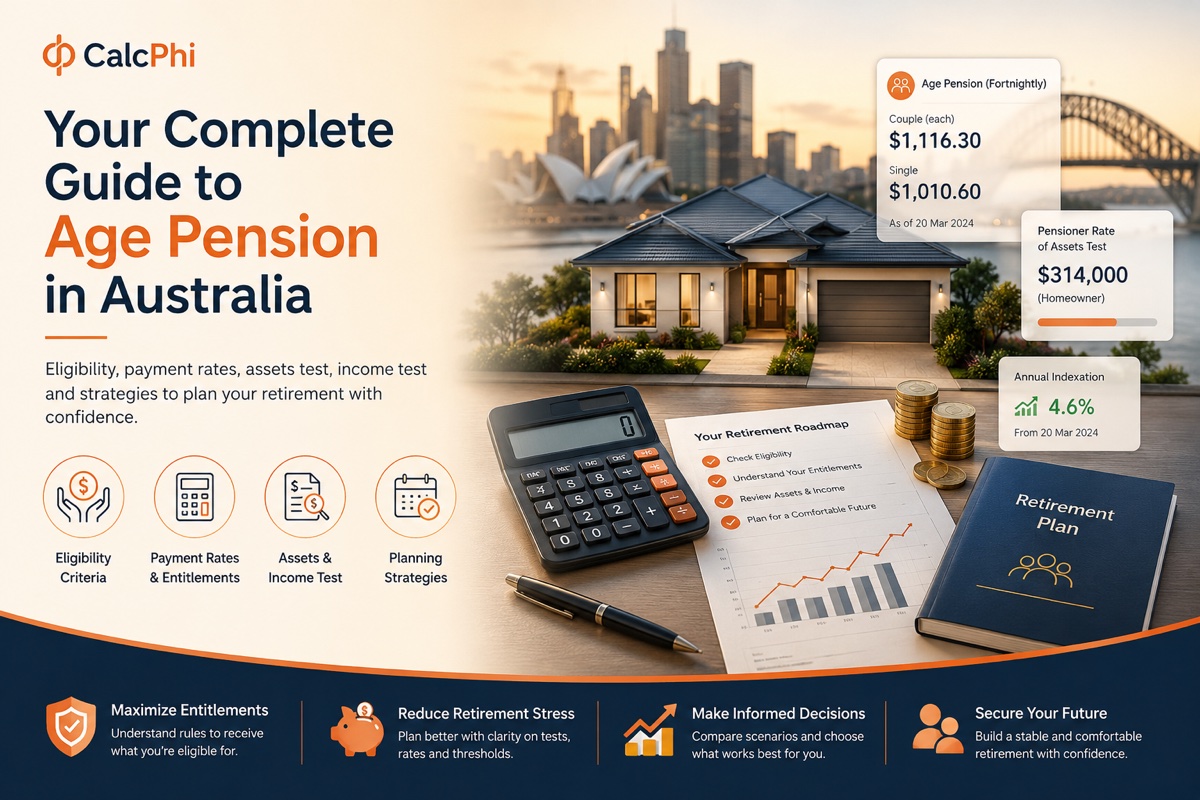
The Age Pension is one of the most important financial safety nets in Australia. For millions of retirees, it provides a reliable fortnightly income that helps cover living expenses when paid work has ended. Yet a surprising number of Australians either assume they won't qualify — or leave money on the table by not understanding how the system works.
In 2026, the maximum Age Pension pays $29,754 per year for singles and $44,855 per year for couples combined. That's not a small amount. And with the right planning, many Australians can qualify for at least a partial pension even if they have significant assets. This guide explains exactly who qualifies, how both means tests work, and the practical strategies you can use to legally increase your entitlement.
Who Is Eligible for the Age Pension in Australia?
To receive the Age Pension from Centrelink, you need to meet three basic criteria: age, residency, and the means tests.
Age Requirement
The eligibility age is 67 for anyone born on or after 1 January 1957. This age was gradually raised from 65 between 2017 and 2023. As of 2026, there is no legislated plan to raise it further, though the topic is periodically revisited in political discussions.
Residency Requirement
You must be an Australian resident and physically present in Australia when you claim. You also need to have been an Australian resident for at least 10 years in total, with at least 5 of those years as a continuous period. Some international social security agreements can count time lived in certain countries toward the residency requirement — worth checking if you have lived abroad.
The Two Means Tests
This is where most of the complexity sits. Centrelink applies both an assets test and an income test to your situation. The test that results in the lower pension payment is the one that applies. This means you only need one test to work against you to reduce what you receive.
How the Assets Test Works
The assets test looks at the total value of things you own, with some notable exclusions. The most important exclusion is your principal place of residence — the home you live in is not counted as an asset, regardless of its value.
Assets that are counted include superannuation balances (once you have reached Age Pension age), shares, managed funds, bank accounts, investment properties, caravans, boats, and most personal property.
| Status | Full Pension Below | Part Pension Cuts Out Above |
|---|---|---|
| Single homeowner | $314,000 | ~$686,250 |
| Couple homeowners (combined) | $470,000 | ~$1,031,000 |
| Single non-homeowner | ~$543,750 | ~$935,000 |
| Couple non-homeowners (combined) | ~$728,000 | ~$1,289,000 |
Above the full-pension threshold, the pension reduces by $3 per fortnight for every $1,000 of assessable assets. It does not drop to zero instantly — it tapers gradually until the cut-out point is reached.
Let's make this concrete with an example. A single homeowner with $400,000 in super and no other significant assets sits $86,000 above the full-pension threshold. That means a reduction of $86 × $3 = $258 per fortnight. Against a maximum of approximately $1,144 per fortnight, they'd still receive around $886 per fortnight — over $23,000 a year. That's a meaningful income stream, and one many people incorrectly assume they'd miss out on.
How the Income Test Works
The income test assesses how much you earn from various sources. But for financial assets like bank accounts, shares, and super in accumulation phase, Centrelink doesn't look at your actual returns — it applies deeming rates instead.
Deeming means Centrelink assumes your financial investments earn a set rate of return, regardless of what they actually earn. As of 2026, the deeming rates are:
- 0.25% on the first $60,400 of financial assets (singles) or $100,200 (couples)
- 2.25% on financial assets above those thresholds
So if a single retiree has $300,000 in a super account paying 5% in practice, Centrelink doesn't assess $15,000 in income — it deems approximately $5,535 in income from those assets instead. This can work in your favour during periods when actual returns exceed the deeming rate.
| Status | Free Area (per fortnight) | Pension Reduces By | Cuts Out At (approx) |
|---|---|---|---|
| Single | $204 | 50c per $1 over threshold | ~$2,444/fortnight |
| Couple (combined) | $360 | 50c per $1 over threshold | ~$3,737/fortnight |
Real-world income — from employment, rent on an investment property, or a business — is assessed directly at its actual value, not deemed.
What the Age Pension Actually Pays in 2026
The full Age Pension rates (indexed March and September each year) are adjusted to the higher of CPI or Male Total Average Weekly Earnings — so the real value of the pension doesn't quietly erode over time. The rates below include the base pension, pension supplement, and energy supplement.
| Payment Type | Per Fortnight | Per Year |
|---|---|---|
| Single — full pension | $1,144.40 | ~$29,754 |
| Couple (each) — full pension | $862.60 | ~$22,428 |
| Couple (combined) — full pension | $1,725.20 | ~$44,855 |
5 Strategies to Maximise Your Age Pension Entitlement
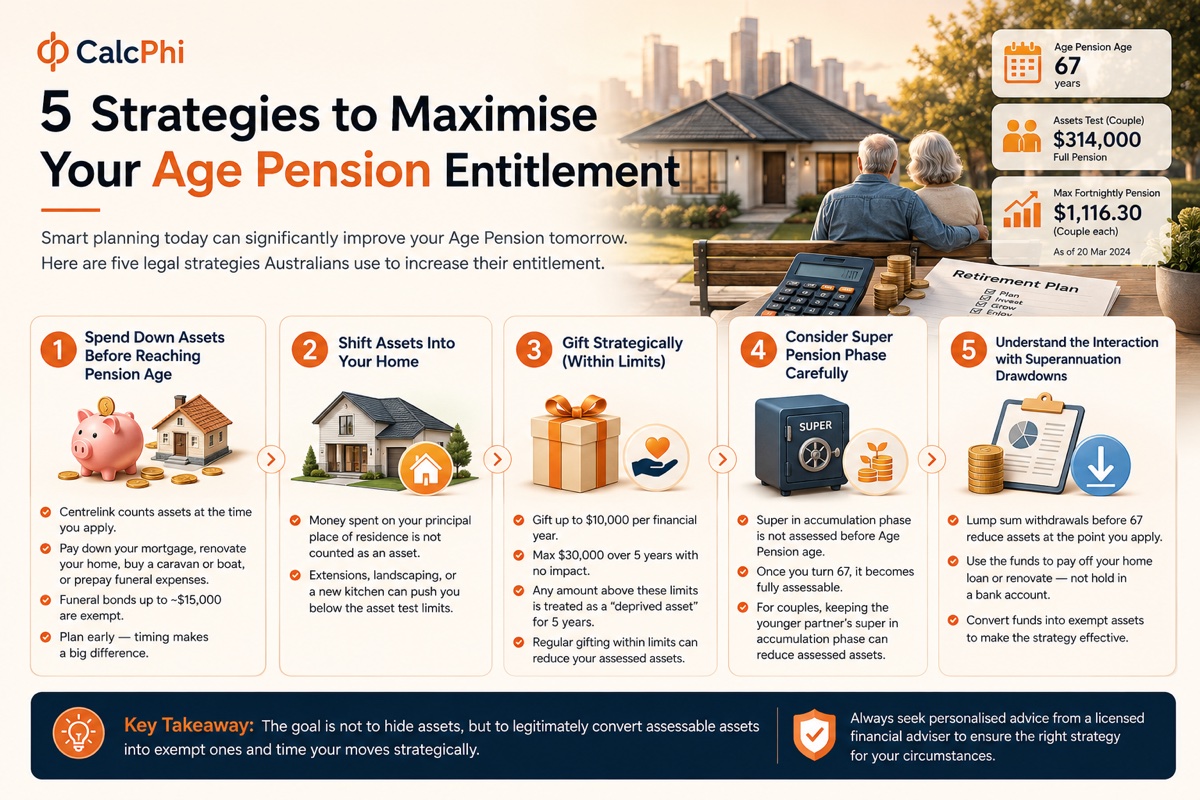
Understanding the rules is one thing. Using them strategically is another. Here are five legal approaches Australians use to increase their pension entitlement.
1. Spend Down Assets Before Reaching Pension Age
Because Centrelink counts your assets at the time you apply, reducing assessable assets before you turn 67 can significantly increase your entitlement. Common approaches include paying down your mortgage (your home is exempt), renovating your home, purchasing a caravan or boat for personal use, or prepaying funeral expenses through an exempt funeral bond (up to approximately $15,000). None of these strategies involve hiding assets — they involve genuinely converting assessable assets into exempt ones. But timing matters, and you should plan this well before you apply.
2. Shift Assets Into Your Home
Any money you put into your principal place of residence — extensions, landscaping, a new kitchen — immediately shifts from counted to uncounted assets. For homeowners approaching the cut-out threshold, a well-timed renovation can make a large difference to pension eligibility.
3. Gift Strategically (Within Limits)
Centrelink allows you to gift up to $10,000 per financial year, with a maximum of $30,000 over five years, without it affecting your pension. Any gifting above these amounts is treated as a "deprived asset" and still counted for five years. So gifting money to adult children right before applying doesn't work beyond these thresholds — Centrelink's rules account for it. Within the limits, however, regular gifting over several years can meaningfully reduce your assessed assets.
4. Consider Super Pension Phase Carefully
Super in accumulation phase is not assessed as an asset before you reach Age Pension age. Once you hit 67, it becomes fully assessable. For couples where one partner is under pension age, keeping that partner's super in accumulation phase can reduce the couple's assessed assets — a strategy worth discussing with a financial adviser.
5. Understand the Interaction with Superannuation Drawdowns
Drawing down super as a lump sum before age 67 reduces your assessable assets at the point you apply. But be careful: those funds need to go somewhere. If they go into a bank account, they're still assessed. If they're used to pay off your home loan or fund renovation, they shift into the exempt category. The strategy only works if you genuinely spend or convert the money, not simply move it.
Does the Age Pension Count as Taxable Income?
Yes, the Age Pension is assessable income for tax purposes. However, most retirees pay little or no tax on it in practice, because the Seniors and Pensioners Tax Offset (SAPTO) effectively raises the tax-free threshold for eligible older Australians to approximately $32,279 (singles) or $28,974 per person (couples) in 2026. For those receiving a full or partial pension alongside super drawdowns, it's worth running your numbers through an income tax calculator to understand your full tax position.
How to Apply for the Age Pension
You can apply for the Age Pension through myGov, linked to your Centrelink account. You'll need to supply identification documents, details of all your assets, proof of your income sources, and information about your super funds. Centrelink will then assess both the assets test and the income test and notify you of your entitlement.
You can apply up to 13 weeks before you reach pension age — which means you can be receiving payments from the day you turn 67 if you apply early enough. Don't wait until after your birthday; you can't backdate claims once that window passes.

Frequently Asked Questions
What is the Age Pension eligibility age in Australia in 2026?
The Age Pension eligibility age is 67 for anyone born on or after 1 January 1957. This applies uniformly from 2026 onward. The eligibility age was gradually increased from 65 between 2017 and 2023, and there is no current legislation to raise it further, though the topic occasionally surfaces in budget discussions.
Does my home count as an asset for the Age Pension assets test?
No. Your principal place of residence is fully excluded from the assets test, regardless of its value. A retiree living in a $2 million Sydney home is assessed on the same basis as one living in a $400,000 regional property — the home itself is invisible to Centrelink. Only the surrounding land in excess of two hectares may be assessed in some cases.
Can I receive both the Age Pension and draw from my superannuation?
Yes, you can receive a partial or full Age Pension while also drawing income from your super. However, your super balance counts as an assessable asset, and your super drawdowns may be assessed under the income test depending on how they are structured. Many Australians combine a partial pension with super drawdowns to manage their retirement income efficiently.
What happens if my assets increase after I start receiving the Age Pension?
You are required to notify Centrelink within 14 days if your circumstances change in a way that might affect your payment — including a significant increase in assets. Centrelink will reassess your entitlement. Failing to report changes can result in overpayments that Centrelink will require you to repay, sometimes with a penalty.
What are the deeming rates for the Age Pension income test in 2026?
Centrelink applies 0.25% to the first $60,400 of financial assets for singles (or $100,200 for couples), and 2.25% on amounts above those thresholds. These rates are set by the government and reviewed periodically. They are not the same as actual investment returns — deeming is simply the formula used to calculate deemed income for the income test.
Can I still get a part pension if I'm over the full pension threshold?
Yes, and this is one of the most misunderstood aspects of the system. The pension tapers off gradually — it does not disappear the moment you cross the full pension threshold. A single homeowner can have up to approximately $686,250 in assessable assets and still receive a partial payment. Many Australians with substantial savings qualify for a part pension, which also comes with the Pensioner Concession Card and its associated discounts.
Disclaimer: The information in this article is for educational and general informational purposes only. CalcPhi's calculators are estimation tools and do not constitute financial advice. Age Pension rules, rates, and thresholds are subject to change by the Australian Government and are indexed twice yearly. Please consult a licensed financial adviser (holding an AFS licence) or contact Services Australia directly for personalised guidance on your Age Pension eligibility and entitlement.

Written & verified by Emma Hartley
Certified Financial Planner & Mortgage Specialist
Emma is a CFP based in Brisbane with 9 years of experience in mortgage advice, first home buyer strategy, and retirement planning for Australian households navigating property markets and the age pension system.